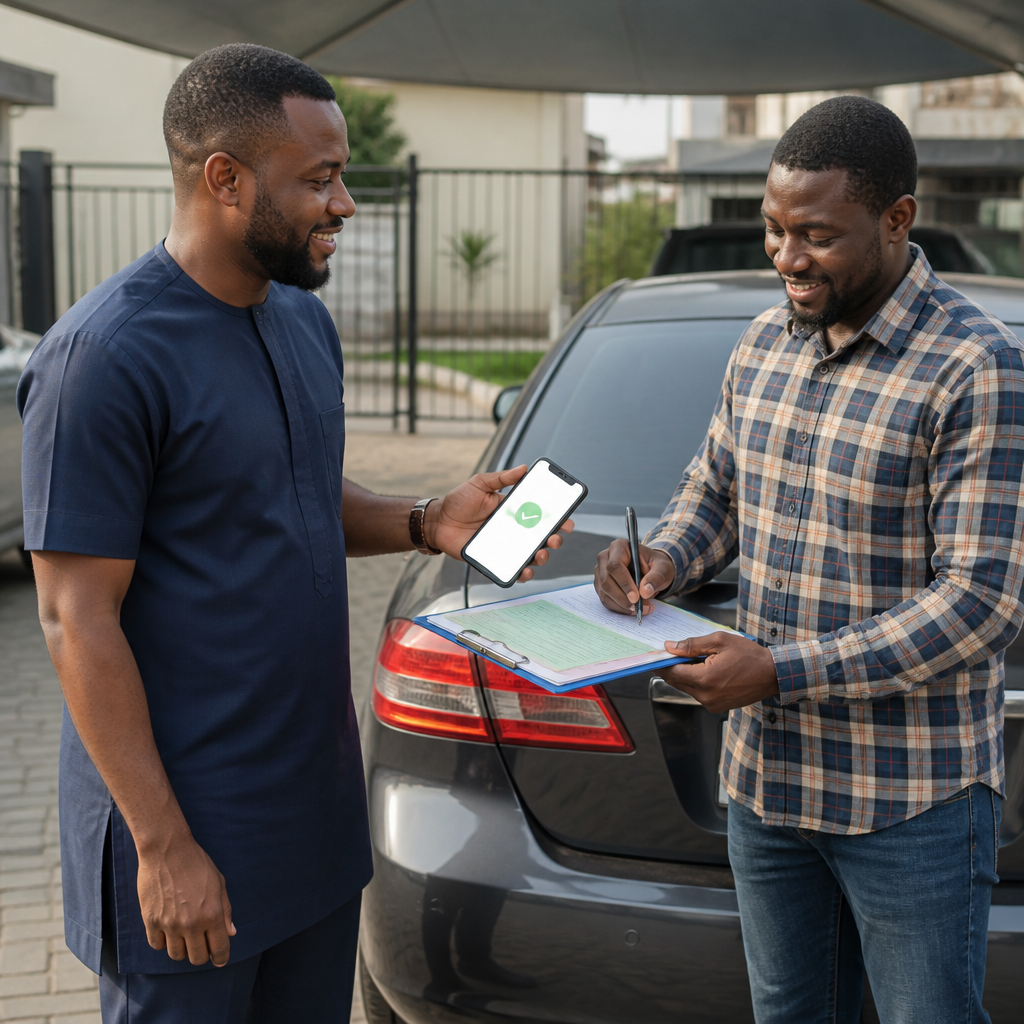
When you pay for a used car in Nigeria, the safest approach is to verify the vehicle, confirm the seller’s authority, agree on written terms and release money in controlled stages. A careful payment process can protect you from stolen vehicles, forged documents, hidden finance, identity fraud and disputes after the sale.
Buying a used vehicle is not only a financial decision. It is also a documentation and trust exercise. A clean-looking car can still have unresolved ownership issues. Likewise, a friendly seller can be acting as an unauthorised middleman. Therefore, do not treat payment as the final casual step after a test drive. Treat it as a process that begins before you make an offer and ends only after the vehicle and documents are properly handed over.
This guide explains how to pay for a used car safely in Nigeria. It covers seller checks, vehicle inspection, documentation, payment methods, transfer procedures, red flags, practical examples and actions to take if something goes wrong. How to Choose Tyres for Nigerian Roads
Why the payment process needs careful planning
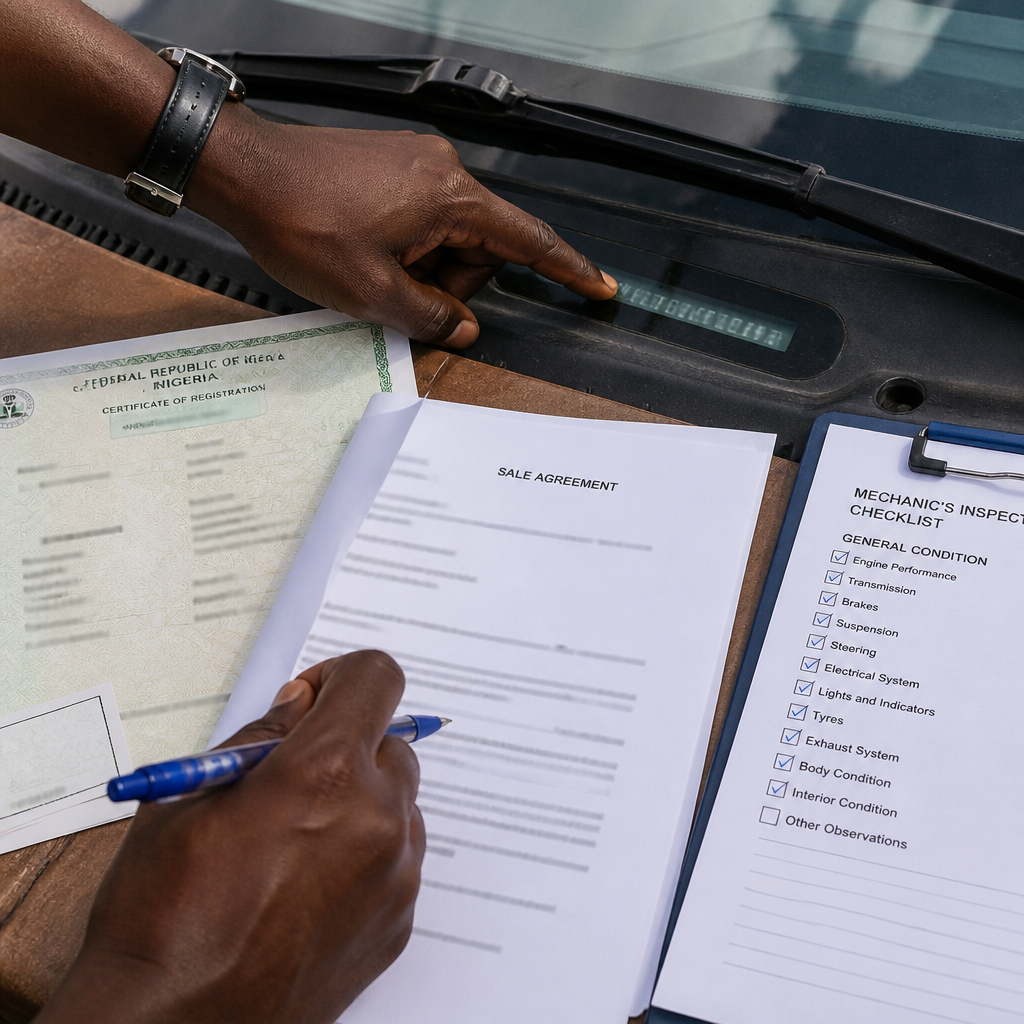
Many buyers focus on negotiating the price and inspecting the engine. Those steps matter, but the payment itself can create serious risk. Once money leaves your account, recovering it may be difficult. A seller may stop answering calls, provide incomplete documents or claim that your payment was only a deposit.
Used-car transactions also involve several different risks at the same time:
- Ownership risk: The person selling the vehicle may not be the registered owner or may lack authority to sell it.
- Identity risk: A scammer may use another person’s name, account or social media profile.
- Vehicle-history risk: The car may have been stolen, badly damaged, imported with unresolved issues or altered to hide its history.
- Document risk: Some papers may be fake, expired, inconsistent or unrelated to the vehicle.
- Payment risk: A transfer may go to an account controlled by someone who is not part of the sale.
- Dispute risk: The buyer and seller may remember the agreed price, deposit or promised repairs differently.
The solution is not to avoid every private sale. Instead, separate the transaction into stages. Verify first, inspect second, document the agreement third and pay only when the conditions are satisfied.
Before you pay for a used car: verify the seller
The seller should be the first subject of your checks. A vehicle can have valid papers while the person presenting them has no right to sell it. Ask direct questions and watch how the seller responds. A genuine owner may need time to gather documents, but should not object to reasonable verification.
Ask who legally owns the vehicle
Ask whether the seller is the owner, a dealer, an agent or a representative of an organisation. Request the seller’s full name and compare it with the available ownership documents. If the names differ, ask for a clear explanation before discussing final payment.
If an agent is handling the sale, ask to speak directly with the owner. Confirm that the owner knows the asking price, the proposed buyer and the person receiving payment. Where another person has authority to act, request written evidence of that authority. Do not assume that a phone call alone protects you.
For a company-owned vehicle, confirm the organisation’s identity and the authority of the staff member handling the sale. The payment account should match the agreed seller or the organisation, unless the written agreement clearly explains another arrangement.
Compare identity details
Compare the seller’s identification details with the name on the vehicle documents and the name on the receiving bank account. A mismatch does not automatically prove fraud, especially where a dealer or representative is involved. However, it requires an explanation and supporting paperwork.
Be careful with sellers who refuse to show identification, insist on communicating through several unrelated people or keep changing the story. Also be cautious if the seller pressures you to pay an account belonging to a friend, driver, relative or unrelated business.
Never send a copy of your identity document to an unknown person without a clear reason. If you must provide identification for a legitimate transaction, share only what is necessary and avoid posting sensitive details in public chats or online groups.
Inspect the car and confirm its identity
Do not make a final payment based on photographs, a short video or a verbal description. Inspect the actual vehicle in daylight and, where possible, take it to an independent mechanic. The mechanic should work for you, not for the seller.
Ask the mechanic to examine the engine, transmission, suspension, steering, brakes, cooling system, electrical systems, tyres and signs of accident repairs. A mechanical inspection cannot prove ownership, but it can reveal expensive problems that should affect your decision and the agreed price.
Also compare the vehicle identification details with the documents. Check the chassis or vehicle identification number, engine number where applicable, registration details, plate number, make, model, colour and year information. The markings should appear consistent and should not show obvious signs of tampering.
If numbers look ground down, restamped, covered, poorly aligned or different from the paperwork, stop the transaction. Do not allow a seller to explain away a serious identity mismatch as a minor clerical error. Ask the relevant vehicle registration or law-enforcement authority for guidance before proceeding.
Use independent checks
Ask the seller for permission to conduct appropriate checks through the relevant authorities and official channels. The Federal Road Safety Corps provides road-safety and vehicle-related public information through its official website. Depending on the vehicle and location, other government offices may also be involved in registration, licensing, import documentation or ownership records.
Do not rely on a screenshot sent by the seller when an official verification route is available. Screenshots can be edited, outdated or taken from another vehicle’s record. If a verification service requires the seller’s participation, complete the check together and save the result.
For an imported vehicle, ask for the documents connected to its import and clearance history. Where the seller cannot produce the relevant papers, do not assume that a registration plate settles every customs or ownership question. The Nigeria Customs Service publishes official information for customs-related matters. If you have doubts, seek clarification from the appropriate office before paying.
Review every document before payment
Documents are part of what you are buying. A car without a reliable documentation trail can become difficult to register, insure, resell or defend if its history is challenged. Review the papers calmly. Do not allow a seller to rush you because another buyer is supposedly waiting. car battery dying — How to Know If a Car Battery Is Dying
Depending on the vehicle’s history and location, documents may include registration evidence, proof of ownership, purchase records, import or customs documents, insurance evidence and other papers issued or required by the relevant authorities. The exact paperwork can differ by vehicle type, state and transaction history, so confirm the current requirements with the appropriate government office.
Look for consistency across all papers. Check the following details:
- The owner’s name and identifying details.
- The vehicle identification or chassis number.
- The engine number, where it appears in the applicable documents.
- The registration or plate information.
- The make, model, colour and other vehicle descriptions.
- Dates, signatures, stamps and issuing authorities.
- Any stated restrictions, liens, outstanding obligations or transfer conditions.
Do not accept a document merely because it has a stamp or appears official. A document can still relate to another vehicle, contain incorrect information or require additional confirmation. Take clear copies or photographs for your records, but keep the originals in the agreed custody until the transaction is complete.
Ask about finance, disputes and outstanding obligations
Ask the seller whether the car is subject to a loan, hire-purchase arrangement, court dispute, police investigation, insurance claim or any other restriction. A seller may describe the vehicle as fully paid even when another party has an interest in it.
Ask for written confirmation that the seller has the right to transfer the vehicle and that there are no undisclosed claims. This statement is not a substitute for independent checks, but it creates a clear record of what the seller represented.
If the seller says a document will arrive later, identify the exact document, the responsible person and the deadline. Decide whether the missing document is minor or essential. Do not pay the full balance for a vehicle when a key ownership or import document remains unresolved.
Agree on the full deal in writing
A written agreement protects both sides. It does not need complicated legal language, but it should be specific. A basic receipt that says car sold and money received may not record enough detail to resolve a later disagreement.
Include the following information in the agreement:
- The full names and contact details of the buyer and seller.
- Identification details for the vehicle, including the chassis or vehicle identification number.
- The agreed purchase price and currency.
- The amount of any deposit and whether it is refundable.
- The payment schedule and the account or method approved for payment.
- The documents and items the seller must deliver.
- The agreed handover date, location and conditions.
- Any known defects disclosed by the seller.
- Any repairs or promises the seller must complete before handover.
- The point at which ownership and possession are intended to pass, subject to applicable requirements.
- Signatures, dates and witnesses where appropriate.
Write numbers clearly. State whether the price includes inspection costs, registration charges, delivery, repairs, accessories or other expenses. If a deposit is involved, explain what happens if the buyer withdraws or the seller cannot provide valid documents.
Each party should receive a signed copy. Keep the agreement, receipts, messages, inspection report and document copies in more than one secure location. These records can help you explain the transaction to a bank, adviser, insurer or relevant authority.
Choose a safer payment method
The safest payment method depends on the parties, the transaction size and the available banking arrangements. The key principle is traceability. Use a method that produces a reliable record showing who paid, who received the money, when it was paid and what the payment was for.
Bank transfer
A bank transfer is often practical because it creates a transaction record. Before sending money, confirm the recipient’s account name, bank and account number. Make sure those details match the written agreement.
Send a small verification amount only if it is genuinely necessary and the seller agrees that it forms part of the documented transaction. A small transfer does not prove that the seller owns the vehicle. It only helps confirm the receiving account details.
After payment, save the bank confirmation, transaction reference and account details. Do not rely only on a screenshot from your banking application. Confirm that the transaction was completed through your bank and that the recipient’s account information was correct.
Bank draft or other bank-supported instruments
Some buyers and sellers may prefer a bank-supported payment instrument. If you use one, confirm how the seller will verify it and when the funds are considered available. Do not hand over the car or original documents based solely on a message claiming that the instrument is genuine.
Ask the bank about its verification procedure. Avoid instruments made payable to a person or business that is not identified in the agreement. Also avoid accepting a third-party payment arrangement unless all parties understand and document it. How to Verify a Vehicle’s VIN Before Buying in Nigeria
Cash
Cash creates security and proof problems. It can be lost, stolen or disputed, and it is harder to prove the exact amount handed over. If the parties choose cash, meet in a secure location, count it carefully and obtain a signed receipt stating the amount, date, vehicle details and purpose of payment.
Do not carry large amounts alone or meet in an isolated location. A bank or professional office may offer a safer environment, subject to its own rules. Never allow urgency to make you ignore basic personal security.
Escrow and staged payment
A genuine escrow arrangement can reduce risk by holding funds until agreed conditions are met. However, scammers also create fake escrow websites, fake payment portals and fake customer-service numbers. Use only a service you independently verify, and access its contact details through the organisation’s official website.
Staged payment can be useful when documents, inspection and handover occur at different times. For example, a small documented deposit may reserve the vehicle, another payment may follow successful verification and the balance may be paid at handover. The stages must be written clearly. A staged plan is not safe if the seller can change the conditions whenever money is due.
How to pay for a used car safely on handover day
Handover day should be organised, not improvised. Arrange the meeting in a secure, observable location. If possible, attend with someone you trust and tell another person where you will be. Avoid meeting at a private residence or remote area if you have never met the seller.
Before releasing the balance, complete a final checklist:
- Confirm that the vehicle you inspected is the vehicle being handed over.
- Compare the chassis or vehicle identification number with the agreement and documents.
- Check the registration and plate details again.
- Confirm that all agreed documents are present and legible.
- Inspect the car for new damage or missing equipment.
- Confirm that keys, spare keys, manuals and accessories listed in the agreement are present.
- Read the payment details one more time.
- Make payment only to the agreed recipient.
- Obtain a signed receipt confirming the amount received.
- Record the date, time and location of handover.
If the seller changes the account at the last minute, pause. Call the seller using a number you already verified, not only the number in a new message. A changed account may be legitimate, but it can also indicate account takeover or impersonation.
Do not let a driver, broker or friend collect the money unless the written arrangement authorises that person. If a representative must receive payment, confirm the authority and record the representative’s identity in the agreement and receipt.
Complete ownership and registration steps promptly
Payment and physical possession do not always complete every administrative requirement. Ask the relevant vehicle registration authority what must be done to record the change of ownership or update the vehicle information. Requirements can depend on the state, vehicle history and type of transaction.
Keep the seller involved until the necessary forms, signatures and verification steps are completed. Do not assume that the seller’s receipt alone updates government records. Ask for proof of submission or completion where available.
Also arrange insurance and any required inspection or licensing steps before using the vehicle extensively. The Federal Road Safety Corps is one official starting point for road-safety and vehicle-related information. Use current official guidance because administrative procedures can change.
For imported vehicles, retain the customs-related records supplied during the sale. If a document appears inconsistent, contact the Nigeria Customs Service through its official channels. Avoid paying a person who promises to fix a documentation problem informally without providing a verifiable process.
Common used-car payment scams to avoid
Scams often rely on pressure rather than technical sophistication. The seller wants you to act before you have time to check the car. Recognising common patterns helps you slow down.
- Below-market urgency: The seller claims the price is available for only a few minutes or that several buyers are waiting.
- Deposit before inspection: The seller demands a large payment before allowing you to see the vehicle.
- Fake location story: The seller says the car is in another city or country and requests payment for transport before inspection.
- Third-party account: The seller insists that money must go to a different person because of a temporary banking issue.
- Fake escrow: A link or contact claims to protect the payment but is controlled by the scammer.
- Document delay: The seller promises that critical papers will be delivered after full payment.
- Identity mismatch: The seller, vehicle documents and bank account belong to different people without a convincing explanation.
- Emotional pressure: The seller uses a personal emergency to make you skip checks.
- Cloned listing: A scammer copies photographs and details from another advertisement and offers the car at an unusually attractive price.
A legitimate seller may negotiate firmly, but should still allow reasonable inspection and documentation. If you cannot verify the vehicle and seller, walk away. Another car will become available; a lost payment may not be recovered.
What to do if something goes wrong
Act quickly if you suspect fraud, a mistaken transfer or unauthorised account activity. Contact your bank immediately through its official customer-service channel. Explain that the payment may be fraudulent and ask what emergency steps are available. Your bank may not be able to reverse a completed transaction, but early reporting can matter.
Preserve evidence. Keep the advertisement, profile link, phone numbers, bank details, payment references, messages, voice notes, receipts, inspection reports and copies of documents. Do not edit screenshots or delete conversations. Why Your Car Vibrates While Driving and What It Could Mean
Report suspected criminal conduct to the appropriate law-enforcement authority. If the vehicle may be stolen or its identity markings appear altered, do not drive it around unnecessarily or attempt your own investigation. Provide the vehicle details and records to the authorities and follow their instructions.
If the dispute concerns a dealer, consider notifying the dealer’s business, marketplace or professional association where applicable. You may also need legal advice, especially where the amount is significant or the vehicle has been seized. Avoid threats or confrontation. A calm, documented response is safer and more useful.
A practical example of a safer transaction
Suppose a buyer finds a used sedan advertised by a private seller. The buyer first asks for the seller’s identity details, the vehicle identification information and copies of the available documents. The names do not initially match, so the seller explains that he is acting for a family member and arranges a direct conversation with the owner.
The buyer then meets the owner, compares identity details and takes the car to an independent mechanic. The mechanic finds worn suspension components, which the parties record in their written agreement. The buyer also asks the relevant authorities about the vehicle records and reviews the import or registration documents that apply to the car.
The agreement states the total price, the deposit, the balance, the documents to be handed over and the condition that the buyer can withdraw if the ownership verification fails. The buyer pays the deposit by traceable transfer to the agreed account. On handover day, the buyer confirms the vehicle identification number, receives the documents and keys, pays the balance to the same agreed recipient and obtains a signed receipt.
This process takes more time than sending money after a short test drive. It also gives the buyer stronger evidence, clearer expectations and more opportunities to stop when something does not make sense.
Questions to ask before making payment
- Who is the legal owner of the vehicle?
- Does the seller have authority to receive the payment?
- Do all vehicle identification details match the documents?
- Has an independent mechanic inspected the car?
- Are there outstanding loans, disputes, claims or restrictions?
- Which documents will be handed over at payment?
- Is the payment account named in the written agreement?
- What happens if a document or verification result is unsatisfactory?
- When and how will the ownership or registration update be completed?
- Will the seller provide a signed receipt and handover record?
Frequently asked questions
Should I pay a deposit to reserve a used car?
A deposit can be reasonable, but it creates risk if the terms are unclear. Before paying, inspect the vehicle as far as possible, verify the seller and write down whether the deposit is refundable. State what happens if the seller cannot prove ownership or provide the agreed documents. Keep the deposit modest enough that losing it would not place you under severe financial pressure.
Is a bank transfer automatically safe?
No. A bank transfer is traceable, but it does not prove that the recipient owns the car. You can still transfer money to a fraudster. Confirm the account name, document the purpose of payment and complete seller and vehicle checks before transferring the balance.
Can I use a seller’s receipt as proof of ownership?
A receipt proves that someone acknowledged receiving money. It may not, by itself, establish lawful ownership or complete the required administrative transfer. Obtain the relevant ownership documents and follow the applicable registration process.
What if the seller says the documents are with an agent?
Ask to see the documents before final payment or verify them directly through the relevant authority. Do not rely on repeated promises that the papers will arrive later. If essential documents are unavailable, postpone the transaction.
Should I pay the seller’s mechanic or agent directly?
Only if the arrangement is clear, authorised and written down. Otherwise, pay the seller or organisation identified in the agreement. A third-party account makes it harder to establish who received your money and why.
What if the price is much lower than similar vehicles?
A low price may reflect urgent circumstances, mechanical defects or a genuine bargain. It may also signal stolen property, hidden damage or a fake listing. Treat the low price as a reason to investigate more carefully, not as a reason to skip checks.
Final checklist for a secure purchase
Before you pay for a used car, confirm that you can answer yes to most of the following questions:
- Have I seen and inspected the actual vehicle?
- Has an independent mechanic checked it?
- Have I confirmed who owns it and who is authorised to sell it?
- Do the vehicle identification marks match the documents?
- Have I considered import, registration, insurance and transfer requirements?
- Have I asked about loans, disputes, restrictions and outstanding obligations?
- Have I written down the price, deposit, balance and handover conditions?
- Will my payment go to the agreed person or organisation?
- Will I receive a signed receipt and copies of the transaction records?
- Do I know what to do if the seller changes the terms at the last minute?
The strongest protection is a combination of independent checks, written terms, traceable payment and patience. No method eliminates every risk, but these steps make deception harder and give you better evidence if a dispute occurs. When the seller refuses reasonable verification, creates pressure or provides inconsistent information, the safest decision is usually to stop the transaction.
3 thoughts on “How to Pay for a Used Car Safely in Nigeria”