
Asking the right car dealer questions before paying a deposit can help you identify hidden problems, confirm ownership, and avoid committing money to a vehicle you have not properly checked. A deposit may feel like a small step toward securing a good car, but it can become difficult to recover if the agreement is unclear or the vehicle does not match the seller’s promises.
Whether you are buying from a dealership, an individual trader, or an online seller, slow down before transferring money. Ask direct questions, request evidence in writing, inspect the vehicle independently, and understand the refund terms. A trustworthy dealer should be willing to explain the car’s history, documents, condition, price, and sales process without pressuring you.
Why car dealer questions matter before a deposit
A deposit can serve different purposes. Some sellers use it to reserve a vehicle while the buyer arranges finance or completes an inspection. Others treat it as part payment toward the purchase price. In some cases, a seller may describe the money casually as a booking fee while the written agreement gives it a different meaning. Why Your Car Vibrates While Driving and What It Could Mean
That difference matters. If the vehicle is withdrawn from sale, the deposit may be refundable. If you simply change your mind, the seller may claim that the money is non-refundable. If the car fails an inspection or the documents cannot be verified, your rights may depend on what you agreed before paying.
Do not assume that a verbal promise will protect you. A message, receipt, invoice, or signed agreement can provide a clearer record of what the seller promised. It should identify the vehicle, the amount paid, the reason for the payment, the balance due, and the circumstances in which the money will be returned.
Questions also help you compare sellers. A dealer who gives clear answers and supplies documents promptly is easier to assess than one who avoids basic questions. You are not being difficult by asking for proof. You are making a large financial decision responsibly.
Car dealer questions to ask about the vehicle
Start with the identity and history of the specific vehicle. Do not rely only on the model name or photographs. Two cars of the same make, model, and year can have very different histories, mileage, specifications, and repair needs.
What is the exact vehicle identification number?
Ask for the full vehicle identification number, commonly called the VIN or chassis number, before paying a deposit. Compare the number supplied by the dealer with the number physically displayed on the vehicle and recorded on its documents.
A mismatch is a serious warning sign. It may indicate an administrative error, a documentation problem, or an attempt to sell a vehicle using records that do not belong to it. Do not proceed until the difference has been explained and independently verified.
Use the exact vehicle details in every written document. The receipt, inspection report, sales agreement, and transfer paperwork should all refer to the same vehicle. If the dealer says the number will be confirmed later, treat that as a reason to delay payment rather than a minor inconvenience.
Is the vehicle locally used, imported, or previously registered elsewhere?
Ask where the car came from and how it entered the local market. A vehicle may have been locally used, imported as a used car, bought at auction, or transferred between several owners. The answer affects the records you should request.
For an imported vehicle, ask for available import and clearance records. Do not assume that a vehicle displayed in a showroom has completed every required process. If the dealer says the documents are being processed, ask what remains outstanding, who is responsible, and whether you can receive a written commitment.
For a locally used vehicle, ask for previous registration details, service records, and evidence of ownership. A dealer should be able to explain how the vehicle came into its possession. If the seller cannot give a consistent answer, investigate further before paying.
How many owners has the vehicle had?
Ask how many owners the vehicle has had and whether the dealer has evidence to support the answer. Multiple owners do not automatically make a car a bad purchase. However, frequent changes of ownership may deserve closer investigation, especially when they are not reflected clearly in the available records.
Ask whether the seller is the registered owner or is acting for someone else. If the dealer is selling on behalf of a customer, confirm who will sign the transfer documents and who will be responsible for correcting any ownership problem.
Has the vehicle been involved in an accident, flood, fire, or major repair?
Ask this question directly and request a specific answer. Do not settle for a vague statement such as the car is clean or it drives well. A vehicle may look presentable after major repairs, yet still have structural, electrical, safety, or corrosion problems.
Ask whether any panels, airbags, suspension components, lights, glass, or major mechanical parts have been replaced. Also ask whether the vehicle has been exposed to flooding or prolonged water damage. Flood-related faults may appear later in wiring, sensors, control units, and interior materials.
A dealer who refuses an independent inspection should concern you. The inspection should be performed by a qualified mechanic or reputable vehicle inspection provider who is not financially connected to the sale. You should receive the report before making the deposit, or your written agreement should make the deposit conditional on a satisfactory inspection.
Is the mileage genuine and supported by records?
Ask how the mileage was verified. Look for consistency between the odometer, service invoices, inspection records, import documents, maintenance stickers, and the visible wear on the steering wheel, pedals, seats, and door controls.
Low mileage is not proof of a better vehicle. An older car with unusually low mileage may need closer review. Ask the dealer to state the recorded mileage in the receipt and sales agreement. If the seller will not stand behind the mileage displayed, do not treat it as a reliable fact.
Why is the vehicle being sold?
The answer may be straightforward, but it can reveal useful context. A dealer may have acquired the car through a trade-in, auction, customer consignment, or import process. Ask follow-up questions if the explanation changes during the conversation.
Do not expect every seller to disclose private details about a previous owner. Focus on information that affects the vehicle’s condition, ownership, legal status, and value. The important point is whether the explanation is consistent with the documents and inspection results.
Questions about inspection and mechanical condition
A test drive is helpful, but it is not the same as a professional inspection. A car can start, move, and feel smooth during a short drive while still having expensive faults. Ask what checks have been completed and arrange your own assessment whenever possible.
Can I inspect the vehicle in daylight before paying?
Ask to see the car in good lighting and from every side. Inspect the paint for differences in colour, overspray, uneven gaps, dents, ripples, and signs of replacement panels. Check the windscreen, windows, lamps, tyres, wheels, and visible underside areas.
When possible, view the vehicle when it is dry. Water can hide paint differences and small dents. Take photographs of the vehicle and its identification markings, but ask permission before photographing private premises or documents that contain personal information.
Can I have an independent mechanic inspect it?
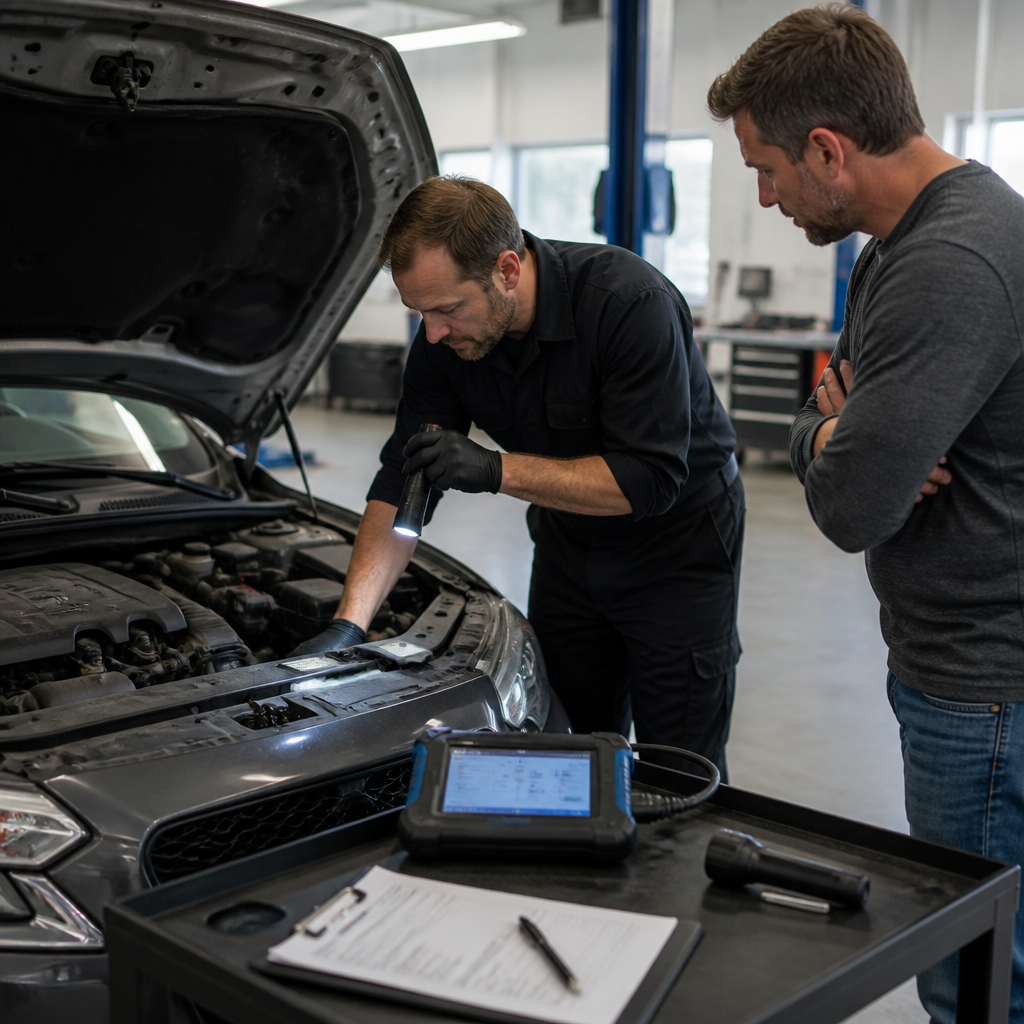
This is one of the most important questions to ask. Choose the mechanic yourself rather than accepting only the dealer’s preferred technician. A professional inspection may include the engine, transmission, cooling system, suspension, steering, brakes, electrical systems, tyres, body structure, and diagnostic faults.
Ask the mechanic to explain which issues are urgent, which are normal wear, and which repairs may be needed soon. Request a written report. If the report identifies serious problems, compare the cost and risk of repairs with the asking price. How to Choose a Fuel-Efficient Car for Nigerian Roads
A dealer may offer to repair faults before delivery. If so, record the agreed repairs in writing. Include the part or system involved, the standard expected, the completion date, and whether you can inspect the work before completing payment.
Can I take a proper test drive?
Ask how long the test drive can last and whether you may drive in different conditions. If permitted, test the vehicle at low and moderate speeds, on a quiet road, over small irregularities, and during normal stopping and turning. Pay attention to warning lights, vibrations, steering pull, unusual noises, delayed gear changes, overheating, and brake behaviour.
Test the air conditioning, windows, locks, lights, wipers, infotainment system, reverse camera, parking sensors, seat adjustments, and other equipment. Electrical faults can be expensive or inconvenient, even when the engine runs well.
Never test a vehicle in a dangerous way. Follow local traffic rules, confirm that the vehicle is legally permitted to be driven, and avoid driving without appropriate insurance or the seller’s permission.
What maintenance has been completed recently?
Ask for invoices or service records rather than relying on a verbal statement that the car has been serviced. Find out when the oil, filters, brake components, tyres, battery, timing-related parts, fluids, and other scheduled items were last checked or replaced.
The exact maintenance requirements depend on the make, model, engine, transmission, age, mileage, and previous use. Use the manufacturer’s guidance where available. If a major service is due soon, include that cost in your buying decision.
Ask whether replacement parts are original, manufacturer-approved, or aftermarket. Aftermarket parts are not automatically unsuitable, but you should know what has been installed and whether the work was carried out properly.
Questions about ownership and vehicle documents
Documents are not an administrative detail to check after payment. They are part of the vehicle’s value. A car with unclear ownership or incomplete records can create delays, additional expense, and legal complications.
Who legally owns the vehicle?
Ask the dealer to show evidence of ownership or authority to sell. Confirm that the name on the relevant records matches the person or business receiving your payment. If a representative is involved, ask for proof that the representative is authorised to complete the sale.
Be cautious if the seller asks you to pay into an unrelated personal account, a third party’s account, or an account with a name that does not match the invoice. There may be legitimate explanations, but you should verify them before transferring money.
Are the registration and transfer documents available?
Ask to see the vehicle’s available registration and transfer documents before paying. Check the vehicle identification number, registration details, ownership information, and any descriptions of the vehicle. Confirm that the documents are legible and appear consistent with the vehicle.
Ask who will handle the ownership transfer, what fees are included, and what documents you must provide. Do not accept a promise that everything will be sorted out later without a written timeline and clear responsibility.
Requirements can vary depending on the vehicle’s history and location. For current guidance, consult the relevant transport and road-safety authorities rather than relying only on a dealer’s explanation. In Nigeria, the Federal Road Safety Corps provides official road-safety information at frsc.gov.ng.
Are there outstanding finance, liens, claims, or restrictions?
Ask whether any lender, previous owner, insurer, authority, or other party has a financial or legal interest in the vehicle. A dealer should disclose known restrictions that could prevent a clean transfer.
Request evidence where a formal search or clearance process is available. If the dealer says there is no problem but will not provide supporting records, delay the deposit. Your ability to use or transfer the vehicle may be affected if another party has a claim.
Are import, customs, or clearance requirements complete?
For an imported vehicle, ask whether all relevant customs and clearance obligations have been completed. Request the applicable documents and confirm that the vehicle details match the car you are viewing.
Do not confuse a customs document with proof of ownership, road registration, or a clean mechanical condition. Each document serves a different purpose. You may need to confirm several parts of the vehicle’s status before completing the purchase.
The Nigeria Customs Service publishes official information through its website at customs.gov.ng. If the dealer gives you documents that you cannot interpret, seek independent professional help before paying.
Questions about the price and total cost
The advertised price may not be the final amount you need to spend. Ask for a complete written breakdown before paying a deposit. It should show the vehicle price and any separate charges connected with inspection, registration, transfer, delivery, repairs, documentation, taxes, or other services.
What exactly is included in the asking price?
Ask whether the price includes the vehicle only or also includes specific services and documents. Clarify whether accessories shown in photographs are included. This might include floor mats, spare keys, a spare tyre, tools, a warning triangle, roof equipment, or upgraded audio and camera systems.
Do not assume that every item displayed with the vehicle forms part of the sale. List included items in the agreement. If an item is missing at delivery, you will have a clearer basis for raising the issue.
Are there additional fees after the deposit?
Ask the dealer to disclose every known charge before you pay. You should understand whether delivery, document processing, transfer, registration, inspection, repairs, storage, or payment processing costs are separate. How to Choose the Right Tyres for Nigerian Roads
Use a simple calculation. Start with the agreed vehicle price. Add known fees, expected immediate maintenance, insurance, registration-related costs, and any transport costs. Then consider a reasonable reserve for defects that an inspection may not identify. This gives you a more realistic purchase budget.
Is the price negotiable after inspection?
Ask how the dealer handles faults found during an independent inspection. Some sellers may agree to repair specific problems. Others may reduce the price or sell the vehicle as inspected. You need to know the approach before you pay a reservation deposit.
Do not make a large deposit based on a verbal promise that the final price will be adjusted later. If the price depends on inspection results, write that condition into the agreement. State what happens if the inspection identifies major damage, missing documents, or a material difference from the advertisement.
Questions about the deposit itself
The deposit deserves its own discussion. Many disputes begin because the buyer and seller use the same word to describe different arrangements. Ask precise questions and request written answers.
What is the deposit for?
Ask whether the money is a reservation fee, part payment, inspection fee, administrative charge, or another type of payment. The receipt should use clear wording. Avoid paying money described only as a commitment fee without further explanation.
Confirm whether the deposit reduces the final balance. If it does not, ask why. Also ask whether the seller will stop advertising the car, reserve it exclusively for you, or continue showing it to other buyers.
Is the deposit refundable?
Ask for the refund policy in writing. Specifically ask what happens if:
- the vehicle fails an independent inspection;
- the VIN or chassis number does not match the documents;
- the seller cannot prove ownership or authority to sell;
- the vehicle has undisclosed accident, flood, fire, or structural damage;
- the dealer cannot complete agreed documentation;
- the advertised price or included items change;
- the seller fails to deliver the vehicle within the agreed period; or
- you decide not to proceed for a personal reason.
These situations may be treated differently. Do not assume a refund is available just because the vehicle is not suitable for you. Conversely, do not accept an automatic loss of the deposit if the seller materially misrepresented the car or cannot complete the promised transaction.
When can the seller keep the deposit?
Ask the dealer to explain the circumstances in which the deposit may be retained. The answer should be understandable and included in the written agreement. Watch for broad wording that gives the seller unlimited discretion.
A clear agreement should identify the buyer’s obligations, such as a deadline for completing payment, and the seller’s obligations, such as holding the vehicle or providing specified documents. Both sides should know what happens if either party fails to perform.
How will the payment be acknowledged?
Pay only through a traceable method and obtain a receipt immediately. The receipt should include the dealer’s legal or trading name, contact details, payment date, amount, payment method, vehicle description, VIN or chassis number, and the purpose of the payment.
Keep the bank transfer confirmation, payment reference, messages, email exchanges, advertisement, photographs, inspection report, and signed agreement. Store copies somewhere secure. If a dispute occurs, a complete record is more useful than a single payment screenshot.
Questions about warranty, returns, and after-sale support
Ask what support you will receive after collection. A dealer may offer a warranty, limited guarantee, service period, or no after-sale cover. None of these descriptions should be left vague.
Is there a written warranty?
If a warranty is offered, ask what parts and systems it covers, how long it lasts, where repairs must be carried out, and whether you must follow specific maintenance requirements. Ask about exclusions, claim procedures, diagnostic fees, labour limits, and parts restrictions.
Read the warranty before paying the deposit. A statement such as engine and gearbox covered may exclude many components that can cause expensive failures. Request clarification in writing if the wording is unclear.
What happens if a fault appears shortly after purchase?
Ask how the dealer handles faults discovered after delivery. Find out who pays for diagnosis, whether you must return the car to a particular workshop, and how quickly the dealer normally responds.
Do not treat a warranty as a replacement for an inspection. Warranty terms may have limits, and some problems may be considered pre-existing wear. The best protection is still a careful inspection and accurate written description before purchase.
Is there a return or exchange policy?
Ask whether the dealer allows returns or exchanges and under what conditions. Do not rely on general statements such as customer satisfaction guaranteed unless the actual terms are written clearly.
Consumer rights and contract rules vary by location and transaction type. If you are unsure about your rights, consult a qualified local adviser or the appropriate consumer-protection authority. In Nigeria, the Federal Competition and Consumer Protection Commission provides official consumer information at fccpc.gov.ng.
Warning signs that should make you delay payment
A single unusual detail does not prove dishonesty. However, several warning signs together should make you pause. Protecting your money is more important than securing a vehicle immediately.
- The dealer refuses to provide the VIN or chassis number.
- The vehicle identity does not match the documents.
- The seller will not permit an independent inspection.
- You are told that another buyer is waiting and you must pay immediately.
- The price changes after you show interest.
- The seller asks you to pay into an unrelated account without a clear explanation.
- The refund policy is only verbal or contains confusing wording.
- Important documents are always promised for later.
- The dealer avoids questions about ownership, accident history, or import status.
- The advertisement contains details that the seller now says were incorrect.
- The seller discourages you from bringing a mechanic or adviser.
- You are asked to sign blank forms or incomplete paperwork.
Pressure is not proof of a scam, but it reduces your opportunity to make a careful decision. A genuine seller may have other interested buyers, yet should still be able to provide basic information and reasonable time for verification. car battery dying — How to Know If a Car Battery Is Dying
How to verify the answers before paying
Good questions are only useful when you check the answers. Create a short verification plan before visiting the dealer. Write down the advertised price, vehicle details, promised features, stated mileage, and any claims about condition.
- Match the vehicle identity. Compare the VIN or chassis number on the car, documents, inspection report, receipt, and agreement.
- Check the seller. Confirm the business name, physical location, phone number, and person authorised to complete the sale.
- Inspect independently. Use a mechanic or inspection provider who is not connected to the seller.
- Review the documents. Check ownership, registration, import or clearance records where relevant, and any transfer requirements.
- Calculate the complete cost. Include fees, immediate maintenance, insurance, registration-related expenses, and transport.
- Record the agreement. Put the deposit amount, refund terms, deadlines, repairs, included items, and balance in writing.
- Pay traceably. Use a payment method that creates a clear record and obtain a detailed receipt.
Do not send money simply because photographs look convincing. Ask for a live viewing or a trusted inspection. Be especially careful when a seller says the vehicle is in another city, asks for payment before viewing, or refuses to identify the business receiving the funds.
For general vehicle identification and road-safety guidance, the United States National Highway Traffic Safety Administration provides an official VIN-related resource at nhtsa.gov/vin-decoder. This does not replace local registration, ownership, customs, or inspection checks, but it can help explain the role of a VIN and the type of information it identifies.
A practical deposit agreement checklist
Before signing or transferring money, review the agreement line by line. It should contain enough detail for another person to understand the transaction without relying on your memory.
- Full names and contact details of the buyer and seller.
- The dealer’s registered or trading name, where applicable.
- Vehicle make, model, year, colour, registration details, and VIN or chassis number.
- Agreed purchase price and exact deposit amount.
- Whether the deposit counts toward the final price.
- Payment date, method, and receipt reference.
- Deadline for completing the purchase.
- Documents the seller must provide.
- Repairs or accessories included before delivery.
- Inspection conditions and the result required to proceed.
- Refund conditions and the process for requesting a refund.
- Warranty or after-sale support terms.
- Who pays each known fee.
- Signatures or clear confirmation from the relevant parties.
Read every page before signing. Do not sign blank spaces, incomplete forms, or documents containing details that differ from the advertisement. If a contract uses legal language you do not understand, seek advice before paying.
What to do if the dealer refuses to answer
You do not need to argue with a seller who will not cooperate. Politely explain that you need the information for your records and that you will not pay until the vehicle and terms are verified. Then leave if the dealer continues to avoid reasonable questions.
Save the advertisement and correspondence if the seller made specific claims. If you believe money was obtained through deception or a serious transaction problem occurs, contact your bank or payment provider promptly and seek advice from the appropriate local authorities or a qualified legal professional. Do not threaten, harass, or publish unverified accusations against the seller.
For future purchases, improve the process rather than trying to recover from pressure. Bring someone with you, inspect during the day, avoid rushed decisions, and compare several vehicles. A missed opportunity is usually less costly than a bad purchase.
Questions to ask a car dealer: a quick conversation guide
You can use the following short script when speaking with a dealer:
- What is the exact VIN or chassis number?
- Who owns the vehicle, and can I see proof or authority to sell?
- Has the vehicle had any accident, flood, fire, or major repair history?
- Is the mileage supported by service and ownership records?
- Can I arrange an independent inspection before paying?
- What documents will I receive, and who will complete the transfer?
- Are import, customs, registration, or clearance requirements complete?
- What is the complete price, including every known fee?
- What exactly does this deposit reserve?
- When is the deposit refundable, and when can it be retained?
- What warranty or after-sale support is included?
- Will all these terms appear on the receipt or written agreement?
If the answers are clear, consistent, and supported by evidence, you can move to the next stage with greater confidence. If the answers create more questions, pause. Your money should not be at risk while basic facts remain uncertain.
Frequently asked questions
Should I pay a deposit before inspecting the car?
Ideally, inspect the vehicle and its key documents before paying. If a deposit is necessary to arrange an inspection or reserve the vehicle, make the payment conditional on a satisfactory inspection and accurate documentation. Put the condition and refund process in writing.
Is a non-refundable deposit always unfair?
Not necessarily. A deposit may be described as non-refundable in some transactions, but the effect depends on the agreement and applicable law. You should still ask what happens if the seller misrepresents the vehicle, cannot prove ownership, or fails to deliver the promised transaction. Do not pay until you understand the terms.
What if the dealer says another buyer will pay today?
Do not let urgency replace verification. You can state that you are interested but will only pay after checking the vehicle, documents, and deposit conditions. If the seller refuses reasonable checks, walk away.
Can I rely on the dealer’s mechanic?
The dealer’s mechanic may identify genuine problems, but an independent inspection gives you a less conflicted assessment. If you use the dealer’s mechanic, ask for a written report and consider a second opinion before paying a substantial deposit.
What should I do if the car differs from the advertisement?
Record the differences with photographs and messages. Do not complete payment or accept delivery until the issue is resolved in writing. If the difference is material, ask about cancelling the transaction and recovering the deposit under the agreement.
How can I make a deposit safer?
Use a traceable payment method, pay only the agreed amount, verify the recipient, obtain a detailed receipt, and keep all communications. Make the payment conditional on specific checks where possible. Never transfer money to an unknown person merely because they claim to represent a dealer.
Final checklist before you transfer money
Before paying a deposit, ask yourself whether you can answer yes to each of these questions:
- Have I identified the exact vehicle?
- Does the VIN or chassis number match everywhere?
- Have I seen evidence of ownership or authority to sell?
- Have I checked the vehicle’s condition independently?
- Have I reviewed the available registration and import documents?
- Do I know the full purchase cost?
- Do I understand what the deposit means?
- Do I know exactly when it can be refunded?
- Are promised repairs and included items written down?
- Have I received a proper receipt?
- Am I paying the correct person or business?
- Am I comfortable proceeding without pressure?
If the answer to any important question is no, delay the payment. A reputable dealer should understand why you need to verify a significant purchase. The safest car-buying decisions come from clear records, independent checks, realistic budgeting, and enough time to think.
Remember that a deposit does not make a questionable vehicle safer. It only makes you financially committed. Ask the right questions first, verify the answers, and pay only when the vehicle, paperwork, price, and written terms all make sense.
3 thoughts on “Car Dealer Questions Before Paying a Deposit”