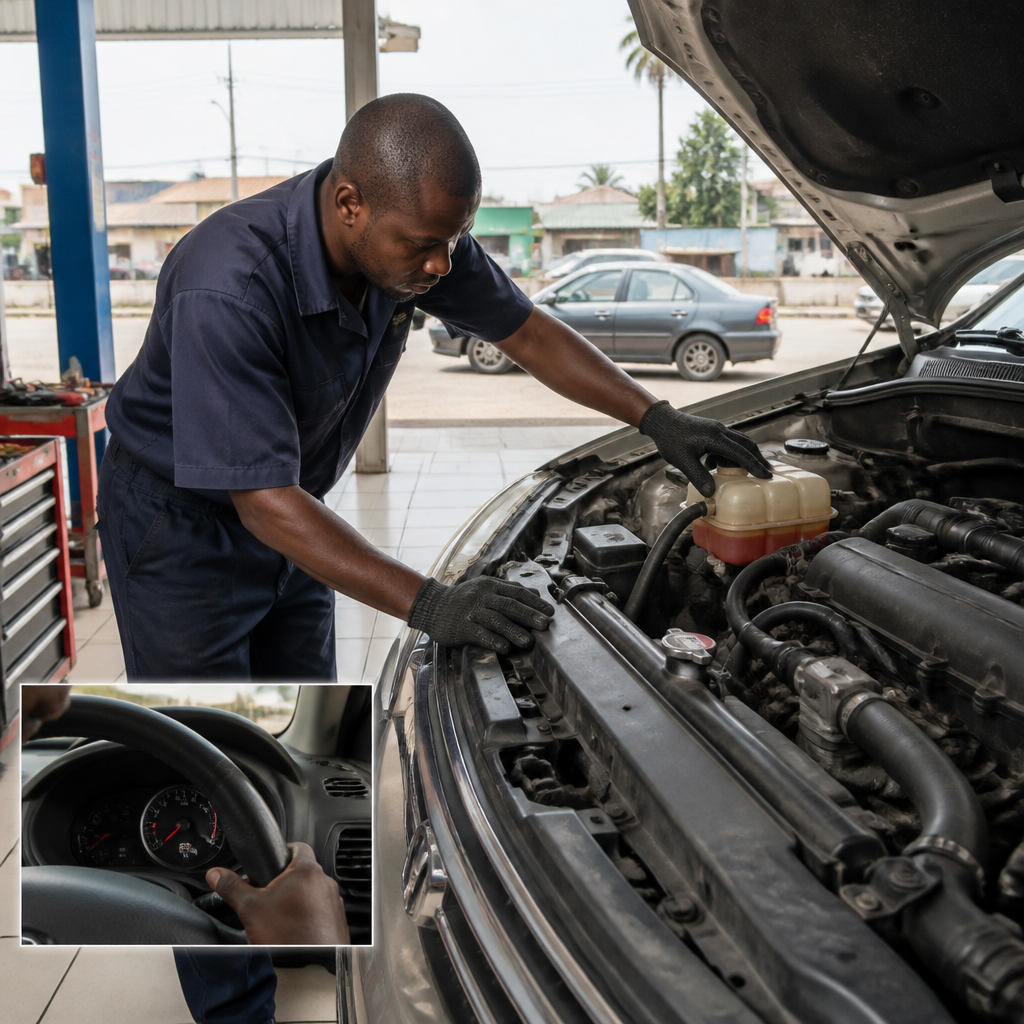
Buying a used car in Nigeria requires more than checking the body, interior and engine sound. Used cars overheating Nigeria buyers inspect may look fine during a short viewing, then run hot in traffic, on a long uphill drive or with the air conditioner working. This guide explains why overheating happens, how sellers sometimes hide the symptoms, and what you should check before making payment.
Overheating is not a minor inconvenience. A vehicle that repeatedly runs above its normal temperature can damage the cylinder head, head gasket, pistons and other engine parts. In severe cases, the car may stop suddenly and require an expensive engine rebuild. However, not every temperature problem means the engine is finished. A weak radiator fan, blocked radiator, faulty thermostat or leaking hose may be repairable if identified early.
Nigeria creates demanding conditions for a vehicle cooling system. Traffic delays, high ambient temperatures, dusty roads, poor-quality coolant, neglected servicing and heavy air-conditioning use all increase the workload on the engine. Before you buy, inspect the car when it is completely cold, drive it long enough to expose problems, and have an independent technician verify the cooling system.
If you are inspecting a tokunbo vehicle, do not assume a clean engine bay proves good mechanical condition. Some cars arrive after long storage, overseas auction damage or flood exposure. Others may have received temporary repairs before sale. A broader mechanical inspection is useful, so review this guide on checking a tokunbo car for hidden mechanical problems while planning your inspection.
Why used cars overheat in Nigeria
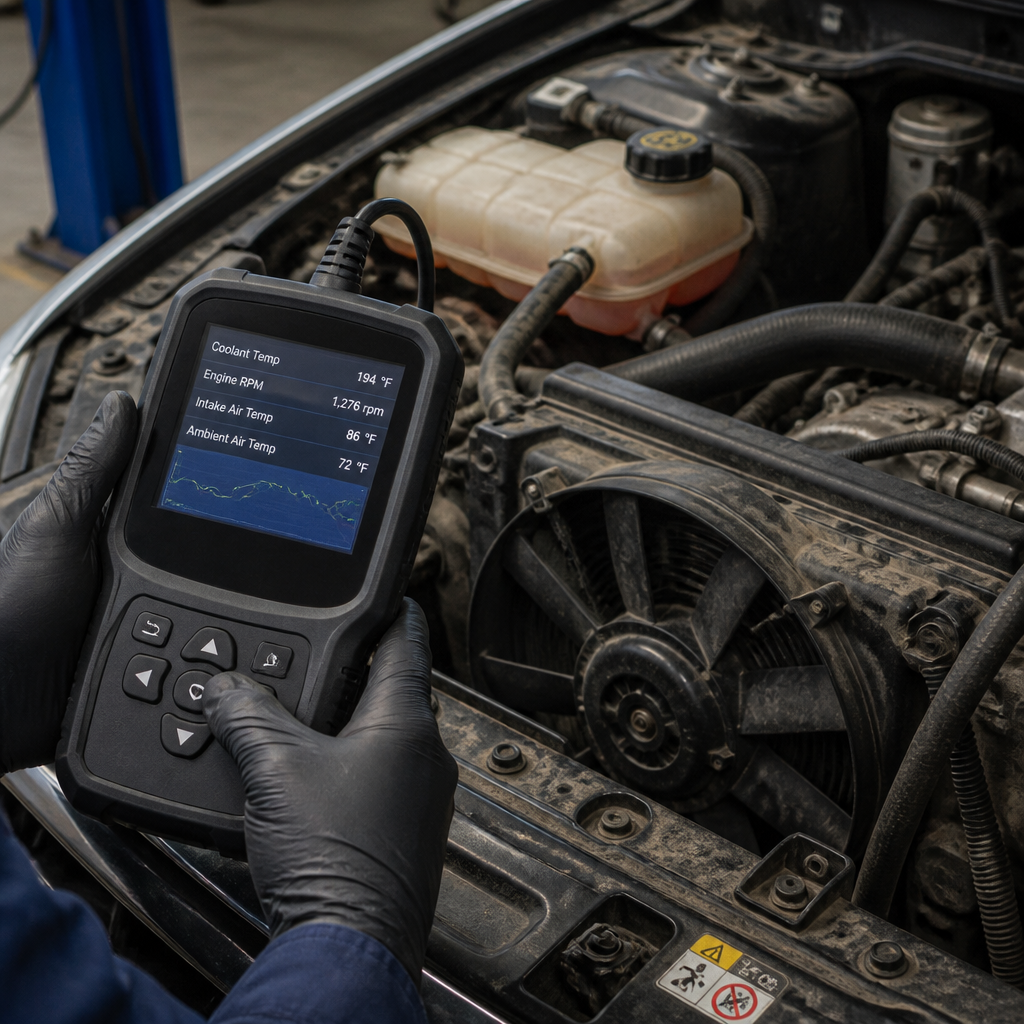
Overheating occurs when the cooling system cannot remove heat from the engine quickly enough. The system normally circulates coolant through passages in the engine and radiator. A water pump moves the coolant, a thermostat controls when it flows through the radiator, and fans help draw air across the radiator when the vehicle is stationary or moving slowly.
When one part becomes weak, the temperature may rise gradually or suddenly. A car can appear normal on a cool morning but overheat after an hour in Lagos traffic. It may also stay cool on a short test drive while losing coolant slowly. That is why a quick spin around the block cannot prove that a used vehicle is healthy.
Traffic and heat increase cooling demand
Stop-and-go traffic removes much of the natural airflow that passes through the radiator at road speed. The radiator fan must then operate correctly. If the fan motor is weak, the relay is faulty, the wiring has been altered or the fan switch does not work, the temperature can rise while the car waits in traffic.
High outdoor temperatures also reduce the difference between the temperature of the coolant and the surrounding air. The radiator has less opportunity to release heat. When the air conditioner is running, the condenser and engine cooling fan may face additional demand. A vehicle that behaves well on an open road can therefore show a problem during a hot afternoon in congested traffic.
Poor maintenance and incorrect repairs
Many overheating problems begin with maintenance that was delayed. Coolant loses its protective properties over time, hoses become brittle, radiator fins collect dirt, and belts can wear or loosen. Some owners use ordinary water for long periods. Water may keep an engine running temporarily, but it does not provide the same corrosion protection and boiling-point performance as the correct coolant mixture recommended for the vehicle.
Previous repairs can also create trouble. A mechanic may remove a thermostat instead of replacing a faulty one, fit an incorrect fan, bypass a temperature sensor, use sealant to hide a leak, or install a radiator that is too small. Such changes can make a car appear usable while leaving little safety margin for Nigerian driving conditions.
Before paying, ask for service records and look for evidence that cooling-system work was performed properly. Also read our practical advice on testing a used car before you pay, because overheating is only one of several faults that a proper road test can expose.
Common mechanical causes of overheating
A buyer does not need to diagnose every component alone. Still, understanding the common causes helps you ask better questions and recognise a risky vehicle.
Low coolant or a hidden leak
Low coolant is one of the simplest causes of overheating, but it should never be dismissed. The level may fall because of a split hose, loose clamp, cracked radiator, damaged expansion tank, leaking water pump or failed head gasket. A seller may top up the reservoir before your visit, hiding a slow leak temporarily.
Inspect the coolant reservoir when the engine is cold. The level should sit between the marked limits, not far above the maximum line. Look around hose joints, the radiator, water pump area and under the engine for wetness, dried residue or staining. Green, pink, orange or blue residue may indicate coolant, depending on the product used. The colour alone does not identify the exact fluid or prove that it is suitable.
Never remove a radiator cap while the engine is hot. Pressurised coolant can cause serious burns. If you need to inspect the radiator itself, allow the engine to cool fully and ask a technician to do it safely.
Faulty radiator fan or fan control
The electric fan should usually operate when the engine reaches a high temperature and may also operate when the air conditioner is switched on. The exact control strategy differs by vehicle, so do not treat one silent fan at a particular moment as proof of failure. Instead, ask a technician to check fan operation, relays, fuses, wiring, sensors and the fan motor.
Listen for unusual grinding, scraping or intermittent operation. A fan that starts only after tapping, stops randomly or runs at an obviously weak speed deserves attention. Some vehicles have more than one fan or more than one speed. A missing fan shroud can also reduce airflow and cause problems in traffic.
Blocked, corroded or damaged radiator
The radiator must allow coolant to flow internally and air to pass across its fins. Dirt, mud, insects and dust can cover the external fins. Internal corrosion or deposits can restrict the coolant passages. Bent fins reduce airflow, while a previously repaired radiator may leak again under pressure.
Inspect the radiator face with a light. It should not be heavily packed with dirt or flattened across a large area. Check for wet spots, crusty deposits, fresh paint or signs of recent repair. A clean-looking radiator is not automatically healthy, so a cooling-system pressure test and temperature check remain valuable.
Thermostat problems
The thermostat helps the engine reach and maintain its normal operating temperature. If it remains closed, coolant cannot circulate through the radiator properly and the engine may overheat quickly. If it remains open, the engine may run too cool, consume more fuel or produce weak cabin heat. Removing the thermostat is not a proper long-term repair.
Because thermostat faults may not appear during a very short drive, compare the temperature behaviour from a cold start to normal operating temperature. A technician can use scan data and temperature measurements to determine whether the engine warms up in a reasonable pattern for that model.
Water pump, belt and circulation faults
The water pump circulates coolant through the engine. A worn bearing, damaged impeller or leaking seal can reduce circulation. Some pumps are driven by a belt, while others use a timing belt or chain arrangement. The repair procedure and consequences vary significantly by engine design.
Watch for coolant near the pump, bearing noise, belt damage or unusual movement. A loose or damaged drive belt can also affect other components. Do not rely on a quiet idle alone. A pump may circulate enough coolant at low speed but fail to perform properly under load.
Head-gasket or cylinder-head damage
A failed head gasket can allow combustion gases into the cooling system, coolant into the cylinders or oil into the coolant. A warped or cracked cylinder head may produce similar symptoms. These faults can follow previous overheating, but they can also result from age, poor maintenance or other engine problems.
Warning signs include repeated coolant loss without an obvious external leak, bubbles in the reservoir after the engine warms, white exhaust smoke that continues after startup, milky oil, unexplained misfires and a pressure hose that becomes extremely hard soon after a cold start. None of these signs alone proves a head-gasket failure. A combustion-gas test, compression test, leak-down test or cooling-system pressure test can provide stronger evidence.
Be cautious if the engine bay is freshly washed, the coolant is unusually clean while the rest of the car is neglected, or the oil filler cap has been cleaned but service records are missing. These observations do not prove deception. They simply justify a more careful inspection.
Signs that a used car may be overheating
The temperature gauge is the first warning tool in many vehicles, but gauges are not identical. Some remain near the middle across a broad temperature range, while others move more noticeably. Learn how the gauge behaves during a normal drive and treat any movement toward the hot zone seriously.
- The temperature gauge rises above its usual position.
- A red temperature warning light appears or flashes.
- Steam or vapour comes from the bonnet.
- The engine loses power, hesitates or enters a reduced-power mode.
- The air conditioner stops cooling as the engine temperature rises.
- There is a sweet coolant smell inside or outside the vehicle.
- The reservoir is empty, overflowing or bubbling excessively.
- The engine fan runs loudly for long periods or never comes on.
- Coolant stains appear below the vehicle after parking.
- The engine misfires after running hot.
Some sellers may describe these symptoms as normal for an old car. They are not conditions you should ignore. A vehicle can complete a test drive and still have a serious fault that appears later, especially if the seller starts the inspection with a warm engine or drives only on an open road.
Ask to see the car before it has been driven that day. Touching the radiator hose is not a reliable temperature test, and you should not handle hot components. Instead, confirm that the engine is cold using a scan tool or by allowing the technician to inspect it safely.
How to inspect a used car before payment
A careful inspection should combine visual checks, a cold start, a road test, diagnostic scanning and an independent mechanical opinion. No single test catches every fault. The following process reduces the chance of buying a car that has been prepared only for a brief demonstration.
1. Arrange a cold-start inspection
Tell the seller that you want to see the car cold. If the engine is already warm when you arrive without a clear reason, ask why. A warm engine may hide hard starting, excessive smoke, a noisy water pump or a temperature problem that occurs during the first part of operation.
Before starting, inspect the reservoir level, visible hoses, belts and the area beneath the vehicle. Look for fresh coolant, water marks, oil contamination and recently cleaned areas. Check whether the engine has unusual oil or coolant residue around the cylinder head, radiator and pump area.
Start the engine and observe the exhaust. A small amount of condensation can be normal, especially during a cold start. Continuous thick white smoke after the engine warms requires investigation. Blue smoke may indicate oil consumption, while black smoke may indicate an overly rich fuel mixture. These symptoms have different causes, but all justify a professional inspection.
2. Monitor the warm-up period
Let the vehicle warm naturally. Do not allow a seller to rev the engine repeatedly to make the fan start. Watch the gauge and listen for abnormal noises. The engine should reach its normal operating range without rapidly climbing toward hot.
Check the cabin heater if the vehicle has one, but remember that weak heat can have several causes. Low coolant, trapped air, a blocked heater core or a control fault may all affect heater performance. Ask a technician to interpret the result rather than making a diagnosis from one observation.
When the engine reaches operating temperature, confirm that the fan operates when required. The technician should also check whether the fan runs at the correct speed and whether the air-conditioning system changes fan behaviour. A fan that works only when connected directly to power may indicate a control-system problem.
3. Test the car in realistic conditions
Drive long enough to reproduce the conditions you expect to face. Include slow traffic, a stretch of open road, gentle acceleration, braking and, where safe, an incline. Keep an eye on the gauge throughout. Do not drive aggressively to force a fault, but do not accept a two-minute demonstration as a complete test.
Use the air conditioner during part of the drive. A healthy vehicle should maintain a stable temperature when the cooling system is working correctly. If the gauge rises only with the air conditioner on, investigate the fan, condenser airflow, radiator condition and refrigerant-system interaction.
After the drive, park safely and inspect for leaks or steam. Listen for gurgling, fan operation and unusual ticking. Some fans continue running briefly after the engine is switched off, depending on the vehicle. That behaviour can be normal, but a technician should investigate an unusually long or repeated fan cycle.
4. Use diagnostic equipment
A scan tool can reveal stored fault codes, live coolant temperature and sensor readings. It may also show that warning codes were recently cleared. However, scanning is not a substitute for a physical inspection. A vehicle can have no stored fault code and still suffer from a blocked radiator, leaking hose or weak water pump.
Ask the technician to compare the dashboard reading with scan data and, where appropriate, an independent temperature measurement. The goal is to identify whether the engine is genuinely running too hot or whether a sensor, gauge or wiring issue is creating a false warning.
5. Request pressure and combustion tests
A cooling-system pressure test can reveal leaks that are not obvious during a visual inspection. The system is pressurised with suitable equipment while the technician checks whether pressure drops. This test must follow the vehicle’s specifications and should be performed by someone who understands the risks.
If a head-gasket problem is suspected, a combustion-gas test may help detect exhaust gases in the cooling system. Compression and leak-down tests can provide additional information about cylinder sealing. No test is perfect in isolation, so interpret the findings together with the symptoms and service history.
How flood damage and accident repairs can cause overheating
Flood exposure can damage fan motors, electrical connectors, sensors, relays and engine components. Mud or debris may remain in the radiator and condenser. Corrosion can appear later, even if the car starts and drives normally immediately after cleaning.
Inspect carpets, seat rails, spare-wheel wells, wiring, connectors and hidden metal areas for water lines, corrosion or unusual odours. Compare the condition of the interior with the mileage and exterior. A recently replaced carpet does not prove flood damage, but it should lead to more questions.
For a detailed inspection, see our advice on detecting a flood-damaged car before buying. Flood damage is particularly relevant to overheating because electrical faults may prevent the fan from operating when needed.
Accident repairs can also affect cooling. A front-end collision may damage the radiator, condenser, fan shroud or mounting points. An insurer or repairer may replace one component while leaving another bent or restricted. Look for uneven panel gaps, fresh paint, non-matching fasteners and a radiator that does not sit squarely.
Our guide to detecting accident and repainted tokunbo cars can help you examine the body and front-end history. Mechanical and body inspections should work together, because an accident may explain why a cooling component appears new but poorly fitted.
Questions to ask the seller
Good questions do not guarantee honest answers, but they can reveal gaps in the vehicle’s history. Ask when the car last overheated, what parts were replaced, why the parts were replaced and which workshop performed the work. Ask whether the radiator, thermostat, water pump, fan motor, head gasket or hoses have been changed.
Request receipts where available. A receipt does not prove that the work was done correctly, but it provides useful context. Ask whether the car has been driven regularly in traffic and whether the seller agrees to an independent inspection before payment.
Be careful with explanations such as the car only overheated because of a temporary water shortage, a faulty gauge that was already fixed, or a fan that has been wired directly. The explanation may be true, but you should verify the repair. A direct-wired fan can mask a failed relay, sensor or control module and may create other electrical or battery problems.
If the seller refuses a cold start, independent technician, diagnostic scan or proper road test, treat that refusal as a buying risk. Walk away if necessary. A discounted price does not make a severe cooling-system fault safe, especially when the underlying cause is unknown.
Repair clues and costs buyers should interpret carefully
Buyers often ask for an exact overheating repair price before a mechanic has diagnosed the fault. That is unreliable. Replacing a hose and clamp is very different from repairing a cracked cylinder head. Parts availability, vehicle model, labour, import status and the quality of replacement components also affect the final amount.
Instead of focusing only on the cheapest possible repair, ask for a written diagnosis and a list of required parts. Find out whether the technician tested the system or simply guessed. Confirm whether the quotation includes coolant, bleeding the system, pressure testing, machining, new seals and any related belts or fluids.
Do not accept a bottle of stop-leak additive as proof that a cooling problem has been repaired. Such products may temporarily reduce a small leak, but they can also restrict narrow passages in a radiator or heater core. The correct response depends on the source and size of the leak.
Likewise, a new radiator cap, thermostat or fan may not solve the problem if the engine has already suffered internal damage. If the car has a history of repeated overheating, insist on stronger testing before you consider buying it.
A practical checklist for inspecting used cars overheating Nigeria buyers may consider
Save this checklist on your phone and use it during the inspection. It does not replace a qualified technician, but it helps you avoid forgetting important steps.
- Arrange to inspect the car with the engine cold.
- Check the coolant reservoir level and look for leaks or dried residue.
- Inspect radiator fins, hoses, clamps, belts and the fan shroud.
- Look beneath the vehicle for coolant, oil or water stains.
- Start the engine and watch the temperature gauge from cold.
- Observe exhaust smoke, unusual smells, misfires and abnormal noises.
- Confirm that the radiator fan operates when required.
- Use the air conditioner during a realistic road test.
- Drive through slow traffic and, where safe, an incline.
- Check the gauge after the test drive and look for fresh leaks.
- Scan the vehicle for fault codes and compare live temperature data.
- Request a cooling-system pressure test if any symptom appears.
- Request combustion, compression or leak-down testing when head-gasket damage is suspected.
- Inspect for flood damage, accident repairs and poorly fitted front-end components.
- Get an independent written report before negotiating or paying.
Also inspect the vehicle identification number, ownership records and import documents before completing the transaction. Mechanical condition matters, but a car with unresolved documentation problems can create a separate financial and legal burden.
What to do if the car overheats during your inspection
Stop the test as soon as the gauge enters the hot zone or a warning light appears. Turn off the air conditioner and move to a safe location if possible. Do not continue driving simply to reach the seller’s workshop. Continued operation can turn a repairable cooling fault into major engine damage.
Switch off the engine and keep people away from steam or escaping coolant. Do not open the radiator cap while hot. Wait for the vehicle to cool, then arrange professional recovery or inspection. If the seller says the problem is harmless, still rely on an independent diagnosis rather than reassurance.
Record what happened, including the time, road conditions, distance driven, gauge position and whether the air conditioner was operating. These details help a technician reproduce the fault. Do not pour cold water over a very hot engine, as sudden temperature changes may damage components.
How to decide whether to buy
A minor, clearly diagnosed issue may be negotiable if the repair is properly documented and you understand the risk. For example, a damaged hose with no evidence of overheating may be a manageable repair. Even then, have the technician confirm that the engine has not been affected.
Be much more cautious when the cause is uncertain. Repeated overheating, coolant loss, bubbling, thick white smoke, contaminated oil, a hard-starting engine or a warped cylinder head can create costs that are difficult to predict. If the seller refuses testing, treat the vehicle as a high-risk purchase.
Do not allow urgency, scarcity or a verbal promise to replace parts after payment to control your decision. Put any agreed repair in writing before payment, but remember that the safest option may be to choose another car. There are usually more used vehicles available than buyers first assume.
When comparing two similar cars, favour the one with a verifiable maintenance history, stable temperature during a long drive, functioning air conditioning and an independent inspection report. A slightly higher purchase price may be better value than a cheaper vehicle with hidden cooling-system damage.
Frequently asked questions
Can a car overheat only in traffic?
Yes. At road speed, air passes through the radiator naturally. In traffic, the fan must provide most of the airflow. A failed fan, blocked radiator, missing shroud or faulty fan control can therefore cause overheating mainly at low speed. Ask a technician to test the fan and observe the vehicle in realistic conditions.
Is it safe to buy a car with a new radiator?
Not automatically. A new radiator may solve a blocked or leaking radiator, but it may not address a faulty fan, water pump, thermostat, head gasket or electrical problem. Ask why the radiator was replaced and request a full cooling-system inspection.
Does clean coolant prove that the engine is healthy?
No. Fresh coolant can be added shortly before a sale. Clean coolant also says little about the fan, thermostat, pump or cylinder-head condition. Check the level, inspect for contamination and test the system properly.
Can ordinary water be used in the cooling system?
Water may be used temporarily in an emergency, but long-term use can encourage corrosion and does not provide the same protection as the correct coolant mixture. The appropriate product and mixing ratio depend on the vehicle. Follow the manufacturer’s guidance and have the system flushed if it contains contaminated or unsuitable fluid.
What if the temperature gauge looks normal?
A normal gauge is encouraging but not conclusive. Some gauges hide small changes, and problems may appear only under load or in traffic. Combine the gauge reading with a cold start, road test, scan, visual inspection and professional testing.
Should I test-drive the vehicle with the air conditioner on?
Yes, if the system works and conditions are safe. Air-conditioning use adds load and can reveal a weak fan or restricted airflow. Stop immediately if the temperature rises abnormally, warning lights appear or steam comes from the engine bay.
Can overheating damage an automatic transmission?
Excess engine-bay heat can affect surrounding components, and some vehicles use a shared or nearby heat-exchange arrangement for transmission fluid. However, the exact risk depends on the model. If the vehicle has overheated, ask a technician to check the transmission fluid, cooling system and related lines.
Final advice for Nigerian used-car buyers
Used cars overheating Nigeria buyers encounter are often the result of neglected maintenance, traffic stress, poor repairs or hidden damage. The visible symptom is only the beginning. Your job is to identify the cause before you negotiate, not after the engine fails.
Inspect the car cold, monitor the warm-up, test it in traffic, use the air conditioner, scan the system and request pressure testing when necessary. Check for flood and accident damage, question vague repair stories and insist on an independent technician. Never open a hot radiator and never continue driving an overheating vehicle to complete a sale.
The best purchase is not simply the car with the cleanest paint or lowest asking price. It is the vehicle whose mechanical condition, maintenance history and documents you can verify. By taking your time, you greatly reduce the chance that a hidden cooling-system fault will become your first major expense after purchase.
4 thoughts on “Used Cars Overheating Nigeria: What Buyers Should Check”