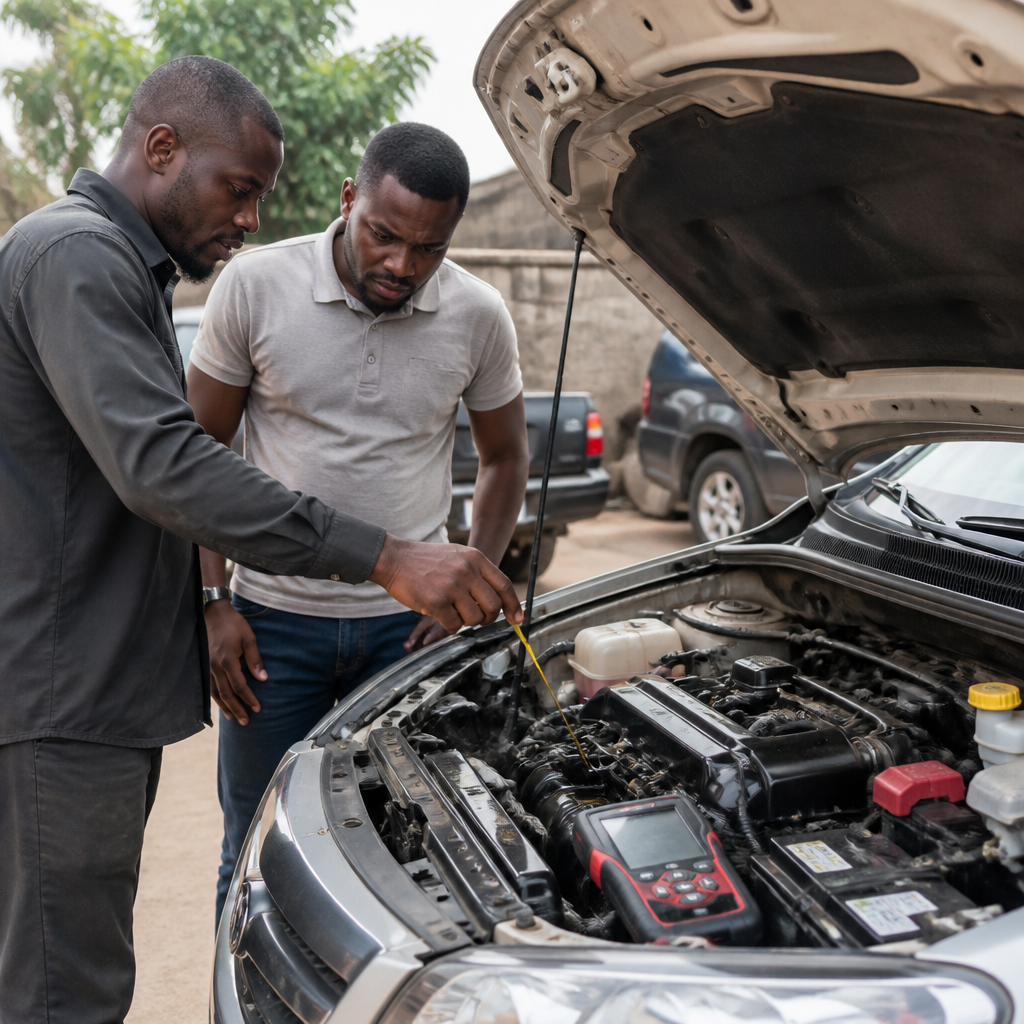
If you want to check a tokunbo car for hidden mechanical problems, do not rely only on a clean body, a low price or a seller’s assurance. A used imported vehicle can look excellent while hiding transmission wear, cooling-system faults, electrical issues or accident-related mechanical damage. The safest approach is to inspect the car in daylight, review its history, start it from cold, test-drive it properly and obtain an independent mechanic’s opinion before you pay.
This guide explains how to check a tokunbo car step by step. It covers what to inspect under the bonnet, inside the cabin, beneath the vehicle and during a road test. It also explains how to identify warning signs that may not appear during a short visit to a dealership or viewing location.
A tokunbo car usually arrives in Nigeria after previous use in another country. Its condition depends on mileage, climate, servicing, storage, accident history, flood exposure and the quality of repairs carried out before or after importation. The term itself does not guarantee good mechanical condition. Treat every vehicle as a used car that needs evidence and inspection.
Before arranging an inspection, gather the vehicle identification number, available service records, auction or shipping information and the seller’s maintenance claims. If you need broader guidance on checking whether the vehicle is genuinely imported and properly represented, read this guide to knowing if a tokunbo car is genuine before buying. Mechanical checks and history checks work best together because a healthy-looking engine cannot prove that the car has a clean past.
Also confirm that you are dealing with the exact vehicle shown in the advert. Compare the VIN on the dashboard, driver’s door frame and vehicle documents. Differences may indicate an administrative mistake, a replaced panel or a more serious identity problem. Do not continue with the purchase until every mismatch is explained and independently verified.
Prepare before you inspect the vehicle

Good preparation makes a mechanical inspection more reliable. Arrange to see the car when the engine is completely cold. A warm engine can hide hard starting, excessive smoke, noisy valve operation and some cooling problems. Ask the seller not to start the car before you arrive. If the engine is already warm, record that fact and consider returning later for a cold-start inspection.
Choose a bright, level location. Daylight helps you see fluid leaks, uneven tyre wear, paint differences and smoke from the exhaust. A flat surface also makes it easier to judge the engine oil level, transmission fluid level where accessible and coolant reservoir level. Avoid inspecting only at night or in heavy rain.
Take a small torch, clean tissue or paper towel, disposable gloves, a tyre-pressure gauge and a phone for photographs. An inexpensive OBD-II scanner can help identify stored diagnostic trouble codes, although it cannot replace a skilled mechanic. Do not clear codes before inspection. Cleared codes may return after the car completes its drive cycles.
Ask the seller for permission to inspect and test-drive the vehicle before discussing final payment. A genuine seller may set reasonable safety conditions, but should not object to an independent inspection. If the seller insists on using only a mechanic chosen by them, refuses a cold start or pressures you to pay immediately, treat that behaviour as a significant warning sign.
It is useful to make a checklist. Divide your inspection into five areas: identity and history, engine bay, exterior and underbody, cabin and electronics, and test drive. Write down every fault, even if it appears minor. Several small faults can reveal poor maintenance or become expensive together.
How to check a tokunbo car from its history and identity
Start with the VIN. The VIN is a unique identification number used to distinguish the vehicle. Compare it across the dashboard plate, door or pillar label, chassis area where visible and all available documents. The characters should be clear, consistent and free from signs of tampering such as fresh rivets, scratched metal, mismatched fonts or damaged labels.
A VIN check may reveal information such as the vehicle’s manufacturer, model details, production characteristics and, depending on the database, recall or reported history. Use an official or reputable source, and remember that a clean search result does not prove that the vehicle is mechanically sound. Records can be incomplete, especially when repairs were private or carried out in another country.
The United States National Highway Traffic Safety Administration provides a public VIN decoder and recall information. You can use its official tools to compare basic vehicle information and look for unrepaired safety recalls. This is not a substitute for a physical inspection, but it can expose inconsistencies between the VIN and the seller’s description.
For vehicles with a North American history, the National Insurance Crime Bureau also provides VINCheck information for certain reported theft and salvage records. Coverage is not universal, so do not treat a clear result as a guarantee. If the seller claims a complete history, request supporting documents rather than relying on a verbal statement.
Examine the service history carefully. Look for dates, mileage, workshop details, parts replaced and evidence of regular oil changes. A record that shows repeated servicing at realistic intervals is more useful than a folder containing only one recent invoice. Pay attention to gaps. A large unexplained gap does not prove abuse, but it increases the need for a thorough inspection.
Compare recorded mileage with the condition of the steering wheel, pedals, driver’s seat, door handles and suspension. Wear varies by driver and climate, so this comparison is not exact. However, very low mileage combined with heavily worn interior controls deserves questions. Likewise, a recently replaced instrument cluster may affect the reliability of the displayed mileage.
Review any auction photographs, inspection reports or import documents available to you. Look for descriptions involving flood, fire, undercarriage damage, airbag deployment, structural damage or engine problems. Repairs can be performed well, but serious previous damage may affect reliability, safety and future resale value.
Mechanical condition should be assessed separately from documentation. For document-specific checks, you can also review this practical guide on checking vehicle document validity before driving. Proper papers do not confirm a healthy gearbox or engine, while a mechanically sound vehicle can still create legal and ownership problems if its documents are defective.
Inspect the engine bay before starting the car
With the engine cold, open the bonnet and take a slow look before touching anything. A clean engine bay is not automatically a good sign. Some sellers pressure-wash the area shortly before a viewing, which can remove evidence of leaks and introduce moisture into electrical connectors. Look for both excessive dirt and suspiciously fresh cleaning.
Check the engine oil and visible leaks
Remove the dipstick, wipe it, reinsert it and check the level according to the manufacturer’s procedure. The oil should generally sit within the marked range. Very low oil may indicate neglect or an active leak. Thick sludge under the oil filler cap can suggest infrequent servicing, although a small amount of residue can occur in some engines because of moisture and operating conditions.
Oil colour alone cannot diagnose engine health. Fresh oil may look clean after a recent service, while dark oil does not automatically mean the engine is damaged. More important signs include a burnt smell, metallic particles, an abnormal level, creamy contamination or evidence that the oil level is far above the recommended mark.
Look around the valve cover, timing-cover area, oil pan, front and rear of the engine and beneath the vehicle. Dampness, fresh oil trails or drops on the ground may indicate a leak. Some leaks are inexpensive to repair, while others require major disassembly. Ask a mechanic to identify the source rather than accepting a claim that it is only normal sweating.
Inspect the coolant and cooling system
Never open a hot radiator or coolant reservoir. When the engine is cold, check whether the coolant is at the correct level and whether the reservoir contains an appropriate coolant mixture. The colour differs among coolant products, so do not judge quality by colour alone. Rust-coloured liquid, oily film, heavy deposits or an empty reservoir deserves attention.
Inspect the radiator, hoses, water pump area and hose connections for stains or crusty residue. A cooling system may lose fluid slowly without leaving a large puddle. Ask whether the vehicle has ever overheated. Overheating can cause expensive cylinder-head, head-gasket or engine damage, even when the car starts and drives normally during a brief inspection.
Check whether the cooling fans operate as the engine warms and the air conditioner is switched on, but keep hands, clothing and tools away from moving parts. A mechanic should carry out this part if you are not familiar with the risks. Warning signs include a temperature gauge that rises unusually high, fans that never operate or fans that run loudly all the time.
Look for belt, hose and battery problems
Inspect drive belts for severe cracking, fraying, missing ribs or excessive looseness. Some modern belts may show little visible cracking even when replacement is due, so ask for the maintenance record. Examine hoses for swelling, softness, oil contamination and damaged clamps. A weak hose can fail under pressure and cause rapid coolant loss.
Check the battery case for swelling, cracks or leakage. Look at the terminals for heavy corrosion and poorly fitted cables. A new battery can hide an electrical drain, so ask how long the battery has been installed and whether the vehicle has experienced starting problems. Do not disconnect the battery before scanning the car, because that can erase useful fault information.
Observe the engine mounts where visible. Excessive movement, torn rubber or a heavy thump when the engine starts may point to worn mounts. Some vibration can be normal, but a strong vibration through the steering wheel, seat or dashboard requires diagnosis.
Start the engine and listen carefully
Ask the seller to start the cold engine while you stand outside and observe the exhaust. The engine should start without extended cranking, repeated accelerator pumping or the need for jump leads. A rough first start may result from a weak battery, fuel-delivery issue, ignition fault or internal engine problem. The cause must be identified before purchase.
Listen for abnormal sounds during the first minute. A brief light ticking may occur in some engines, but persistent knocking, deep tapping, rattling, grinding or squealing is more concerning. Change the listener’s position carefully and avoid placing hands near belts or fans. A mechanic can use a stethoscope or other diagnostic method to locate a noise.
Watch the exhaust after startup and during gentle acceleration. Blue smoke may suggest oil consumption. Thick white smoke that continues after the engine warms can indicate coolant entering the combustion process, although condensation can produce temporary vapour in some conditions. Black smoke may indicate an overly rich fuel mixture or another running fault. Diesel engines can behave differently, so smoke should be interpreted with the engine type in mind.
Check the instrument cluster immediately after starting. The oil-pressure, battery, ABS, airbag, check-engine and other warning lights should illuminate briefly as part of the self-test, then go off if the systems detect no active fault. A warning light that never illuminates may have been removed, disabled or masked. A light that stays on requires diagnosis, not a promise that it will disappear after servicing.
Use an OBD-II scanner after the warning-light check. Record stored, pending and permanent codes before anyone clears them. Also check whether the readiness monitors show that the system has recently been reset. Several monitors not ready may mean the battery was disconnected or diagnostic codes were recently erased. That does not prove fraud, but it prevents you from assuming the car has completed a clean emissions and engine-management test.
Do not rely on a scanner alone. A vehicle can have serious mechanical wear without a fault code. Conversely, a code may identify a sensor or wiring issue rather than a failed major component. Ask a technician to interpret the code in context and test the related system.
Inspect the transmission, clutch and drivetrain
Automatic transmissions should engage Drive and Reverse without a long delay, harsh bang or excessive slipping. With your foot firmly on the brake, select each gear as appropriate and notice whether engagement is smooth. Do not repeatedly shift between gears or race the engine. If the transmission fluid is accessible, check its condition according to the manufacturer’s instructions.
During acceleration, the transmission should shift without severe flare, shudder or repeated hesitation. A small change in engine sound during a shift is normal. A sudden jump in engine speed without matching vehicle acceleration may indicate clutch or transmission slip. Harsh shifts can arise from software, sensors, fluid condition or internal wear, so a specialist diagnosis is important.
For a manual vehicle, test the clutch on level ground and during an incline if it can be done safely. A clutch that engages at the very top, slips under acceleration or produces a burning smell may need replacement. Difficulty selecting gears, grinding during shifts or a clutch pedal that feels abnormal can indicate hydraulic or gearbox problems.
Listen for clicking while turning slowly at full steering lock. This can indicate a worn constant-velocity joint. Clunks over bumps may come from suspension links, bushings, struts or other components. A humming sound that changes with road speed may point to a wheel bearing or tyre issue. Drivetrain noises should not be dismissed simply because the car still moves.
Inspect beneath the car for fluid leaks, damaged covers, bent components and fresh underseal. Fresh coating can conceal repairs or corrosion. Look at driveshaft boots, differential areas and the underside of the engine and transmission where visible. Do not crawl beneath a vehicle supported only by a jack. If the underside must be examined closely, use proper lifting equipment at a workshop.
Examine the suspension, steering, brakes and tyres
Push down on each corner of the car if the design allows and observe how the body responds. Excessive bouncing, repeated movement or a knock may indicate worn dampers or suspension components. This simple test is not conclusive, but it can identify a need for further inspection.
Look for uneven ride height, leaking shock absorbers and damaged springs. Inspect control arms, bushes, ball joints and stabiliser links where visible. A worn suspension part can affect tyre wear, braking stability and steering control. Imported vehicles may also have been exposed to poor roads after arrival, so do not assume that tokunbo status protects the suspension.
Check the steering wheel for excessive free play before driving. During the road test, the car should track reasonably straight on a safe, level road. Pulling may result from alignment, tyre pressure, brake drag, suspension damage or steering faults. A steering wheel that sits off-centre can be a simple alignment issue, but it can also follow collision repairs.
Inspect all four tyres, including the spare. Compare tread depth and look for feathering, cupping, cracks, bulges and exposed cords. Uneven wear can reveal alignment, suspension or wheel-bearing problems. Check the tyre size and load rating against the manufacturer’s requirements where possible. Very old tyres can become unsafe even if their tread appears acceptable.
Test the brakes at low speed first, then during firmer braking on a clear road. The pedal should feel firm and predictable. Pulsation may indicate disc or hub issues. A car that pulls to one side, produces grinding sounds or needs excessive pedal effort requires attention. Do not conduct aggressive tests in traffic or on a crowded road.
Check the cabin, electronics and safety systems
Start with the dashboard warning-light self-test, then inspect every switch. Test the headlights, brake lights, indicators, hazard lights, fog lamps where fitted, reverse lights, interior lights, wipers and washers. Electrical faults can be difficult to trace, especially in vehicles that have suffered water entry or poor aftermarket repairs.
Operate the air conditioner through its settings. It should produce cold air after a reasonable period and respond to fan-speed and temperature controls. Listen for unusual compressor or blower noises. Check the heater if the climate system supports it. A weak air conditioner may need simple servicing, but it may also require compressor, condenser, evaporator or electrical work.
Test the power windows, central locking, mirrors, sunroof, seat adjustments, audio system, parking sensors, cameras and charging ports. Confirm that the key fobs work and ask whether all available keys are included. A missing smart key can be costly to replace, depending on the model.
Inspect the seats, carpets, boot lining and spare-wheel well for dampness, mould, stains or an unusual musty smell. Lift floor mats and examine hidden areas carefully. Water damage may cause intermittent electrical problems long after the carpet has dried. Look for corrosion on seat rails, connectors and exposed metal.
Check the seat belts for smooth extension, secure locking and proper retraction. Confirm that airbags are present and that the airbag warning light completes its self-test. Do not buy a car simply because the dashboard looks tidy. Some repaired vehicles have missing, substituted or poorly connected restraint components.
For a broader ownership-risk review, the National Highway Traffic Safety Administration’s safety recall page is a useful official starting point: https://www.nhtsa.gov/vehicle-safety/recalls-and-defects. Recall information does not assess every mechanical component, but unresolved safety defects should be identified and addressed.
Carry out a proper road test
A road test should last long enough for the engine, transmission, brakes, steering and temperature system to reach normal operating conditions. Choose a route with smooth pavement, rougher sections, a gentle incline and a safe area for controlled braking. Keep the radio off so you can hear the car.
Begin with gentle acceleration. Observe whether the engine responds cleanly or hesitates. Watch the temperature gauge as the vehicle warms. It should settle within its normal range and remain stable. A gauge that rises in traffic, falls unusually low or fluctuates may indicate a thermostat, cooling, sensor or electrical issue.
Test acceleration at different speeds without abusing the vehicle. Note misfires, jerking, transmission hesitation and unusual vibration. If the seller refuses to let you drive, arrange for an independent mechanic to conduct the test. A short passenger ride is less useful because you cannot feel the clutch, brake pedal and steering response directly.
Release the steering lightly on a safe straight road and observe whether the vehicle drifts. Do not remove your hands or create a hazard. Test the brakes progressively. Pay attention to pedal feel, stopping stability, steering-wheel vibration and unusual sounds.
Drive over a few ordinary bumps at a moderate speed. Listen for knocks and observe whether the car settles quickly. Do not deliberately hit potholes. Turn the steering at low speed and listen for clicking, groaning or rubbing. Test Reverse and parking manoeuvres, because transmission engagement and camera or sensor faults may appear there.
After the test drive, park on a clean surface and inspect beneath the car again. Fresh fluid drops may appear only after pressure and heat build up. Open the bonnet carefully and look for new leaks, coolant smell, fan activity and signs of overheating. Do not touch hot components. Ask the mechanic to inspect the vehicle once it has cooled enough to do so safely.
Record your findings immediately. Sellers and buyers often remember the general impression but forget exact symptoms. Write down whether the noise occurred during cold start, acceleration, turning, braking or gear selection. Specific descriptions help a technician diagnose the car and help you estimate the seriousness of each issue.
Use an independent mechanic and request targeted tests
A pre-purchase inspection is one of the most valuable steps when you check a tokunbo car. Choose a mechanic who is independent of the seller and familiar with the vehicle’s engine and transmission. If the car is a European, American, Japanese or Korean model, specialist knowledge can make diagnosis more accurate.
Ask for more than a quick visual opinion. The mechanic should inspect the engine, transmission, cooling system, suspension, steering, brakes, tyres, electrical systems and underbody. Where appropriate, request a compression test, cooling-system pressure test, battery and charging test, brake inspection and scan-tool diagnosis. These tests should be selected based on symptoms and the vehicle’s design.
A compression test can provide useful information about cylinder sealing, but results must be interpreted across all cylinders and against the manufacturer’s specifications where available. A single number without context is not enough. Similarly, a cooling pressure test may identify leaks, but it cannot by itself prove that the engine has never overheated.
Ask the mechanic to separate urgent safety faults from maintenance items and cosmetic defects. Worn wiper blades and due servicing are different from a slipping transmission, damaged steering joint or overheating engine. Request an estimated repair scope, not just a general statement that the car is good.
If the seller will not allow an independent inspection, walk away unless you have a compelling, independently verified reason to continue. A vehicle that cannot withstand reasonable scrutiny is not a bargain. Do not let a deposit, transport cost or emotional attachment force you into a risky purchase.
When reviewing inspection results, negotiate from evidence. A minor service item may justify a modest adjustment, while major engine, gearbox, structural or safety problems may justify rejecting the vehicle entirely. If the seller agrees to repairs, document exactly what will be repaired, who will do it and how you will verify completion.
Warning signs that should make you pause
- The engine is already warm when you arrive despite asking for a cold start.
- The seller refuses an independent mechanic or limits the inspection to a preferred workshop.
- VIN characters are damaged, inconsistent or different across the vehicle and documents.
- Warning lights fail to illuminate during startup or several diagnostic monitors are not ready.
- There is thick smoke, persistent overheating, severe vibration or deep engine knocking.
- The transmission slips, delays engagement or makes loud grinding and banging noises.
- The cabin smells damp, carpets are wet or electrical features work intermittently.
- Tyres show severe uneven wear, suspension components leak or the vehicle pulls strongly.
- Fresh underbody coating, recent engine-bay washing or new paint appears to hide repairs.
- The seller creates urgency by claiming another buyer is waiting or payment must be immediate.
- The asking price is far below comparable vehicles without a clear, documented reason.
- Service records contain mileage inconsistencies, unexplained gaps or vague descriptions.
One warning sign does not always prove a bad vehicle. For example, a recently washed engine may reflect normal preparation, and a dashboard code may be a minor sensor issue. The important point is to investigate rather than assume. Multiple warning signs should substantially increase your caution.
How to decide whether the car is worth buying
After the inspection, classify the vehicle into three groups. First are immediate safety or reliability concerns, such as brake defects, steering looseness, severe tyre damage, overheating or a failing transmission. Second are repairable mechanical items, such as worn belts, weak battery, leaking shock absorber or overdue service. Third are normal used-car items, such as minor scratches, faded trim or ordinary interior wear.
Do not calculate the purchase price alone. Add likely immediate repairs, inspection cost, registration and documentation expenses, replacement tyres, preventive servicing and a reasonable reserve for unknown issues. If the total is close to the cost of a better-maintained vehicle, the apparently cheaper car may not be the better choice.
Ask whether the vehicle’s model has parts and qualified technicians readily available in your area. A car can be mechanically sound but inconvenient to maintain if specialised components are difficult to source. Confirm part availability through reputable suppliers rather than accepting unsupported claims from a seller.
Consider how the car will be used. A vehicle that passes a basic city test may still be unsuitable for frequent long-distance travel if it has marginal cooling performance, worn suspension or poor tyres. Match the inspection decision to your driving conditions, passenger needs and maintenance budget.
Only pay after you have completed the inspection, agreed on the vehicle identity and reviewed the required documents. Use a payment method that gives you a clear record. Ensure the written agreement identifies the car by VIN and states the agreed condition, included keys, accessories and outstanding repairs.
For a complete paperwork handover, review the guidance on documents to collect when buying a used car in Nigeria. Mechanical inspection protects you from repair costs, while proper documentation protects your ownership and ability to use or resell the vehicle lawfully.
Common mistakes buyers make
Judging the car by appearance
Fresh paint, polished tyres and a clean interior can improve presentation without improving the engine, gearbox or suspension. Cosmetic preparation is normal in vehicle sales, but it should never replace mechanical testing. Inspect the car underneath, during startup and on the road.
Taking a short test drive
A five-minute drive around a dealership may not reveal overheating, transmission slip or brake fade. Extend the test drive responsibly and allow the vehicle to reach normal temperature. If conditions do not permit a meaningful test, arrange another appointment.
Ignoring small symptoms
A faint vibration, occasional warning light or small fluid stain may represent an early-stage fault. It may also be inexpensive. The mistake is not noticing the symptom; the mistake is buying without identifying its cause.
Letting the seller control every step
The seller can provide useful information, but the buyer should control verification. Use your own inspection checklist, confirm the VIN independently and select the mechanic. Friendly service does not remove the need for evidence.
Assuming imported means problem-free
Tokunbo vehicles can be excellent purchases when selected carefully. However, importation does not guarantee complete service history, low wear or freedom from flood and accident damage. Condition varies from one vehicle to another.
Frequently asked questions
Can I check a tokunbo car without a mechanic?
You can perform a useful first inspection yourself, including checking the VIN, fluid levels, warning lights, tyres, leaks, smoke and basic driving behaviour. However, you may miss internal engine wear, transmission problems, structural repairs and electrical faults. An independent mechanic remains strongly recommended before payment.
Should I reject a car with a small oil leak?
Not necessarily. Some oil leaks are straightforward to repair, while others require significant labour. Ask the mechanic to locate the exact source, assess the leak rate and explain the likely repair. Do not accept a vague claim that every used car leaks.
Is a clean OBD scan proof that the car is healthy?
No. A scanner may find electronic faults, but it cannot detect every mechanical problem. It may not identify worn piston rings, weak suspension bushes, damaged bearings or a gearbox that is beginning to slip. Combine scanning with physical inspection and a road test.
What should I do if the seller will not allow a cold start?
Ask to return at a time when the vehicle has been parked for several hours. If the seller still refuses, treat that as a warning sign. Cold starting is an important part of checking engine behaviour, and a rushed purchase creates unnecessary risk.
How can I check a tokunbo car for flood damage?
Look for damp or musty odours, water marks, corrosion beneath seats, residue in hidden compartments, inconsistent electrical operation and moisture around wiring connectors. Check the spare-wheel well and lift carpets where possible. Because flood damage can be concealed, have an experienced technician inspect the wiring and control modules.
Is a high-mileage tokunbo car always a bad purchase?
No. A higher-mileage car with consistent maintenance can be safer than a low-mileage vehicle with a missing history. Condition, service quality, wear patterns and inspection results matter more than the odometer alone. Still, higher mileage may mean that more components are approaching replacement intervals.
Should I pay a deposit before inspection?
Avoid paying a non-refundable deposit before confirming the car’s identity and condition. If a deposit is unavoidable, obtain written terms explaining whether it is refundable when the vehicle fails an independent inspection or differs from the agreed description. Never allow urgency to replace due diligence.
Final checklist before payment
- Confirm the VIN on the car matches the available documents and seller’s description.
- Inspect the vehicle in daylight on a level surface.
- Check the car with a genuinely cold engine.
- Inspect oil, coolant, leaks, belts, hoses, battery and engine mounts.
- Watch the exhaust and confirm that warning lights perform a normal self-test.
- Scan the vehicle without clearing codes before recording them.
- Test the transmission, clutch, steering, brakes, suspension and drivetrain.
- Inspect tyres, spare wheel, underbody and signs of flood or accident repair.
- Test air conditioning, lights, windows, locks, cameras, sensors and safety systems.
- Complete a meaningful road test until the car reaches normal temperature.
- Obtain an independent inspection and written list of recommended repairs.
- Calculate the total ownership cost, not just the advertised purchase price.
- Review ownership, customs, registration and other required documents before payment.
- Put the vehicle details, condition and agreed repairs in writing.
When researching vehicle history, use sources that clearly explain their coverage and limitations. The official NHTSA VIN decoder is available at https://www.nhtsa.gov/vin-decoder. For eligible vehicles and records, the National Insurance Crime Bureau provides VINCheck at https://www.nicb.org/vincheck. These tools support your inspection; they do not replace it.
The Federal Trade Commission also offers general consumer guidance for buying used cars at https://consumer.ftc.gov/articles/buying-used-car. The guidance is not a substitute for Nigerian-specific professional advice, but its core principle is useful: review the vehicle carefully, obtain promises in writing and understand the deal before signing.
Finally, if you want practical advice on identifying accident repairs and repainting, see detecting accident and repainted tokunbo cars. Body damage can affect suspension alignment, steering geometry, cooling components and safety systems. Combining that inspection with the mechanical checks in this guide gives you a much clearer picture of the vehicle.
To check a tokunbo car properly, slow down the buying process. Start with the VIN and history, inspect the cold engine, test every major system and take an independent mechanic with you. A vehicle that passes these checks is not guaranteed to be perfect, but you will make a far more informed decision and reduce the chance of inheriting an expensive hidden problem.
3 thoughts on “How to Check a Tokunbo Car for Hidden Mechanical Problems”