Learning how to inspect car suspension before buying can help you avoid a vehicle that looks attractive but needs expensive repairs. Suspension parts affect comfort, steering control, braking stability, tyre wear, and the way the car responds to rough roads. A careful inspection will not replace a qualified mechanic, but it can reveal warning signs before you commit your money.
The suspension includes more than shock absorbers. It may contain springs, struts, control arms, ball joints, bushings, stabiliser links, wheel bearings, steering components, and mounting hardware. Some faults are easy to see, while others only appear during a road test or when the vehicle is raised safely. This guide explains what to check, what different symptoms may mean, and when to walk away or negotiate.
Why suspension inspection matters on a used car
A car can have a clean body, a polished interior, and a smooth engine while still suffering from worn suspension. Sellers may also replace tyres or perform a wheel alignment shortly before listing the car. Those actions can temporarily hide symptoms without fixing the underlying problem. Car AC Not Cooling: 10 Possible Causes and What to Check
Suspension repairs vary widely. Replacing one worn bushing may be manageable, while repairing several control arms, struts, springs, wheel bearings, and related alignment issues can become a major expense. The exact cost depends on the vehicle, parts availability, labour rates, and the severity of the damage. Therefore, treat visible faults as evidence that deserves further investigation rather than assuming a single repair will solve everything.
Suspension condition also has a safety impact. A worn component can allow excessive wheel movement, reduce tyre contact with the road, or make the vehicle unstable when braking and turning. A damaged spring may sit unevenly or break further. A leaking damper may reduce control over bumps. These problems deserve attention even when the car still drives.
What the suspension system does
The suspension connects the wheels to the vehicle body while allowing the wheels to move over uneven surfaces. Springs carry the vehicle’s weight and absorb some impact. Dampers, often called shock absorbers or struts, control the spring’s movement so the car does not continue bouncing.
Control arms and their bushings guide the wheel through its normal movement. Ball joints allow controlled movement between suspension parts. Stabiliser bars and links reduce body roll during turns. Wheel bearings allow the wheel to rotate smoothly, although they are not technically suspension springs or dampers. Steering and suspension systems also interact closely, so a problem in one area can create symptoms in another.
Different vehicles use different designs. Some have struts at the front, separate shocks and springs at the rear, air suspension, height-adjustable systems, or electronically controlled dampers. Do not assume every car has the same parts or that a visible component can be judged without knowing its design.
Prepare before you inspect the car
Try to inspect the vehicle in daylight on a level surface. A clean, dry vehicle is easier to assess than one covered in mud. If possible, see it before the engine has been started. A cold inspection gives you more time to notice noises, ride-height differences, and the condition of the tyres.
Take a torch, gloves, a notebook, and a tyre-pressure gauge. A small mirror can help you view areas behind a wheel, but never place any part of your body under a car supported only by a jack. Do not crawl beneath the vehicle unless it is securely supported on properly rated stands and you understand safe lifting procedures.
Ask the seller whether the vehicle has recently had suspension work, an alignment, new tyres, or accident repairs. Request invoices where available. Service records are useful, but they do not prove that every component is currently sound. Likewise, a lack of records does not automatically mean the car is defective. Use the documents alongside your physical checks and road test.
Questions to ask the seller
- Has any suspension or steering component been replaced recently?
- Has the car hit a pothole, kerb, flood, or road obstacle?
- Has it been involved in a collision, even if the damage was repaired?
- When were the current tyres fitted, and were they installed because of uneven wear?
- Has the vehicle had a wheel alignment recently?
- Does the car make any noise over speed bumps or rough roads?
- Has the ride height ever been changed with aftermarket springs, spacers, or air-suspension equipment?
Pay attention to how the seller answers. A clear explanation supported by documentation is more useful than a vague assurance that the car is fine. Do not let pressure, a short viewing window, or a claim that another buyer is waiting prevent a proper inspection.
Inspect car suspension from the outside
Start with the vehicle parked on level ground. Stand several metres away and compare the height of each corner. A corner that sits noticeably lower may indicate a broken or sagging spring, a failed air-suspension component, an overloaded boot, or damage from a previous incident. First confirm that the fuel load and luggage are not creating the difference.
Compare the gap between each tyre and the wheel arch. The front and rear gaps may naturally differ, so compare left with right on the same axle. Look for a vehicle that leans to one side. A small difference can be difficult to judge by eye, but a clear lean deserves professional attention.
Next, examine the tyres. Uneven wear can provide important clues about alignment, worn suspension joints, incorrect tyre pressure, or a bent wheel. Inspect the inner and outer edges, not just the visible centre tread. Feel for unusual ridges or scalloped patches only when the car is stationary and the tyres are safe to handle.
Tyre wear patterns and possible causes
- Wear on both outer edges: This may result from underinflation, although alignment and suspension condition should also be checked.
- Wear in the centre: Overinflation is a common possibility.
- Wear on one edge: Incorrect alignment, a worn joint, a bent component, or a damaged wheel may be involved.
- Scalloped or cupped tread: This can be associated with poor damping, imbalance, misalignment, or worn suspension parts.
- Different wear between left and right: This may indicate a side-specific fault, previous impact, or inconsistent tyre pressure.
These patterns are clues, not definite diagnoses. Tyres can be moved between axles, replaced at different times, or neglected for long periods. Check the tyre age, tread condition, brand, and size as well. A car with new tyres may still have an unresolved suspension problem beneath them. What Causes a Car Lose Power While Driving?
Look for leaks, damage, and corrosion
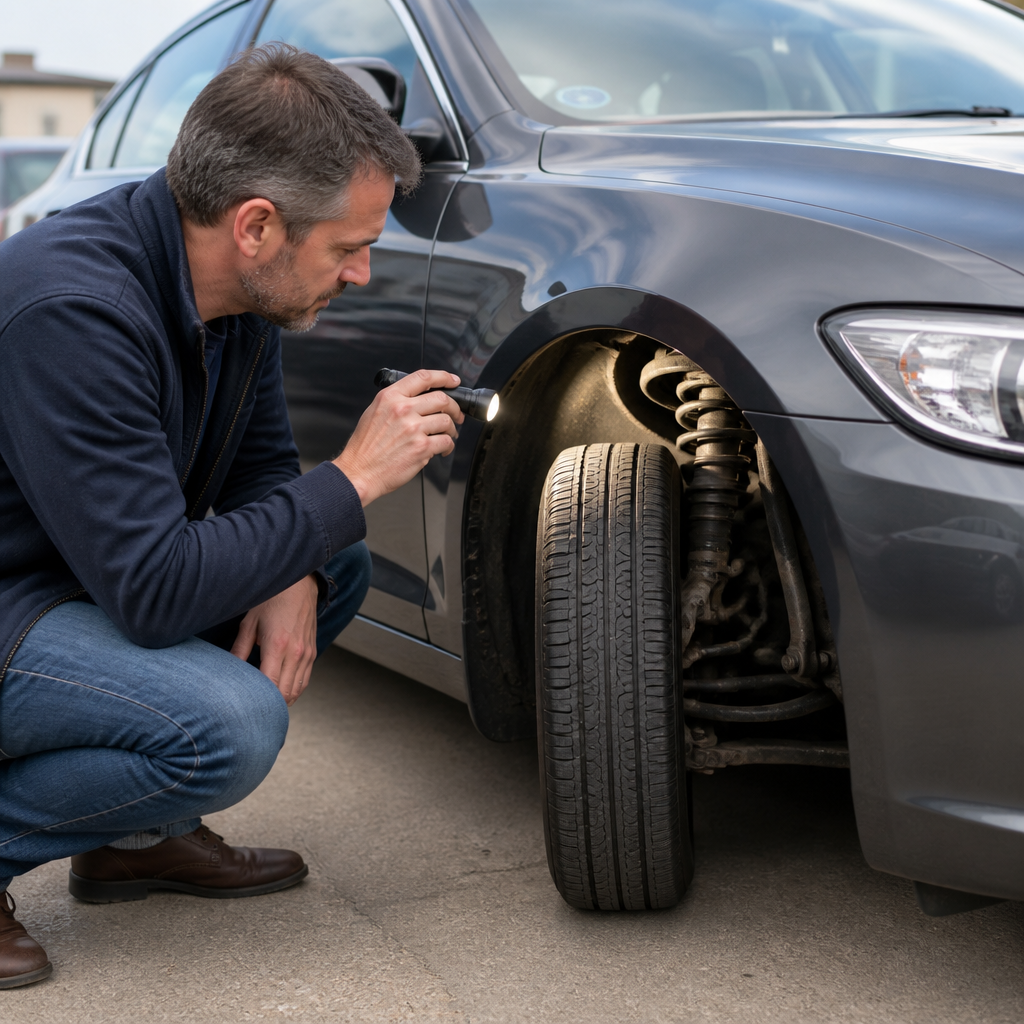
Inspect the visible shock absorbers or struts through the wheel area. A light film of dirt is not necessarily a fault, but wet oil running down the damper body suggests leakage. A leaking damper may no longer control spring movement properly. Some units are difficult to see without removing a wheel, so do not treat a clean-looking area as proof that the damper is perfect.
Examine the coil springs for a broken section, heavy corrosion, or an unusual gap. A broken spring may hide at the top or bottom of the assembly. Look for paint chips, fresh exposed metal, or a spring that does not sit correctly in its seat. Do not touch a spring that appears displaced or under tension.
Use your torch to look for bent control arms, cracked mounting points, torn rubber bushings, missing fasteners, or signs of fresh underbody work. A shiny replacement part is not automatically bad, but it raises questions about why it was replaced and whether the repair included alignment or related components.
Check the underside for impact marks. A deep dent in a suspension arm, scraped subframe, distorted wheel, or damaged protective cover can indicate a pothole strike or collision. Surface rust can be normal in some environments. Severe flaking, perforation, or structural corrosion requires expert assessment because it may affect the strength of mounting points.
Use the stationary bounce test carefully
With the car parked and the doors closed, press down firmly on one corner of the body near a wheel. Release it and watch the movement. A healthy system should settle after a controlled movement. Repeated bouncing, a floating sensation, or a loud clunk may indicate a damping, spring, mount, or joint problem.
Repeat the test on the other corners and compare the response. This test is only a basic screening method. Modern vehicles can be difficult to move by hand, and some suspension designs do not respond clearly. A car may pass the bounce test and still have a worn bushing, loose ball joint, leaking damper, or damaged wheel bearing.
Do not jump on the body or apply force that could damage the car. Stop if the panel flexes, the vehicle shifts, or the corner feels unsafe. Never perform this test while the engine is running or while anyone is positioned near a moving wheel.
Listen for suspension noises
Many suspension faults announce themselves through sound. Ask the seller to drive slowly over a rough section, speed bump, or driveway entrance while you listen from inside. If possible, conduct the test with the windows partly open and the radio off.
- Clunking or knocking: This may come from worn stabiliser links, bushings, ball joints, strut mounts, or loose hardware.
- Squeaking: Dry or worn rubber components can squeak, although brakes and interior trim can create similar sounds.
- Rattling: Loose heat shields, exhaust parts, brake hardware, and suspension components can all rattle.
- Grinding: This may indicate a serious bearing, brake, or damaged component issue and needs prompt inspection.
- Clicking while turning: The cause may involve a driveshaft joint rather than the suspension itself.
Noise diagnosis depends on when the sound occurs. A noise over bumps differs from one during braking, acceleration, or steering. Ask whether it occurs on one side, at low speed, or only when the vehicle is cold. Do not accept a seller’s explanation that a sound is normal without confirming it with a mechanic.
Complete a controlled road test
A road test is essential because some defects only appear when the suspension carries the vehicle’s weight dynamically. Select a safe route with smooth pavement, rough sections, turns, and a controlled braking area. Follow local traffic rules and avoid testing at excessive speed.
Before moving, check that the steering wheel sits reasonably straight and that no warning lights remain illuminated. A steering wheel that is noticeably off-centre while the vehicle travels straight can suggest alignment issues, although road camber can also influence the position. The car should not require constant correction on a reasonably even road.
What to feel during the drive
- Over bumps: The car should absorb the bump without repeated bouncing or harsh crashing.
- During braking: It should remain stable without pulling strongly to one side or diving excessively at the front.
- During acceleration: It should not produce a loud clunk or show unusual body movement.
- In corners: Moderate body roll is normal, but excessive leaning, wandering, or delayed response is concerning.
- At low speed: Listen for knocks when turning, crossing a ramp, or entering a driveway.
- At higher legal speeds: Watch for vibration, float, steering looseness, or instability. Do not exceed safe or legal limits.
Try gentle left and right steering inputs on a safe, open road. The car should respond predictably and return to a stable path. If it wanders, feels loose, or seems to steer itself over road imperfections, stop testing and arrange a professional inspection.
Test the brakes separately from the suspension. A vehicle pulling during braking may have a brake imbalance, tyre issue, alignment fault, or suspension problem. A single road symptom can have several causes, so avoid making a final diagnosis from one observation.
Inspect car suspension with the wheels raised
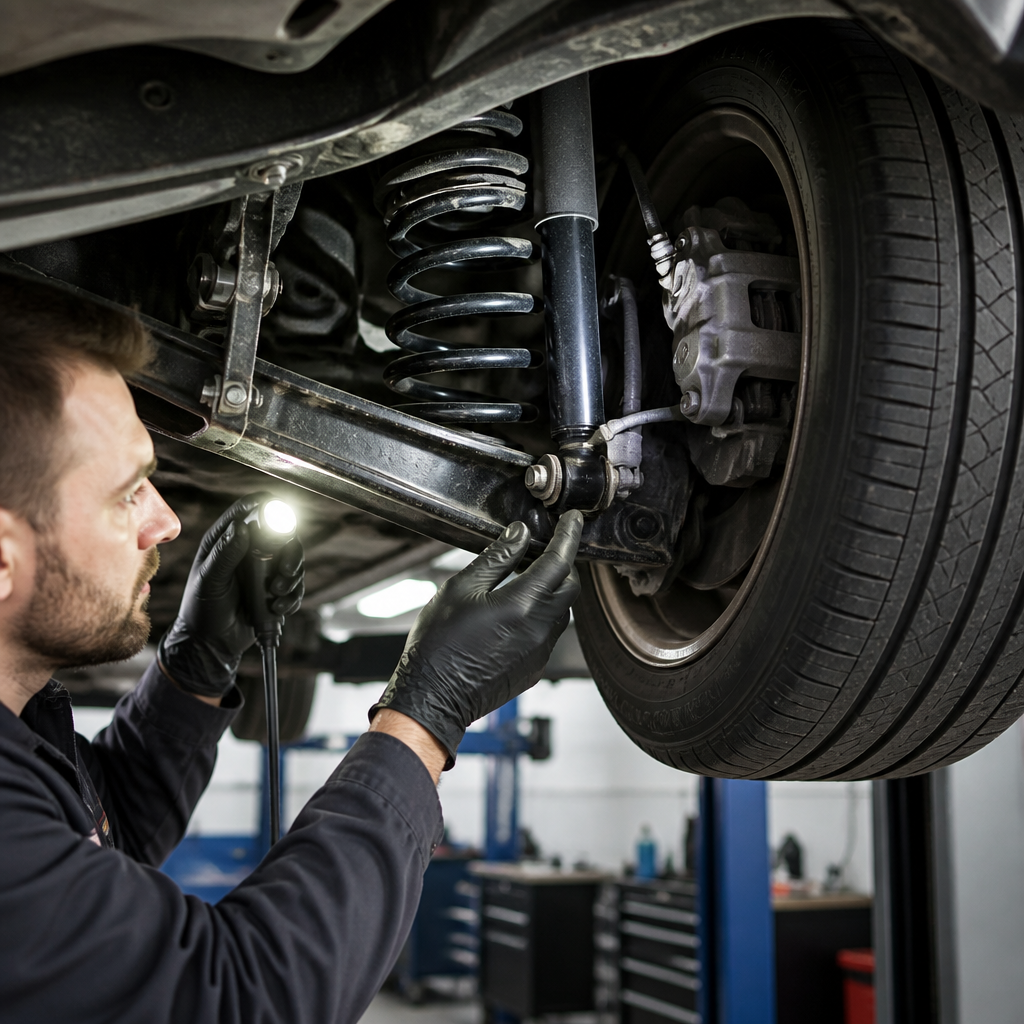
The most reliable hands-on inspection often requires lifting the car. For safety, this should be done by a qualified technician or by someone trained to use the correct lifting points and support equipment. A standard vehicle jack is intended for lifting, not for supporting a person underneath a car. How to Detect a Fake Chassis Number Before Buying a Car
With the wheel safely raised, a technician can check for play in the wheel and suspension joints. Holding the tyre at different positions and applying controlled force may reveal looseness in a bearing, ball joint, tie-rod end, or another steering component. The exact method depends on the vehicle, because some designs naturally show movement in one direction.
The technician can also inspect bushings for separation, cracking, or movement. Rubber that looks old is not automatically unsafe, but a torn bushing or displaced sleeve can affect wheel control. They may examine the strut mount, spring seat, brake hose, wheel bearing, and inner tyre surface more closely than a buyer can from ground level.
Ask for a written report that identifies urgent faults, recommended repairs, and items that simply need monitoring. A useful report should distinguish safety-related defects from normal age-related wear. If the inspector cannot establish the cause without further disassembly, treat the uncertainty as a reason to delay the purchase.
Understand the difference between wear and damage
Suspension components wear gradually. Bushings harden, dampers lose effectiveness, springs weaken, and joints develop play. A high-mileage vehicle may reasonably need maintenance. That does not mean every older car is a poor purchase. The key questions are how severe the wear is, whether the vehicle remains safe, and whether the price reflects the required work.
Damage is different from ordinary wear. A bent arm, cracked spring, distorted subframe, leaking damper, or broken mounting point may indicate a strong impact or failed repair. Damage can affect wheel alignment and may involve hidden structural issues. Ask for evidence of the repair and have the car inspected independently.
Modified suspension needs extra care. Lowering springs, lift kits, spacers, larger wheels, and air-suspension conversions can change geometry and ride quality. Modifications are not automatically unsafe, but they must be correctly installed and suitable for the vehicle. Check that the tyres do not rub, the ride height is even, and the car does not show abnormal wear.
Common inspection mistakes to avoid
- Only looking at the engine: A strong engine does not compensate for unsafe steering or suspension.
- Checking only the visible side of each tyre: Inner-edge wear can remain hidden until a technician lifts the car.
- Assuming new tyres solve the problem: New rubber may conceal the wear pattern caused by a faulty component.
- Relying only on the bounce test: Several faults cannot be identified through body movement alone.
- Ignoring a small noise: A minor knock may be inexpensive, but it can also be an early warning of looseness.
- Inspecting on an uneven surface: Sloping ground makes ride-height comparisons unreliable.
- Testing only on smooth roads: Many suspension problems appear on broken pavement or speed bumps.
- Accepting a recent alignment as proof of health: Alignment may adjust angles without repairing worn or bent parts.
- Using a seller’s mechanic without alternatives: An independent inspection gives you a more objective assessment.
- Standing under an unsupported car: This creates an avoidable and serious safety risk.
When to arrange a professional inspection
Arrange a professional inspection before purchase if you find a fluid leak, uneven ride height, severe tyre wear, a broken spring, repeated bouncing, steering looseness, a strong pull, or any grinding noise. Also seek help if the car has collision history, heavy underbody corrosion, unusual modifications, or incomplete service records.
A professional should inspect the vehicle on a lift and road-test it. Tell the technician what you noticed, but do not instruct them to look only at that one symptom. A clunk may involve several parts, and a tyre-wear problem may originate in an alignment angle or a worn joint.
For a private sale, make the purchase conditional on an independent inspection if the seller agrees. A seller who refuses any reasonable inspection is not automatically dishonest, but the refusal increases your risk. You can choose not to proceed without a clear mechanical assessment.
How to decide whether to buy
Separate findings into three groups: immediate safety concerns, repairs likely to be needed soon, and normal maintenance. A minor bushing crack may deserve monitoring, while a loose ball joint or broken spring may require repair before regular driving. Ask the mechanic to explain the urgency in plain language.
Then compare the likely repair burden with the car’s condition, history, availability of parts, and asking price. Do not subtract a guessed repair amount from the price and assume the result is accurate. Several worn components often interact, and replacing one part may expose another issue.
If you still want the vehicle, negotiate using documented findings rather than vague suspicion. For example, explain that the inspection identified a leaking damper and uneven front tyre wear. Ask whether the seller will repair the issue, reduce the price, or allow you to arrange the repair. Get any agreement in writing. Car Won’t Start but Lights Come On: Causes and Solutions
Walk away when the vehicle has multiple serious faults, unexplained accident damage, unsafe steering behaviour, structural corrosion, or a seller who will not allow independent checks. A different car may cost less than trying to rescue one with a long list of unknown problems.
Useful records and follow-up checks
Keep photographs of tyre wear, ride-height differences, visible leaks, and damaged components. Record the vehicle identification details and the inspection date. If the seller provides repair invoices, compare the listed work with what you can see on the car.
Check the tyre pressures before interpreting handling or tread wear. Incorrect pressure can make a car feel unstable and can quickly damage the tyres. The correct pressure is usually listed on the vehicle information label or in the owner’s documentation, not on the maximum-pressure marking on the tyre sidewall.
After purchase, schedule a baseline inspection if you could not obtain one beforehand. Have the tyre pressures, wheel alignment, braking system, suspension fasteners, and fluid leaks checked. This gives you a starting record and helps prevent a small problem from becoming a larger one.
Frequently asked questions
Can I inspect suspension without lifting the car?
Yes. You can compare ride height, inspect tyres, look for visible leaks, listen for noises, perform a cautious bounce test, and complete a road test. However, many important components are hidden behind wheels or under the vehicle. A ground-level inspection is useful for screening, not for confirming that the suspension is fully sound.
How do I know if a shock absorber is bad?
Possible signs include oil leakage, repeated bouncing, excessive nose dive under braking, unusual body roll, reduced control over bumps, and uneven or cupped tyre wear. These signs can have other causes, so a technician should confirm the diagnosis. Do not replace dampers based on one symptom alone.
Is a clunking sound always a suspension fault?
No. Clunks can come from suspension joints, loose exhaust parts, brake hardware, engine mounts, steering components, or interior trim. The timing of the sound provides a clue. A noise that occurs only over bumps differs from one that occurs when turning or braking. Professional diagnosis is the safest approach.
Should I buy a car with worn suspension bushings?
It depends on the amount of wear, the vehicle’s overall condition, and the repair cost. Minor ageing may be acceptable if the car remains safe and the price reflects future maintenance. Torn, displaced, or loose bushings need more urgent attention. Ask for an inspection report before deciding.
Can a wheel alignment fix suspension problems?
An alignment can correct adjustable wheel angles, but it cannot repair a broken spring, worn ball joint, bent control arm, leaking damper, or damaged subframe. If alignment cannot be maintained because a component is loose or bent, the underlying issue must be repaired first.
What is the single most important suspension check?
There is no single check that covers every fault. The strongest approach combines tyre inspection, ride-height comparison, visual examination, a controlled road test, and an independent inspection on a lift. Together, these checks give you a much clearer picture than any one test.
Final checklist before you pay
- Inspect the car on level ground in good light.
- Compare ride height from side to side.
- Check every tyre, including the inner edges where possible.
- Look for leaking dampers, broken springs, bent parts, and corrosion.
- Listen for knocks, rattles, squeaks, and grinding.
- Perform a cautious road test on different safe surfaces.
- Check steering stability, braking behaviour, and body movement.
- Ask about repairs, accidents, pothole impacts, modifications, and alignments.
- Arrange an independent inspection if anything seems unusual.
- Base your decision on documented condition, repair urgency, and total ownership risk.
Knowing how to inspect car suspension gives you a practical advantage when viewing a used vehicle. You do not need to diagnose every component yourself. Your goal is to identify warning signs, ask informed questions, and obtain professional confirmation before buying. A few careful checks can protect your safety and help prevent an unexpected repair bill after the sale.
2 thoughts on “How to Inspect Car Suspension Before Buying”