
When you notice a car lose power while driving, treat the problem as a safety issue rather than a minor inconvenience. Loss of power can come from something simple, such as poor fuel delivery, or from a serious fault involving the engine, transmission, turbocharger, or electrical system. The right response depends on what the vehicle does next: whether it still runs, whether it shakes, whether warning lights appear, and whether the engine stops completely.
This guide explains the common reasons a vehicle suddenly feels weak, struggles uphill, hesitates during acceleration, or enters limp mode. It also shows what you can check safely, when a diagnostic scan may help, and when you should stop driving and arrange professional assistance.
What does it mean when a car loses power?
Power loss means the engine is not producing or delivering the expected force to the wheels. You may press the accelerator and receive little response. The engine might rev slowly, refuse to go beyond a certain speed, or feel as though it is running out of breath. Engine Oil Change Interval: A Nigerian Car Owner’s Guide
In some cases, the engine continues running but the vehicle cannot accelerate normally. In other cases, the engine cuts out and the car rolls to a stop. These situations can have different causes, so the exact symptoms matter.
A car can lose power during acceleration, while climbing a hill, at high speed, after warming up, or immediately after starting. It can also happen only when the air conditioner is operating or when the engine carries a heavy load. Recording these details gives a technician valuable clues.
Power loss versus transmission slipping
Drivers often describe any weak acceleration as engine power loss. However, a slipping transmission can create a similar feeling. If the engine speed rises sharply but the vehicle speed does not increase, the transmission may not be transferring power properly.
By contrast, an engine problem usually causes low engine speed, hesitation, shaking, misfiring, or poor response when you press the accelerator. A technician must separate these symptoms before replacing parts.
Temporary reduced power and limp mode
Modern vehicles can deliberately restrict performance when the computer detects a fault. This protective setting is often called limp mode or reduced-power mode. The vehicle may still move, but acceleration and maximum speed can be limited.
Limp mode can follow a problem with the throttle system, turbocharger, transmission, exhaust emissions system, or an important sensor. Turning the engine off may temporarily restore normal response, but that does not repair the underlying fault. If the problem returns, have the vehicle scanned and inspected.
Common causes of a car lose power while driving
Several systems work together to make an engine produce power. It needs the correct amount of air, fuel, compression, ignition, and exhaust flow. It also needs accurate information from sensors and reliable electrical power.
A fault in any one of these areas can affect acceleration. The sections below cover the most common possibilities, but a symptom alone cannot confirm a diagnosis.
1. Restricted fuel supply
The engine needs a steady supply of fuel at the correct pressure. A blocked fuel filter, weak fuel pump, damaged fuel line, or failing fuel pressure regulator can reduce delivery. The car may start normally, then lose power when you accelerate or climb a hill.
Under light driving, the engine may need only a small amount of fuel. During hard acceleration, demand rises. A weak pump may cope at low speed but fail to maintain pressure under load.
Other clues include long cranking before the engine starts, hesitation, stalling, or a whining sound from the fuel tank. Do not open fuel lines or test fuel pressure without the right equipment. Petrol and diesel systems can operate under dangerous pressure, and fuel vapour can ignite easily.
2. Clogged air filter or blocked air intake
Engines require clean air to burn fuel efficiently. A severely dirty air filter can restrict airflow, especially when the engine is working hard. Leaves, dust, plastic, or a collapsed intake hose can also obstruct the path between the air filter housing and the engine.
A restricted intake may cause sluggish acceleration, poor fuel economy, and a darker exhaust on some diesel vehicles. Inspect the air filter housing and intake duct if they are easy to access. Replace the filter with the correct part when it is visibly dirty or due for service.
Do not remove the air filter and continue driving in dusty conditions. Unfiltered dust can damage internal engine components and contaminate sensors.
3. Faulty mass airflow or manifold pressure sensor
The engine computer uses airflow and pressure sensors to calculate how much fuel the engine needs. A contaminated or failing mass airflow sensor can send inaccurate information. A manifold absolute pressure sensor can create similar problems if it becomes dirty, damaged, or disconnected.
Possible symptoms include hesitation, uneven idling, poor fuel economy, black smoke, and a check engine light. A sensor fault may also cause reduced power without obvious mechanical damage.
Sensor cleaning is not always the answer. Some sensors can be damaged by unsuitable solvents or rough handling. A technician can compare live data with expected readings and test the wiring before recommending replacement.
4. Throttle body or accelerator pedal fault
Many modern cars use electronic throttle control instead of a direct cable. The accelerator pedal sends a signal to the vehicle computer, which controls a motor at the throttle body. A dirty throttle plate, failed motor, damaged wiring, or inconsistent pedal sensor can reduce or remove throttle response.
The vehicle may display a warning light, enter reduced-power mode, or respond slowly when you press the pedal. Sometimes the engine idles normally but refuses to accelerate.
Because the throttle is a safety-critical system, avoid forcing the mechanism or applying random sprays. A proper inspection may include checking the pedal position sensors, throttle position data, electrical connectors, and manufacturer-specific fault codes. Car AC Not Cooling: 10 Possible Causes and What to Check
5. Ignition misfire
Petrol engines need a strong, correctly timed spark. Worn spark plugs, failing ignition coils, damaged plug wires, or poor electrical connections can cause a misfire. The engine may shake, stumble, or lose power when accelerating.
A severe misfire can make the check engine light flash. A flashing light generally signals a fault that may damage the catalytic converter if you continue driving. Reduce engine load and stop in a safe place unless moving is necessary to avoid immediate danger.
Diesel engines do not use spark plugs for normal combustion, but they can still misfire or run unevenly because of injector, compression, fuel, or timing problems.
6. Turbocharger or boost leak
Turbocharged engines use compressed air to produce more power. A split boost hose, loose clamp, leaking intercooler, faulty wastegate, or turbocharger problem can cause sudden weakness. The engine may feel normal at low speed but lose its expected force when the turbo should produce boost.
You might hear a hissing sound, notice smoke, or see an engine warning light. Some vehicles enter reduced-power mode to protect the engine when boost pressure does not match the computer’s expectations.
Do not assume that a noisy turbocharger always needs replacement. A loose hose or control problem can create similar symptoms. A technician should inspect the complete intake and boost system, then compare requested and actual pressure.
7. Blocked exhaust or catalytic converter
The engine must expel exhaust gases. A collapsed catalytic converter, blocked diesel particulate filter, damaged muffler, or internal exhaust restriction can prevent the engine from breathing out.
Common symptoms include weak acceleration, an engine that struggles to rev, excessive heat, poor fuel economy, and stalling after the vehicle warms up. The restriction may become more noticeable under load.
Diesel vehicles may experience problems when a particulate filter cannot complete its cleaning cycle. The exact warning message and repair procedure vary by vehicle. Do not repeatedly force regeneration without understanding why the filter is restricted.
8. Low fuel quality or contaminated fuel
Incorrect, stale, or contaminated fuel can cause hesitation and loss of power. Water in diesel fuel, dirt in a fuel tank, or petrol in a diesel vehicle can create serious running problems. Fuel contamination may occur after refuelling or after a vehicle has been stored for a long period.
If the symptoms started immediately after visiting a filling station, keep the receipt if available and avoid driving farther than necessary. Do not keep restarting the engine if you suspect the wrong fuel. Continuing to run the vehicle can spread contaminated fuel through the pump, lines, injectors, and other components.
9. Failing fuel injectors
Injectors must deliver the correct quantity of fuel at the correct time. A blocked, leaking, or electrically faulty injector can cause a rough idle, misfire, smoke, poor acceleration, or difficult starting.
One bad injector can affect the entire driving experience. However, replacing all injectors without testing them can be expensive and may not solve the real problem. Proper diagnosis may include balance testing, electrical checks, fuel-pressure testing, and inspection for air or fuel leaks.
10. Weak battery, alternator, or electrical connection
Vehicles rely on stable electrical voltage. A failing alternator may not charge the battery adequately while driving. Loose battery terminals, corroded ground connections, damaged wiring, or a weak battery can also cause electronic systems to behave unpredictably.
Warning signs include a battery or charging light, dim headlights, flickering dashboard displays, slow electrical accessories, repeated stalling, or several unrelated warning lights. If the charging light comes on, switch off unnecessary electrical loads and find a safe place to stop. The engine may continue only until the battery becomes too weak to operate essential systems.
Do not disconnect the battery while the engine is running. That action can create voltage spikes and damage electronic components.
11. Overheating and engine protection
An overheating engine may reduce performance to protect itself. Low coolant, a failed cooling fan, blocked radiator, faulty thermostat, damaged water pump, or coolant leak can raise engine temperature.
Watch for a temperature warning, steam, a strong coolant smell, or a temperature gauge moving into the danger zone. Stop as soon as it is safe. Continuing to drive an overheating vehicle can cause severe engine damage. How to Check Engine Oil Level Correctly
Never remove a hot radiator cap. The cooling system may be pressurised, and escaping coolant can cause serious burns. Wait for the engine to cool before checking the level, and do not treat a temporary coolant refill as a permanent repair.
12. Low engine oil or internal engine wear
Engine oil reduces friction and carries heat away from internal parts. Very low oil, incorrect oil, poor maintenance, or internal wear can reduce performance and create mechanical noise.
If the oil-pressure warning light comes on, stop the engine as soon as safely possible. That warning is more urgent than a routine service reminder. Check the oil level only on level ground and follow the vehicle handbook. Adding oil may help if the level is low, but it does not explain why oil was lost.
Knocking, tapping, heavy smoke, excessive oil consumption, or metal particles in the oil require professional inspection. Avoid driving until the cause is known.
13. Transmission or clutch problems
A manual car with a worn clutch may show rising engine speed without matching road speed. This is especially noticeable in a higher gear or while climbing. An automatic vehicle may slip, hesitate during shifts, remain in one gear, or enter transmission limp mode.
Low transmission fluid, incorrect fluid, overheating, worn clutch packs, damaged solenoids, or internal transmission faults can affect power delivery. Some vehicles do not have a simple dipstick, so checking fluid may require a specific temperature and procedure.
Do not continue aggressive driving when the transmission is slipping. Heat can quickly worsen the damage. A scan tool and road test can help distinguish a transmission fault from an engine problem.
Car lose power while driving: warning signs that change the diagnosis
The moment and manner of the power loss often provide more information than the complaint itself. Before visiting a workshop, note what happened immediately before the problem.
- Power loss only during acceleration: consider fuel delivery, ignition, boost leaks, throttle control, or transmission slip.
- Power loss while climbing: consider restricted fuel flow, weak ignition, low boost, overheating, or an exhaust restriction.
- Power loss after the engine warms up: consider a failing fuel pump, crankshaft sensor, ignition component, cooling fault, or blocked exhaust.
- Power loss with shaking: a misfire, injector problem, or severe air-fuel issue becomes more likely.
- Power loss with high engine revs: suspect clutch or automatic transmission slip.
- Power loss with a flashing check engine light: reduce load and stop when safe because continued driving may cause additional damage.
- Power loss with smoke: the smoke colour, smell, and engine type can help identify fuel, oil, coolant, or air-system problems.
- Power loss with a temperature warning: treat overheating as urgent and stop driving.
What to do immediately when your car loses power
Your first priority is control and visibility. Do not focus on diagnosing the vehicle while it is moving in traffic.
- Stay calm and keep both hands on the steering wheel. Sudden power loss does not always mean immediate loss of steering or braking, but the vehicle may slow quickly.
- Switch on the hazard warning lights. Alert other road users that the vehicle has a problem.
- Move toward a safe location. Use momentum carefully and avoid abrupt lane changes. If the engine stops, steering and braking may require more effort.
- Do not repeatedly press the accelerator. That may not restore power and can worsen a fuel, ignition, or overheating problem.
- Check the dashboard. Note oil pressure, coolant temperature, battery, check engine, transmission, and other warning lights.
- Stop the engine if there is smoke, fire, severe noise, an oil-pressure warning, or overheating.
- Call roadside assistance or a qualified technician when necessary. Be clear about whether the engine still runs and which warnings appeared.
If the car restarts and seems normal, do not assume the fault has disappeared. Intermittent faults can return at a more dangerous time, such as during overtaking or in heavy traffic.
What you can safely check at the roadside
Only inspect items that you can reach safely and understand. Check whether the fuel gauge is empty, whether a dashboard warning is active, and whether there is obvious smoke, fluid leaking, a loose intake hose, or a disconnected electrical connector.
Do not crawl under a vehicle at the roadside unless it is properly supported and the location is safe. Do not touch hot exhaust parts, rotating belts, fans, or pressurised cooling components. If you smell fuel, move away from ignition sources and request assistance.
How a technician diagnoses power loss
A reliable diagnosis starts with a detailed history. Tell the technician when the fault began, whether it occurs hot or cold, what speed you were travelling, how much fuel was in the tank, and whether the vehicle recently received maintenance or refuelling.
The technician may then carry out several checks:
- Visual inspection: checking hoses, wiring, connectors, fluid leaks, belts, filters, and signs of heat damage.
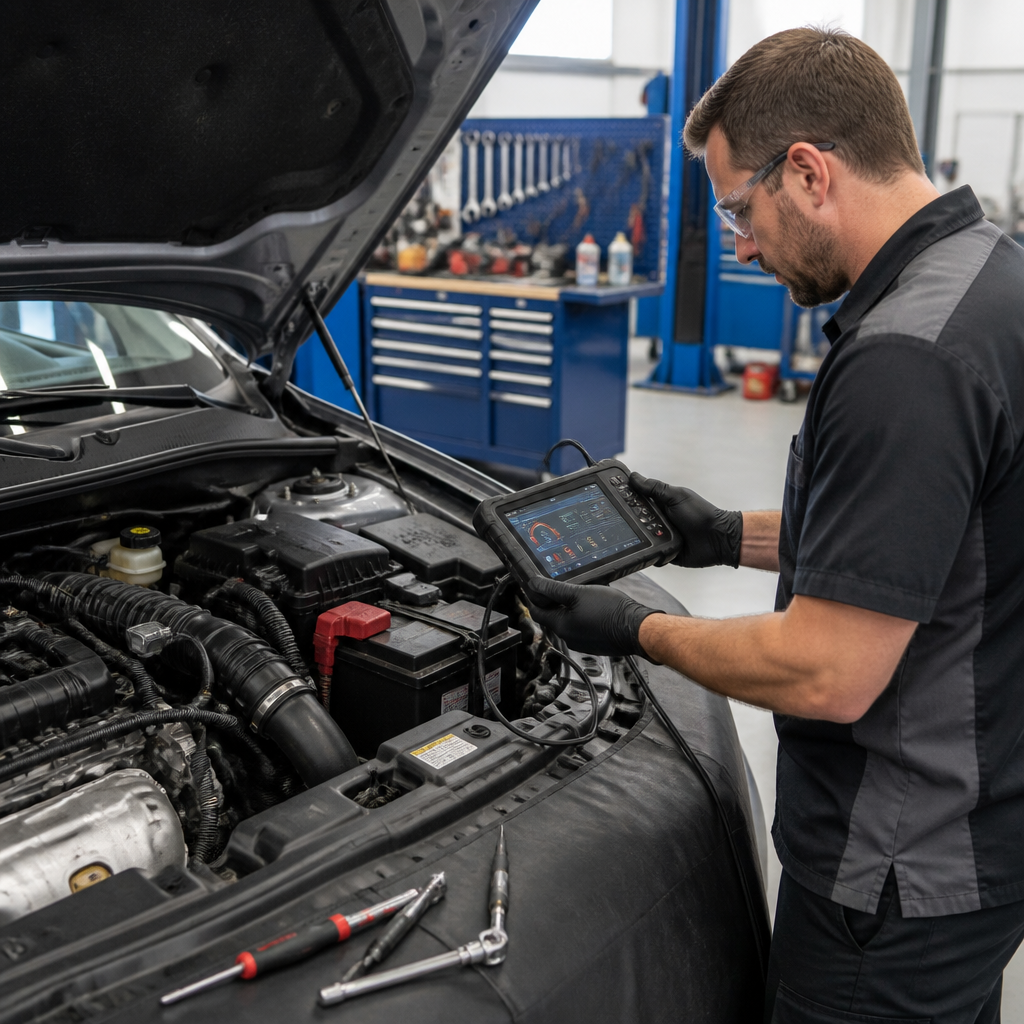
- Diagnostic scan: reading stored and pending fault codes and examining live data. A code identifies a system or condition, not always the failed part.
- Fuel testing: measuring fuel pressure and volume, checking for contamination, and inspecting injector operation.
- Air and boost testing: looking for intake restrictions and pressure leaks.
- Ignition testing: checking plugs, coils, firing patterns, and misfire data on petrol engines.
- Compression and timing checks: assessing internal engine health when mechanical damage or valve timing problems are possible.
- Charging-system testing: measuring battery condition, alternator output, and voltage drop across connections.
- Transmission evaluation: checking fluid condition, shift data, clutch operation, and evidence of slipping.
- Road testing: reproducing the problem under controlled conditions while monitoring engine and transmission data.
Replacing parts based only on a fault code can waste money. For example, an airflow-related code may result from a vacuum leak, wiring issue, or intake problem rather than a defective sensor. Testing should lead the repair decision.
Maintenance that helps prevent sudden power loss
Regular maintenance cannot prevent every failure, but it reduces avoidable problems. Follow the service schedule suitable for your vehicle and driving conditions. Severe dust, frequent short trips, heavy traffic, towing, and very hot conditions may require closer attention.
- Replace engine oil and filters at the recommended intervals.
- Inspect the air filter and intake duct for dirt, damage, and loose connections.
- Use the correct fuel and avoid questionable fuel sources.
- Keep the fuel tank cap secure and respond to fuel-system warning lights.
- Replace worn spark plugs and inspect ignition coils when required.
- Check coolant level only when the engine is cool, and investigate leaks promptly.
- Inspect battery terminals, ground connections, and charging performance.
- Watch for changes in acceleration, idle quality, fuel economy, and exhaust smoke.
- Repair warning lights instead of clearing them without finding the cause.
- Use the correct transmission fluid and service procedure.
A clean engine bay is useful, but avoid spraying water or strong chemicals directly at electronic connectors, sensors, alternators, and ignition components. Moisture-related faults can be difficult to trace. How to Check a Used Car Before Paying in Nigeria
When is it safe to drive to a workshop?
A short, gentle trip may be reasonable when the vehicle has mild hesitation, no dangerous warning lights, no overheating, no smoke, no severe noise, and enough power to keep up safely with traffic. Choose a nearby workshop and avoid highways, steep hills, towing, and hard acceleration.
Arrange recovery instead when the engine stalls repeatedly, the check engine light flashes, the oil-pressure or temperature warning appears, the vehicle cannot maintain safe speed, the brakes or steering feel abnormal, or there is a fuel smell, smoke, or fire risk.
Use your judgement and consider road conditions. A vehicle that can move may still be unsafe if it cannot accelerate into traffic or maintain control on a slope.
Common mistakes to avoid
Continuing to drive because the vehicle still moves
Reduced power can be an early warning before a complete breakdown. Continuing to drive may turn a manageable repair into engine, catalytic converter, transmission, or turbocharger damage.
Clearing the warning light without recording codes
Disconnecting the battery or clearing codes can remove useful diagnostic information. It may also reset readiness monitors and hide an intermittent fault until it returns.
Replacing the most obvious part first
A dirty sensor is not always a failed sensor. A new fuel pump will not solve a blocked filter, damaged wiring, or contaminated fuel. Testing the system is usually more efficient than guessing.
Using unsuitable additives or parts
Fuel and oil additives cannot repair a damaged pump, blocked exhaust, failed sensor, or mechanical fault. Incorrect replacement parts may create new problems or cause warning lights to remain active.
Frequently asked questions
Can low fuel cause a car to lose power while driving?
Yes. A nearly empty tank can expose fuel-delivery weaknesses, especially on hills or during hard cornering. A failing pump may also overheat more easily when the fuel level is very low. However, repeated power loss should not be blamed on the fuel level without further checks.
Can a bad battery cause loss of engine power?
A weak battery alone usually affects starting more than engine power once the engine is running. However, a failed alternator, poor electrical connection, or unstable voltage can affect engine control systems and cause stalling or reduced performance.
Why does my car lose power only uphill?
Uphill driving places a heavier load on the engine. A weak fuel pump, restricted filter, ignition fault, turbocharger problem, blocked exhaust, or slipping transmission may appear only under that load. The problem may be less noticeable on level roads.
Can an air conditioner make a car feel weak?
The air conditioner adds load to the engine. A small change in performance can be normal, especially in a smaller engine. A large drop in power, stalling, belt noise, or poor cooling may indicate a compressor, belt, idle-control, or engine-management problem.
Will changing the air filter fix the problem?
It can help when the filter is severely blocked, but it will not fix every loss-of-power complaint. Fuel pressure, ignition, sensors, exhaust flow, transmission operation, and electrical condition may also need testing.
Why does the car regain power after restarting?
Restarting can temporarily clear reduced-power mode or reset an electronic control condition. It does not prove the fault is gone. Have the vehicle scanned, especially if the warning light remains on or the symptom returns.
Is it safe to drive with the check engine light on?
A steady light may allow a cautious trip to a workshop if the vehicle runs normally and no other warning signs appear. A flashing light, severe shaking, smoke, overheating, or major power loss requires a safer response. Stop driving when continued movement could damage the vehicle or create danger.
Final thoughts
When a car lose power while driving, the cause may involve fuel, air, ignition, exhaust, cooling, electrical systems, engine controls, or the transmission. The safest approach is to note the symptoms, reduce risk, and avoid guessing with expensive parts.
Move out of traffic, check the warning signs, and stop the engine when there is overheating, low oil pressure, smoke, fire risk, severe noise, or a flashing engine light. If the fault is mild and the vehicle remains safe, arrange a prompt inspection rather than postponing it. Early diagnosis can protect the engine, reduce repair costs, and help keep you and other road users safe.
3 thoughts on “What Causes a Car Lose Power While Driving?”