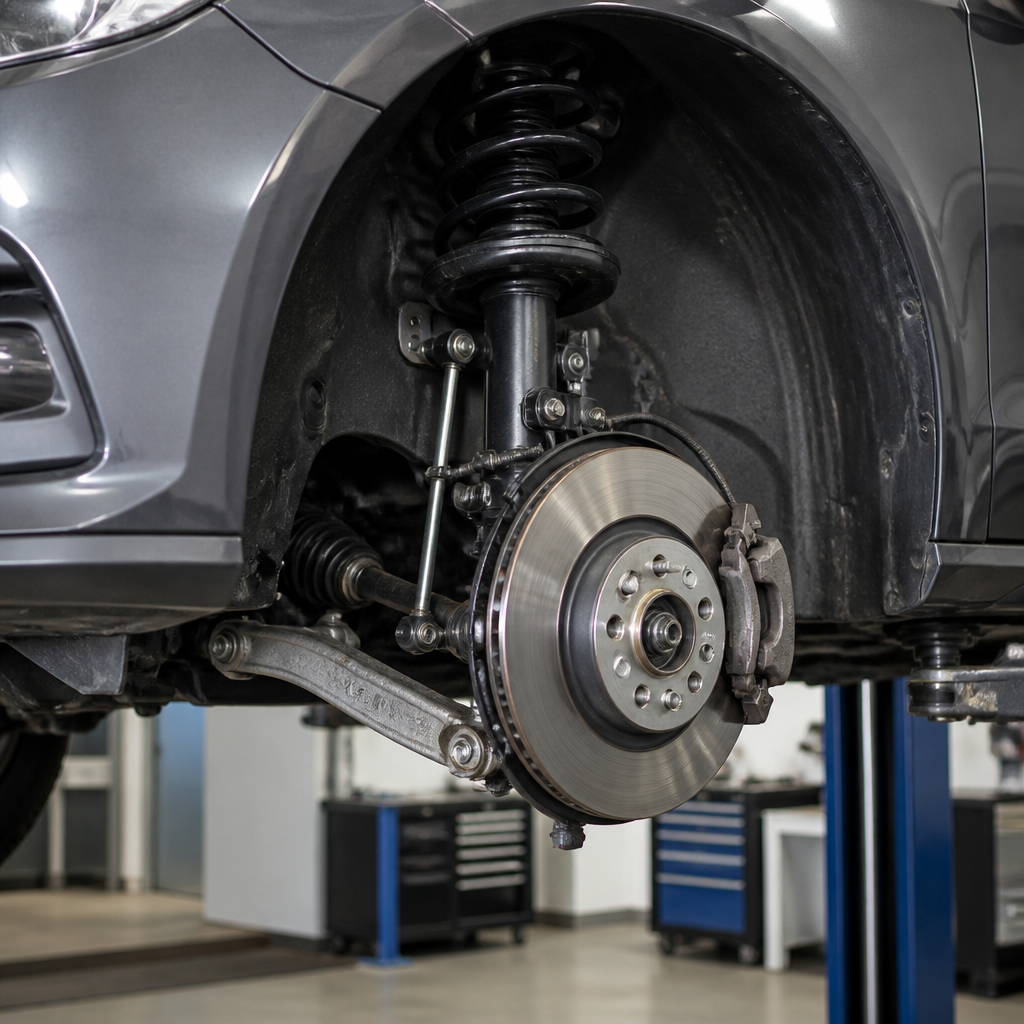
Car suspension noise can make an otherwise smooth drive feel worrying, especially when the sound appears over bumps, during turns, or while braking. A clunk, squeak, knock, or grinding sound may come from a worn suspension component, loose hardware, a damaged rubber mount, or a problem elsewhere near the wheel. The good news is that careful observation can often narrow down the cause before you visit a workshop.
Your suspension system connects the vehicle body to the wheels. It helps the tyres stay in contact with the road, controls body movement, and supports safe braking and steering. Because many parts move together, one sound can have several possible causes. This guide explains the most common reasons for car suspension noise, what each sound may indicate, which checks you can perform safely, and when professional inspection is necessary.
Why car suspension noise should not be ignored
Suspension noise is not always an emergency. For example, a light squeak from a dry rubber bushing may not immediately affect how the vehicle drives. However, noise can also be an early warning of a loose or worn component. That component may later affect steering control, tyre wear, ride height, or braking stability. How to Check an Accident-Damaged Car Before You Buy
A suspension fault may become more serious when the vehicle carries passengers, drives over rough roads, or travels at higher speed. A worn ball joint, damaged control arm, or loose wheel-related part can create unwanted movement. In extreme cases, a failed component may affect the wheel’s position and the driver’s ability to control the vehicle.
Do not rely on noise alone to judge the seriousness of a fault. Pay attention to other symptoms, including:
- Uneven or rapid tyre wear.
- Vehicle pulling to one side.
- Excessive bouncing after a bump.
- Steering wheel vibration.
- Difficulty keeping the vehicle in a straight line.
- Uneven ride height from one side to the other.
- Fluid leaking from a shock absorber or strut.
- Knocking that becomes louder or more frequent.
If a noise appears with poor steering, severe vibration, a visibly loose wheel, or a sudden change in ride height, stop driving as soon as it is safe. Arrange a professional inspection or recovery service instead.
How to describe the sound accurately
A useful description can save diagnostic time. Instead of telling a technician that the vehicle is making a strange sound, note when the noise happens and where it seems to come from. Try to identify whether it occurs at the front or rear, on the left or right, or throughout the vehicle.
Note the driving condition
Ask yourself these questions:
- Does the noise happen over speed bumps, potholes, or uneven roads?
- Does it occur when turning the steering wheel?
- Can you hear it during braking or acceleration?
- Does it appear when the vehicle is cold, hot, wet, or dry?
- Does the sound occur at low speed, high speed, or both?
- Does it happen when the vehicle is parked and the steering is moved?
- Does carrying passengers or cargo make it worse?
Also note whether the sound is a single knock, a repeated rattle, a high-pitched squeak, a dull clunk, or a harsh grinding noise. A phone recording may help, but never record while driving. Ask another person to record from a safe location, or make notes immediately after parking.
Separate suspension sounds from other vehicle noises
Not every bump or squeak comes from the suspension. A loose exhaust heat shield can rattle over rough roads. A damaged tyre can create a thumping sound. A worn engine mount may produce a clunk during acceleration. Brake hardware can also click or grind near the wheel.
For this reason, diagnosis should consider the whole corner of the vehicle rather than one part. The wheel, tyre, brake, steering, suspension, and nearby body panels can all transmit sound through the chassis.
Common types of car suspension noise
Clunking or knocking
A clunk is one of the most common suspension complaints. It often appears when a wheel moves over a pothole, speed bump, or broken road surface. Possible causes include worn stabiliser bar links, loose mounting hardware, worn control arm bushings, a damaged ball joint, or a strut mount that has developed play.
A single clunk may come from a loose tool, spare wheel, jack, or boot trim. Check the luggage area before assuming the suspension has failed. If the sound comes from a front corner and repeats whenever the wheel moves vertically, the suspension should be inspected.
Do not assume that tightening one visible bolt will solve the problem. Suspension fasteners often require correct tightening procedures, vehicle support, and sometimes a specific load condition. Incorrect tightening can damage a bushing or allow movement to return.
Squeaking or creaking
Squeaking and creaking often involve rubber bushings, suspension joints, spring seats, or dry contact surfaces. Rubber can harden with age, crack, or lose its ability to isolate movement. Dirt and moisture can also affect the sound temporarily.
A squeak that changes with rain does not automatically mean the part is healthy. Water may temporarily quiet a dry contact point or make a worn component noisier. A technician should inspect the part for cracking, deformation, separation, and excessive movement.
Some vehicles produce a brief creak when the steering is turned at low speed. This may involve a strut bearing, spring seat, steering linkage, or another component. Avoid spraying general-purpose lubricant onto suspension parts unless the product and application are specifically approved. Lubricant can damage certain rubber materials and may hide a developing fault.
Rattling
A rattle usually suggests looseness. The cause may be a stabiliser bar link, a loose shock absorber mount, a worn bushing, a broken spring, or a detached underbody shield. It can also come from a brake pad fitting or exhaust component.
Rattling over small, repeated bumps points toward a part with play. A broken spring may rattle in its seat and may also lower one corner of the vehicle. Never place any part of your body under a vehicle supported only by a jack. If you need to inspect underneath, use suitable axle stands on a firm, level surface and follow the vehicle manufacturer’s instructions.
Grinding or harsh scraping
Grinding is more urgent than a mild squeak. It may indicate a brake problem, damaged wheel bearing, broken spring, tyre contact, or severe mechanical wear. A suspension spring that has broken near its end can contact another component. A loose splash shield can also scrape against a rotating wheel or brake disc.
If grinding occurs while braking, have the braking system checked promptly. If it changes with vehicle speed or becomes louder during a turn, a wheel bearing or tyre-related issue is possible. Avoid long journeys until the source is confirmed.
Humming or roaring
A humming or roaring sound usually does not come from the suspension itself. It may come from a wheel bearing, tyre wear, tyre pressure problem, or drivetrain component. Uneven tyre wear caused by alignment or worn suspension can create a repeating hum.
To distinguish tyre noise from a mechanical fault, observe whether the sound changes with road surface. Tyre noise often changes on smooth and rough asphalt. A wheel-bearing noise may change when the vehicle gently loads one side during a safe, gradual turn. Do not perform aggressive tests on public roads.
Most common causes of car suspension noise
Worn stabiliser bar links and bushes
The stabiliser bar, also called an anti-roll bar, helps limit body roll during cornering. Links connect the bar to the suspension, while bushes hold the bar in position. When these parts wear, the bar or link may move more than intended.
The typical result is a light or dull knock over small bumps. The noise may be more noticeable on one side of the vehicle. A technician can check the links and bushes for play, torn rubber, corrosion, or loose fasteners. How to Detect a Fake Chassis Number Before Buying a Car
Damaged control arm bushes
Control arms guide wheel movement and connect the wheel assembly to the vehicle body. Their rubber or hydraulic bushes absorb vibration while allowing controlled movement. With age, heat, road salt, heavy impacts, or poor road conditions, a bushing may crack or separate.
Control arm wear can cause a clunk during braking or acceleration. It may also lead to wandering, steering correction, or uneven tyre wear. Replacing a bushing may be possible on some vehicles, while others use a complete control arm assembly. The correct repair depends on the vehicle design and the condition of the arm and ball joint.
Worn ball joints
A ball joint allows controlled movement between the suspension and steering knuckle. It must remain secure while allowing the wheel to move as the suspension travels and the steering turns. A worn ball joint may produce a clunk, squeak, or popping noise.
Other signs can include vague steering, uneven tyre wear, and movement felt through the steering wheel. Ball joints are safety-critical. Do not try to confirm a suspected failure by aggressively levering the part unless you have the correct tools and knowledge. A qualified technician should inspect it using the vehicle maker’s specified method.
Strut mount or strut bearing problems
Many vehicles use a strut assembly at the front. The upper mount attaches the strut to the body, while a bearing may allow the assembly to rotate during steering. A worn mount or bearing can create a knock, creak, or popping sensation when turning the wheel.
The sound may also occur when driving over a bump because the mount supports part of the suspension load. If the spring appears to twist and release suddenly during steering, the strut bearing or spring seat deserves attention.
Worn shock absorbers
Shock absorbers control spring movement. They do not carry the entire vehicle weight, but they help prevent continued bouncing after a bump. A worn shock absorber may leak fluid, allow excessive bouncing, or reduce tyre contact with the road.
Noise can occur when the internal components wear or when the mounting bushings become loose. However, not every worn shock absorber makes noise. A vehicle can have poor damping without an obvious sound, so handling symptoms matter as much as noise.
When shock absorbers are replaced, the technician should inspect the mounts, protective boots, bump stops, and nearby suspension components. Replacing only the visibly leaking unit may not address related wear. Whether one or both units on an axle should be replaced depends on their condition, design, and the manufacturer’s guidance.
Broken or displaced coil springs
Coil springs support the vehicle and maintain ride height. A spring can crack or break after corrosion, repeated heavy loads, impact damage, or long-term fatigue. A broken spring may produce a sharp snap, rattle, or metallic knock.
Look for an uneven ride height, a spring end sitting outside its seat, or a tyre that appears unusually close to the body. Do not touch a spring that looks displaced. Stored spring energy can make inspection dangerous. Arrange professional repair and avoid driving if the spring may contact the tyre.
Loose or damaged suspension hardware
Nuts, bolts, washers, clips, and brackets hold suspension components in their intended positions. Hardware may loosen after incorrect previous work, impact damage, corrosion, or a component failure. A loose bracket can produce a sharp rattle or repeated knock.
Some fasteners are designed to be replaced rather than reused. Others require a specific tightening sequence or torque setting. A general tightening attempt may create a false sense of security. Have the affected area inspected properly, especially if the noise began after recent suspension, brake, tyre, or wheel work.
Worn wheel bearings
A wheel bearing supports the wheel hub and allows it to rotate. Wear commonly produces a humming, growling, or rumbling sound rather than a classic suspension clunk. The noise may change as the vehicle’s weight shifts during a gentle turn.
Wheel-bearing symptoms can overlap with tyre noise. A professional can check for roughness, looseness, and abnormal play. Do not confuse bearing noise with suspension noise and continue driving for weeks without inspection. A damaged bearing can affect wheel control.
Loose brake components
Brake pads, clips, caliper hardware, and backing plates sit close to suspension and wheel components. A loose pad or damaged clip may rattle over bumps. A bent backing plate can scrape against the brake disc.
If the noise started after brake work, return to the workshop that performed the repair and explain exactly when it occurs. If you notice reduced braking, a warning light, pulling, burning smell, or grinding during braking, stop using the vehicle until it has been assessed.
Tyres, wheels, and wheel-arch liners
A tyre with uneven wear can create thumping, humming, or vibration. Incorrect wheel alignment, worn suspension, underinflation, overloading, or internal tyre damage may be involved. A loose wheel or incorrect wheel fitment can cause serious vibration and must be treated as urgent.
Check the tyre pressure when the tyres are cold and compare it with the vehicle maker’s recommended value. Inspect the tread for bulges, exposed cords, cuts, and unusual wear. Also look inside the wheel arch for a loose liner or signs that the tyre has been rubbing.
Safe checks you can perform at home
Simple observations can help you describe the problem. They cannot replace a proper inspection. Work on level ground, keep children away from the vehicle, and apply the parking brake. If you raise the vehicle, use equipment rated for the vehicle’s weight and never work underneath a car supported only by a jack. How to Check Engine Oil Level Correctly
Start with a visual inspection
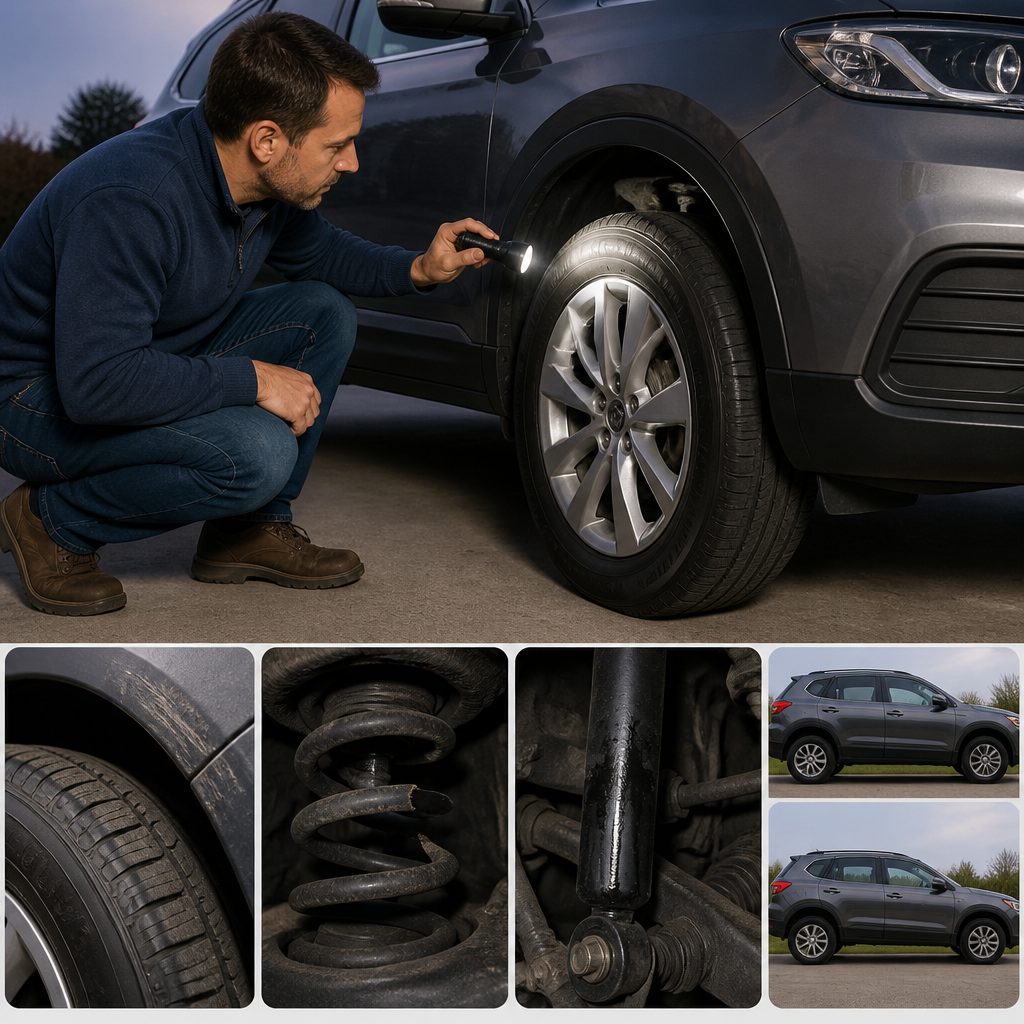
Park the vehicle and compare the left and right sides. Look for a lower corner, a broken spring, leaking fluid, damaged rubber, or a tyre sitting unusually close to the wheel arch. Check for fresh marks where a tyre may have contacted plastic, metal, or the body.
Inspect the tyres for uneven tread wear and confirm that the wheel nuts appear present. Do not assume that a wheel is secure because the nuts are visible. If a wheel was recently removed and you feel vibration or hear a new noise, stop driving and have the wheel fitment checked.
Perform a controlled bounce check
With the vehicle parked, press down firmly on one corner of the body and release it. The vehicle should settle without repeated bouncing. This check is limited and cannot prove that the shock absorber is healthy. Modern suspension designs may also make the test difficult to interpret.
Stop immediately if you hear a loud crack, see unusual movement, or feel that the body does not return evenly. Do not place your hands near springs, linkages, or moving joints during the test.
Check for changes during steering
With the vehicle stationary, ask another person to turn the steering wheel slowly while you listen from a safe position outside the vehicle. Keep hands, clothing, and tools away from the tyres and steering components.
A popping or creaking noise during steering may point toward a strut mount, spring seat, steering joint, or related part. A sound that happens only while moving may require a road test by a technician. Never crawl under the vehicle while someone turns the steering wheel.
Review recent work and driving events
Noise often follows an event. Think about whether it began after a pothole strike, kerb impact, flood, heavy load, wheel change, brake repair, alignment service, or suspension replacement. This information can help identify disturbed hardware or impact damage.
If the noise started immediately after maintenance, contact the repairer promptly. Keep the description factual and explain the conditions that reproduce the sound.
Professional diagnosis and repair process
A good diagnosis begins with a road test, when safe. The technician should note whether the noise occurs during compression, rebound, steering, braking, acceleration, or body movement. The vehicle may then be inspected on a lift or with suitable support.
During the inspection, the technician may check:
- Stabiliser bar links and bushes.
- Control arms, bushes, and ball joints.
- Strut mounts, bearings, and shock absorbers.
- Coil springs and spring seats.
- Steering joints and rack-related components.
- Wheel bearings and hub play.
- Brake hardware and backing plates.
- Tyres, wheels, and wheel-arch liners.
- Fasteners, brackets, and signs of impact damage.
Some faults require a pry bar, dial indicator, electronic listening device, or manufacturer-specific procedure. A visual inspection alone may miss a bushing that moves only under load. The technician should explain the failed part, show relevant damage where practical, and distinguish urgent repairs from items that can be monitored.
Why alignment may be needed after repairs
Several suspension components affect wheel alignment. Replacing a control arm, steering part, strut, or other positioning component may change camber, caster, or toe. Incorrect alignment can cause rapid tyre wear and unstable handling.
Ask whether alignment measurement is recommended after the repair. The answer depends on the vehicle and the part replaced. Alignment does not fix a worn joint or loose bushing, so it should not be used as a substitute for repairing the underlying fault.
Should suspension parts be replaced in pairs?
Some components are commonly replaced on both sides of the same axle to maintain similar performance. This is particularly relevant to parts that control damping or ride behaviour. However, replacing both sides is not automatically necessary for every bushing, link, or ball joint.
The correct approach depends on the part, vehicle design, mileage, condition of the opposite side, and repair guidance. Ask the technician why a pair replacement is recommended and whether the other side shows measurable wear.
Temporary measures that may help identify the source
There are limited safe temporary steps. Remove loose items from the boot, secure the spare wheel and jack, check tyre pressure, and confirm that floor mats or trim are not moving. These checks may eliminate harmless rattles.
Do not use heavy grease, penetrating oil, or adhesive as a general cure for suspension noise. Lubricant can damage rubber, contaminate brake components, or hide a problem temporarily. Do not insert washers, spacers, or improvised materials into suspension joints.
If a component is loose, cracked, bent, leaking, or visibly broken, the correct solution is inspection and repair. Driving slowly may reduce the sound, but it does not restore the part’s strength.
When car suspension noise requires urgent attention
Arrange prompt inspection if the vehicle has a new or worsening knock, particularly after hitting a pothole or kerb. Treat the following symptoms as reasons to stop driving when safe: Car AC Not Cooling: 10 Possible Causes and What to Check
- A wheel appears tilted or has moved from its normal position.
- The tyre is rubbing against the body or suspension.
- A spring is broken, displaced, or contacting the tyre.
- Steering feels loose, unpredictable, or difficult to control.
- The vehicle pulls sharply to one side.
- There is severe grinding, scraping, or repeated metal-to-metal contact.
- A wheel feels loose or there is strong vibration.
- Brake performance has changed.
- Fluid is leaking heavily from a shock absorber or another component.
- A warning light appears together with unusual handling or noise.
A mild noise still deserves attention if it continues for several journeys. Early repair may prevent additional damage to tyres, wheels, mounts, or related suspension parts.
How road conditions and driving habits affect suspension
Potholes, rough shoulders, broken surfaces, overloaded vehicles, and repeated kerb impacts place high loads on suspension components. Speed also matters. Hitting a deep pothole quickly can create a much larger force than crossing the same defect slowly and carefully.
Good driving habits can reduce wear. Slow down before speed bumps, keep both hands ready for steering corrections, avoid carrying more weight than the vehicle is designed to support, and maintain correct tyre pressure. Look ahead for potholes, but do not make sudden swerves into traffic to avoid them.
Regular checks matter too. During tyre service, ask for a visual inspection of the suspension and steering components. Follow the maintenance instructions in the vehicle owner’s manual, especially if the car regularly travels on rough roads or carries heavy loads.
How to choose a repair approach
The cheapest immediate fix is not always the best value. A low-cost part may have poor fitment or a short service life. On the other hand, replacing every nearby component without evidence of wear is unnecessary. Ask for a clear diagnosis and an itemised explanation.
Useful questions include:
- Which part is producing the noise?
- What evidence shows that it has failed?
- Is the part safety-critical?
- Does the opposite side show similar wear?
- Will the repair affect wheel alignment?
- Are there related parts that should be inspected while access is available?
- Is the replacement part suitable for the vehicle’s exact model and specification?
- Is a road test recommended after the repair?
Use a workshop that can explain the work clearly and provide a written record. When possible, retain replaced parts or ask to see them. This is especially useful when a noise has been difficult to reproduce.
Frequently asked questions about car suspension noise
Can I keep driving with a suspension noise?
It depends on the sound and the vehicle’s behaviour. A minor squeak with no handling change may allow a short trip to a workshop, but a new clunk should still be checked. Do not continue driving if the car pulls, vibrates severely, grinds, has a broken spring, or shows a loose wheel or damaged tyre.
Why does my car make a noise only over bumps?
Movement over a bump loads the suspension and can expose play in a stabiliser link, bushing, ball joint, strut mount, spring, or shock absorber mounting point. Loose body panels, exhaust shields, and boot equipment can create similar sounds. A technician should inspect the entire area rather than replace a part based only on the noise description.
Why does the noise disappear when it rains?
Moisture can temporarily change friction between rubber, metal, and other surfaces. It may quiet a squeak or make a worn part sound different. The change does not prove that the component is safe. Persistent or returning noise still needs diagnosis.
Can low tyre pressure cause suspension noise?
Low pressure changes how the tyre absorbs road impacts and can make bumps feel harsher. It may also cause unusual tread wear and steering changes. However, correcting pressure will not repair a damaged suspension part. Check pressure using the vehicle manufacturer’s recommended value, not the maximum number printed on the tyre sidewall.
Is a squeaky suspension always a serious problem?
No. Some squeaks come from harmless trim or a dry contact point. Others indicate worn bushings, spring seats, or joints. The seriousness depends on the source and whether the vehicle also has looseness, uneven tyre wear, poor handling, or a change in ride height.
Can a wheel alignment fix suspension noise?
Alignment may correct steering geometry and tyre wear, but it normally does not remove a loose or damaged suspension component. If a part has play, cracking, or deformation, it must be repaired first. Alignment may then be needed to confirm that the wheels are positioned correctly.
Is it safe to inspect suspension parts with a jack?
A jack is for raising the vehicle, not for supporting a person underneath it. Use suitable axle stands on a firm, level surface, follow safe lifting points, and keep clear of stored spring energy. If you are not experienced with vehicle lifting, leave the inspection to a professional.
Final checks before booking a repair
Before contacting a workshop, write down when the noise occurs, how long it has been present, and whether it is getting worse. Record the road condition, vehicle speed, steering position, braking action, and approximate location of the sound. Mention any recent pothole impact, heavy load, tyre replacement, brake work, or suspension repair.
Also check the simple items first. Secure loose luggage, inspect the tyres, confirm pressure, and look for obvious rubbing or broken parts. These observations will not diagnose the vehicle, but they can help the technician begin in the right place.
Car suspension noise is a symptom, not a diagnosis. The safest fix depends on identifying the actual source. Prompt attention can protect the tyres, preserve steering control, and prevent a small worn part from causing wider damage. When in doubt, choose a professional inspection rather than guessing or applying a temporary lubricant.
2 thoughts on “Car Suspension Noise: Common Causes and Fixes”