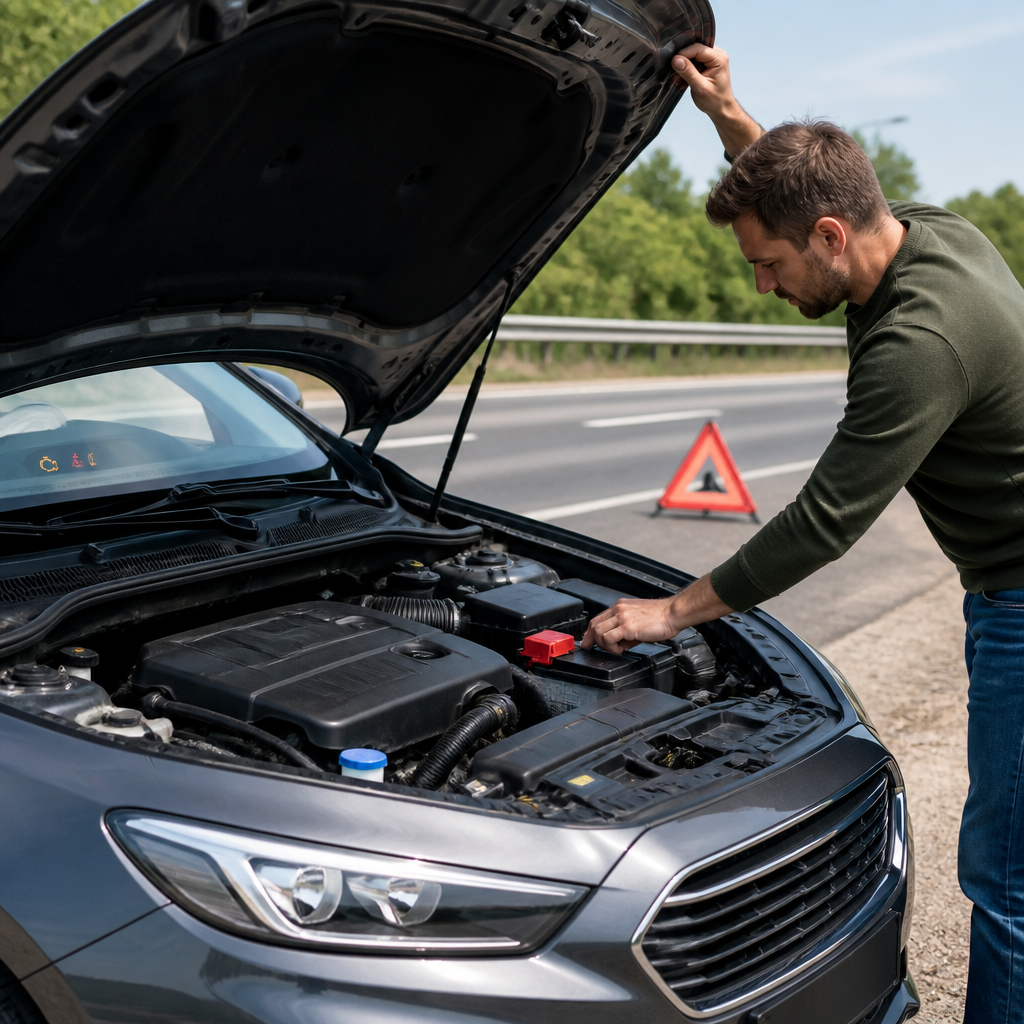
When your car won’t start but the lights come on, the battery may still be too weak to crank the engine. The problem could also involve the starter motor, ignition switch, fuel system, immobiliser, engine sensors or a poor electrical connection. This guide explains what the symptoms mean, which checks you can safely perform, and when professional help is the sensible choice.
Working lights can be misleading. Headlamps and dashboard bulbs need far less power than the starter motor. A battery can therefore operate the lights while failing to deliver enough current for the engine to turn. However, a bright dashboard does not prove that the battery is healthy. It only shows that some electrical power is available.
Before testing anything, move the vehicle to a safe position if possible. Apply the parking brake, select Park in an automatic vehicle or Neutral in a manual vehicle, and keep people away from moving parts. Do not work near fuel vapour, damaged wiring or a hot engine unless you understand the risks. New Tyres vs Used Tyres: Which Is Safer for Your Car?
What it means when the lights work but the engine does not start
A starting system has several stages. The battery supplies electrical power. The ignition switch or start button sends a signal. The starter relay and solenoid direct current to the starter motor. The starter then turns the engine. At the same time, the engine control system must allow fuel and ignition to operate.
A fault at any stage can leave the lights working while the engine remains silent or fails to run. The sound you hear is one of the most useful clues. Listen carefully when you turn the key or press the start button.
- No sound at all: The vehicle may have a weak battery connection, faulty ignition switch, failed starter relay, Park or Neutral safety switch, clutch switch, immobiliser issue or dead starter motor.
- A single click: A discharged battery, loose terminal, poor earth connection or failing starter solenoid is possible.
- Rapid clicking: The battery voltage may be dropping sharply under load. Loose or corroded terminals can cause the same symptom.
- The engine turns slowly: Suspect a weak battery, poor connection, unsuitable battery condition, thick engine oil in cold weather or a starter motor drawing excessive current.
- The engine turns at normal speed but does not run: The problem is more likely to involve fuel delivery, ignition, engine timing, air supply, immobiliser control or a sensor.
- The engine starts briefly and stops: An immobiliser, fuel supply problem, failed sensor or electronic throttle issue may be involved.
Do not keep cranking continuously. Extended attempts can overheat the starter motor, flatten the battery and flood some petrol engines. Use short attempts, then pause for a minute before trying again.
Common reasons a car won’t start while the lights still work
1. The battery is weak or discharged
The battery is the most common place to begin. A battery can provide enough power for interior lights, warning lamps and even a radio. Starting the engine requires a much higher current, especially when the engine is cold or the battery is ageing.
A battery may discharge because a door, boot or interior lamp stayed on. Other causes include a faulty alternator, frequent short trips, a parasitic electrical drain or long periods without driving. Hot weather can also accelerate battery deterioration, while cold weather makes a weak battery’s job harder.
Look at the headlights while someone attempts to start the engine. If they become very dim, the battery or its connections deserve close attention. This test is not conclusive, because some modern vehicles control lighting electronically, but it can provide a useful clue.
Battery age also matters. Many automotive batteries last several years, but lifespan varies with climate, vehicle use, charging performance and battery quality. If the battery has repeatedly needed a jump-start, replacing it without finding the underlying cause may only provide a temporary solution.
2. Loose, dirty or corroded battery terminals
A healthy battery cannot deliver power through a poor connection. Corrosion may form around the positive or negative terminal. A terminal can also loosen because of vibration. In either case, the lights may work while the starter receives insufficient current.
With the engine off, inspect the terminals without touching exposed metal with a tool that could bridge the positive terminal to the vehicle body. Look for white, blue or green deposits, movement at the clamp, cracked connectors or a damaged cable. Do not remove a terminal if the vehicle has special battery monitoring equipment and you are unsure of the correct procedure.
The negative cable deserves equal attention. It connects the battery to the body and engine through earth points. A damaged or corroded earth strap can create symptoms that look like a failed battery or starter.
3. A faulty starter motor or solenoid
The starter motor turns the engine during the first seconds of a starting attempt. Its solenoid engages the starter gear and switches high current to the motor. Wear inside either component can cause a click, a single clunk or complete silence.
Sometimes a worn starter works intermittently. The vehicle may start normally in the morning, then refuse to crank after a short stop. Heat can make an internal fault more noticeable. A starter that turns slowly despite a fully charged battery should be tested with proper equipment.
A light tap on a starter is sometimes mentioned as a temporary roadside trick. It can occasionally move worn internal brushes enough to produce one more start. However, it can also damage the unit or create a safety risk. Do not crawl under a vehicle to try this, especially if it is supported only by a jack.
4. The alternator did not recharge the battery
The alternator normally recharges the battery while the engine runs and supplies electrical power to the vehicle. If it fails, the vehicle may continue for a short time using stored battery energy. Eventually, the battery becomes too weak to start the engine.
Warning signs can include a battery-shaped warning lamp, flickering lights, unusual electrical behaviour, a burning smell or repeated dead batteries. A jump-start may get the engine running, but it does not repair a failed charging system. If the alternator is not charging, the vehicle can stop again shortly afterward.
Do not disconnect the battery while the engine is running to test the alternator. That old method can damage sensitive electronic modules. A technician can check charging voltage and charging-system performance safely with a suitable meter and diagnostic equipment.
5. The vehicle is not fully in Park or Neutral
Automatic vehicles usually include a safety switch that prevents the starter from operating unless the gear selector is in Park or Neutral. A worn switch, a misadjusted linkage or a selector that has not engaged properly can cause a no-crank condition. How to Check a Used Car Before Paying in Nigeria
Press the brake pedal, move the selector firmly into Park, and try again. If nothing happens, try Neutral while keeping the parking brake applied. If the vehicle starts in Neutral but not Park, arrange an inspection rather than treating the workaround as a permanent repair.
Manual vehicles often use a clutch-pedal switch. If the switch fails or the pedal is not fully depressed, the starter may remain disabled. Press the clutch fully to the floor and check whether the pedal feels normal. Never bypass a safety switch with improvised wiring.
6. A problem with the ignition switch or start button
The ignition switch controls several circuits. A worn switch may power the dashboard but fail to send the starting signal. In vehicles with a push-button system, the fault may involve the button, brake-pedal switch, clutch switch, key detection system or a control module.
Notice whether the instrument panel behaves normally. If warning lights disappear unexpectedly, accessories cut out, or the key feels loose in the ignition, the switch may need testing. Do not force a key that sticks. A damaged key or lock cylinder can make the problem worse.
7. The immobiliser or key is not being recognised
An immobiliser prevents unauthorised starting. If the vehicle does not recognise the key, it may crank without starting or may prevent cranking altogether. A security symbol may flash on the dashboard.
Try the spare key if one is available. For a keyless vehicle, hold the fob in the location specified by the owner’s manual. Some vehicles can start with a weak key-fob battery when the fob is placed close to a designated sensor, but the exact procedure differs by model.
Keep other electronic keys, metal objects and aftermarket devices away from the start area while testing. If the security warning remains, the vehicle may need a specialist scan or key reprogramming procedure.
8. There is not enough fuel, or the fuel cannot reach the engine
A faulty fuel gauge can show more fuel than the tank actually contains. Running out of fuel is especially easy when the vehicle has been parked on a slope. Confirm the fuel level rather than relying only on the gauge.
If the engine cranks normally but does not run, listen for a brief fuel-pump sound when the ignition is switched on. Not hearing it is a clue, but it is not proof of pump failure because some systems operate differently. A blown fuse, damaged relay, wiring fault, blocked filter or failed pump can interrupt fuel delivery.
Never spray fuel into the intake as a casual test. Fuel vapour can ignite, and modern engines may have sensitive intake components. A qualified technician can test fuel pressure and injector operation using the correct tools.
9. Ignition, sensor or engine-control faults
Petrol engines need a correctly timed spark. Diesel engines need suitable fuel pressure, cranking speed and control of the injection system. A failed crankshaft-position sensor can prevent the control unit from knowing that the engine is turning. A camshaft sensor, ignition coil, fuse or wiring fault can cause similar symptoms.
Diagnostic trouble codes may be stored even when the check-engine lamp is not illuminated. An inexpensive code reader can provide clues, but a code does not automatically identify the failed part. For example, a sensor code may result from damaged wiring or a timing problem.
If the engine suddenly stopped while driving and now cranks unusually fast, stop repeated attempts. A timing belt or chain problem can cause a loss of compression and, on some engines, serious internal damage. Have the vehicle inspected before further cranking.
What to check first when your car won’t start
A calm, ordered check is safer than replacing parts at random. Start with simple observations and move toward tests that require equipment.
- Make the area safe. Keep the vehicle in Park or Neutral, apply the parking brake and switch off accessories.
- Check the obvious controls. Confirm that the key or fob is present, the transmission is in the correct position, and the clutch or brake pedal is fully pressed.
- Observe the dashboard. Look for a battery warning, security symbol, check-engine lamp or unusual message.
- Listen during one short start attempt. Identify silence, a click, rapid clicking, slow cranking or normal cranking.
- Inspect the battery area. Look for loose terminals, severe corrosion, damaged cables or signs of leakage.
- Try the spare key if available. This can quickly rule out a key or immobiliser problem.
- Check fuel level. If the gauge may be inaccurate, add an appropriate amount of fuel safely.
- Try Park and Neutral where appropriate. Keep the brake applied and do not move the selector carelessly.
- Use a proper battery test. A voltage reading without a load test can miss a battery that collapses during cranking.
- Stop if the vehicle shows danger signs. Smoke, fuel smell, melting insulation or sparks requires professional assistance.
How to test the battery safely
A digital multimeter can show battery voltage, but the reading must be interpreted carefully. A battery may show a reasonable resting voltage and still fail under the heavy load of starting. A professional battery tester applies a controlled load and assesses the battery’s ability to deliver current.
If you use a multimeter, switch off the vehicle and allow the battery to rest before testing. Connect the red probe to the positive terminal and the black probe to the negative terminal. Do not let the probes touch each other or bridge the positive terminal to metal parts of the vehicle. Check Engine Light: What It Means and What to Do
A reading around the mid-12-volt range often suggests a charged conventional 12-volt battery, while a much lower reading suggests discharge. Exact readings vary with battery type, temperature and recent charging. Treat the measurement as a clue rather than a final diagnosis.
Check for unusual voltage drop during cranking only if you know how to hold the probes safely. If the voltage falls sharply and the engine turns slowly, the battery or high-current connections may be at fault. If voltage remains strong but the starter does not operate, attention should shift toward the control circuit or starter itself.
How to jump-start the vehicle
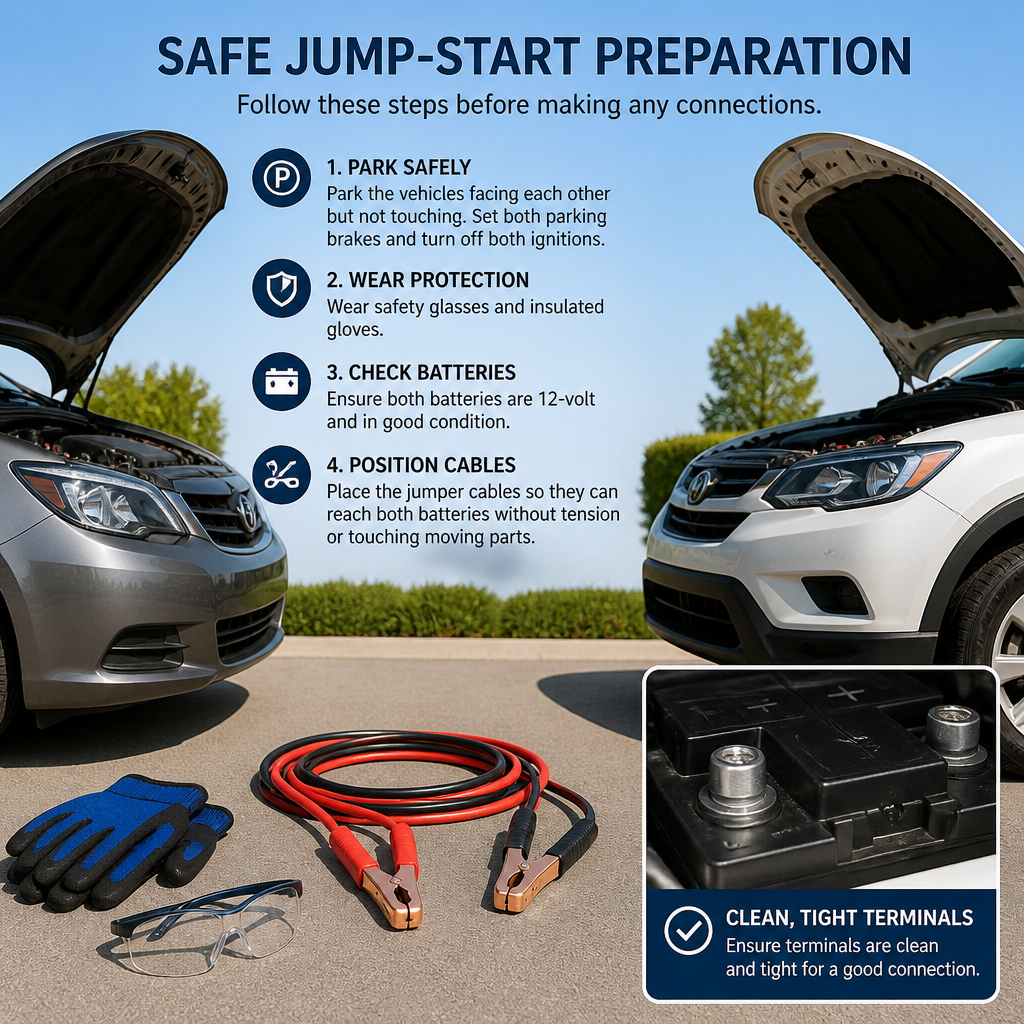
A jump-start can help confirm a discharged battery, but it is not a complete diagnosis. Follow the owner’s manual because some vehicles have designated positive and negative jump points. Hybrid and electric vehicles may have different procedures, and their high-voltage systems should never be handled casually.
- Park the assisting vehicle close enough for the cables to reach, without allowing the vehicles to touch.
- Switch off both vehicles and all electrical accessories.
- Connect the red cable to the positive terminal or approved positive jump point on the disabled vehicle.
- Connect the other red clamp to the positive terminal on the assisting vehicle.
- Connect the black cable to the negative terminal on the assisting vehicle.
- Connect the final black clamp to an approved unpainted earth point on the disabled vehicle, away from the battery if the manual specifies this.
- Start the assisting vehicle and allow it to run briefly, if the manual permits.
- Attempt to start the disabled vehicle for only a few seconds.
- If it starts, remove the cables in reverse order and keep the cables away from moving parts.
Never reverse the polarity. Do not allow the clamps to touch each other. Avoid jump-starting a battery that is cracked, leaking, frozen or visibly damaged. If the car starts but the battery warning lamp remains on, turn off unnecessary electrical loads and arrange immediate assistance because the charging system may have failed.
If the vehicle needs another jump soon afterward, have both the battery and alternator tested. Repeatedly charging a defective battery can leave you stranded again and may hide a parasitic drain.
When the engine cranks but still will not run
Cranking means the starter is turning the engine. It does not prove that the engine has fuel, spark, compression or correct timing. This distinction helps separate a starting-system problem from a running-system problem.
First, check whether the cranking speed sounds normal. A very fast, uneven sound can point to a compression or timing issue. A slow, laboured sound points back toward battery power, cable connections or the starter.
Next, look for dashboard clues. A flashing security light suggests an immobiliser issue. A check-engine lamp may indicate an engine-control fault, although the absence of a lamp does not rule one out.
Do not remove spark plugs or open fuel lines on the roadside unless you have the correct tools and experience. Modern fuel systems may operate at high pressure. A workshop can check fuel pressure, ignition output, injector control, compression and timing in a controlled way.
When to stop troubleshooting and call a professional
Call roadside assistance or a mechanic when the vehicle is in traffic, on an unsafe shoulder, in a flood-prone area or at risk of rolling. Personal safety comes before diagnosing the fault.
Professional help is also appropriate when you notice fuel leakage, smoke, burning insulation, repeated electrical sparks, a damaged battery, unusual engine noise or a warning about high-voltage systems. These conditions can lead to fire, electric shock or expensive damage.
Arrange a proper diagnosis if jump-starting does not help, the starter only works intermittently, the engine stopped suddenly while driving, or the vehicle repeatedly loses battery power. Guessing and replacing several expensive parts can cost more than a structured test.
Tell the technician exactly what happened. Mention whether the lights were bright, what sound you heard, whether the engine cranked, how long the vehicle had been parked, and whether any warning lights appeared. These details can shorten the diagnostic process.
How to prevent future starting problems
Prevention begins with routine checks. Keep battery terminals clean and secure, but follow the vehicle manufacturer’s instructions for battery access. Inspect visible cables for swelling, broken insulation or loose earth connections. How to Check an Accident-Damaged Car Before You Buy
Have the battery tested before long trips, particularly if it has shown slow cranking or has been discharged before. A battery that passes a quick voltage check may still need a professional load test.
Use the vehicle regularly when practical, but remember that short trips may not replace the energy used during starting. If the vehicle sits for long periods, ask a qualified person whether a suitable maintenance charger is compatible with it.
Pay attention to early warnings. Dimming lights, a battery lamp, slow starting, repeated key-fob warnings or intermittent electrical faults should not be ignored. Early testing may prevent a breakdown.
Keep the correct jump-start instructions, emergency contacts and vehicle manual available. Store cables that are suitable for the vehicle, but do not assume every vehicle can be connected in the same way. Some models have special connection points or restrictions.
Common mistakes to avoid
- Assuming the battery is fine because the lights work. Lighting uses much less current than the starter.
- Trying to start the engine repeatedly. This can drain the battery and overheat the starter.
- Replacing the battery without testing the alternator. A charging fault can damage or discharge the replacement.
- Using the wrong jump-start connection. Incorrect polarity can damage electronic systems.
- Bypassing safety switches. Improvised wiring can allow the vehicle to move unexpectedly or create a fire risk.
- Spraying flammable liquid into the intake. This is dangerous and can damage components.
- Ignoring the immobiliser light. A key-recognition problem may not be solved by charging the battery.
- Relying on one fault code. A code identifies a system or condition, not always the failed component.
- Working under a vehicle supported only by a jack. Use proper stands and safe procedures, or leave under-vehicle work to a professional.
Frequently asked questions
Can a car fail to start if the lights are bright?
Yes. Bright lights do not prove that the battery can supply starter current. The battery may have an internal fault, or the starter circuit may have a poor connection or failed component. A battery and starting-system test can identify the cause.
Why does the car click but not start?
A single click often points to the starter solenoid, a weak battery or a poor high-current connection. Rapid clicking commonly occurs when voltage drops repeatedly as the starter tries to engage. Inspecting connections and performing a proper battery test is the best starting point.
Can a bad alternator cause a no-start problem?
Yes. A failed alternator may leave the battery undercharged. The engine can then start once after a short drive or jump-start, but fail again after the stored battery power is used. Test the charging system rather than replacing the battery alone.
Should I keep trying if the engine almost starts?
Use short attempts and pause between them. If the engine almost starts but does not run, repeated cranking may flatten the battery. Stop if you smell fuel, hear unusual mechanical noise or see smoke.
Why does the car start in Neutral but not Park?
The Park or Neutral safety switch, selector linkage or transmission-range sensor may be misaligned or failing. Starting in Neutral may confirm the clue, but it should not replace a repair. Keep the parking brake applied and have the system inspected.
Can a spare key fix the problem?
It can if the original key is damaged or the immobiliser cannot read its transponder. For keyless vehicles, a weak fob battery may also prevent recognition. Follow the manufacturer’s emergency starting procedure and seek specialist help if the security warning continues.
Is it safe to drive after a jump-start?
Only if the vehicle starts normally, no danger signs are present and the charging system appears to work. If the battery warning lamp stays on, electrical systems behave strangely or the engine runs poorly, drive only if necessary to reach a safe location. Roadside assistance may be safer.
Final takeaway
When your car won’t start but the lights come on, begin by identifying whether the engine is cranking. A silent starter or clicking sound usually directs attention to the battery, connections, safety switches, ignition circuit or starter. Normal cranking with no running points more toward fuel, ignition, immobiliser, timing or engine-control problems.
Check simple causes first, but do not take unnecessary risks. A jump-start may restore power temporarily, while a proper battery, charging and diagnostic test reveals why the problem happened. If there is smoke, fuel, high-voltage equipment, damaged wiring or an unsafe location, stop testing and call a qualified professional.
Reliable troubleshooting is not about guessing the most expensive part. It is about observing the symptoms, testing the right system and repairing the underlying fault before the next journey.
1 thought on “Car Won’t Start but Lights Come On: Causes and Solutions”