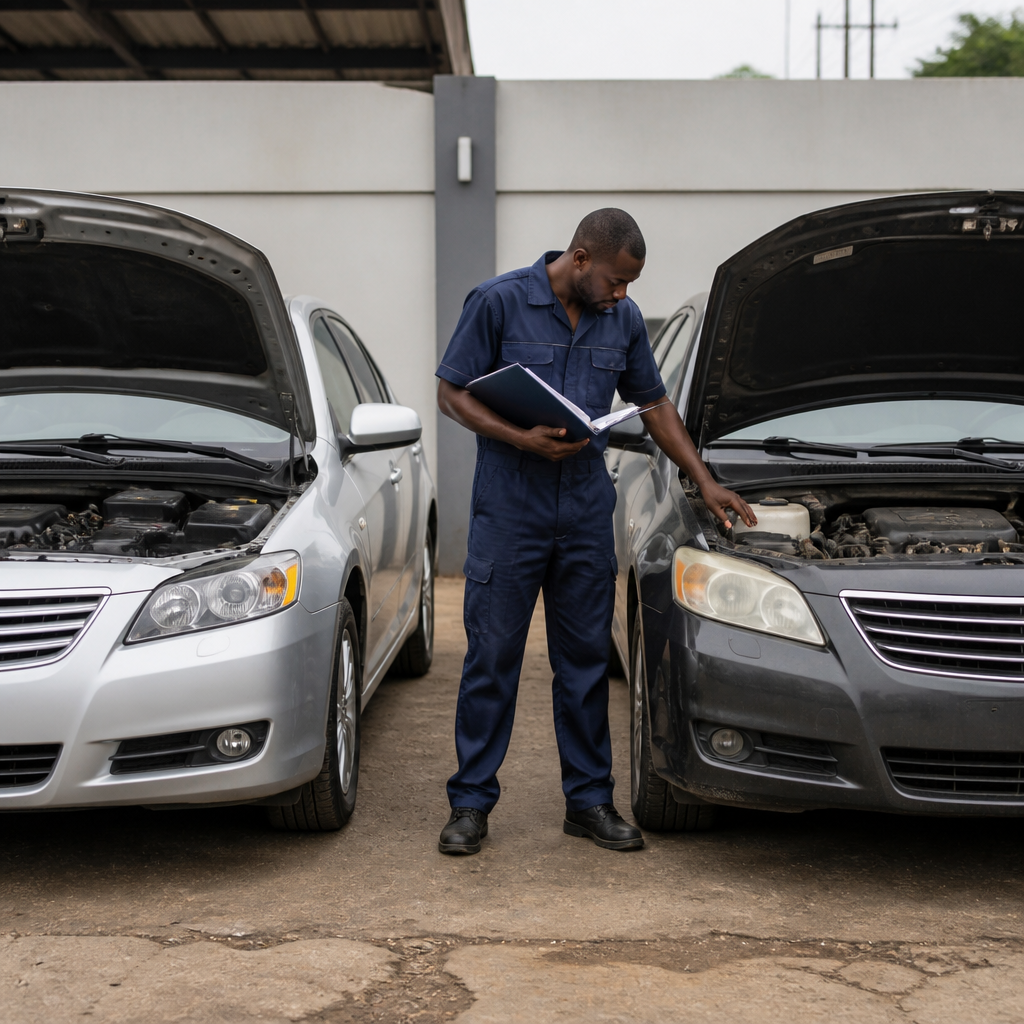
Buying imported used cars or Nigerian-used cars requires more than comparing asking prices. You need to establish where the vehicle came from, how it was used, what repairs it has received, and whether its documents match the car in front of you. A clean appearance can hide flood damage, accident repairs, worn suspension parts, electrical faults, or unresolved ownership issues.
This guide explains what to check before you pay for either type of vehicle. It also shows where the two categories often differ, what they have in common, and how to make a fair comparison without relying on labels such as foreign used, Tokunbo, or Nigerian used.
What do imported used cars and Nigerian-used cars mean?
In everyday Nigerian vehicle sales, an imported used car is usually a vehicle that was previously registered or driven outside Nigeria before being brought into the country. Sellers may also call it foreign used or Tokunbo. The car could have come from several different markets, and its history can vary widely. How to Check Engine Oil Level Correctly
A Nigerian-used car is generally a vehicle that has already been used on Nigerian roads. It may have been imported as a new vehicle, purchased locally as a used vehicle, or transferred between several owners. The label does not automatically tell you whether the car is reliable or problematic.
Both categories contain excellent vehicles and poor vehicles. An imported car may have hidden flood damage or a severe overseas accident history. A Nigerian-used car may have been carefully maintained by one owner and already adapted to local road conditions. Therefore, the vehicle’s condition, history, inspection results, and documentation matter more than the label alone.
Imported used cars: advantages and risks
Many buyers consider imported used cars because they may offer newer model years, more factory options, and a wider choice of trims. Some vehicles also arrive with maintenance records, auction documents, or registration information from the previous country. However, these possible advantages do not remove the need for inspection.
Potential advantages
- More choice: Importers can source vehicles from different markets, making it easier to find a particular model, colour, engine, trim, or transmission.
- Lower local exposure: A vehicle with limited time on Nigerian roads may have experienced less local traffic, dust, heat, potholes, and flooding. This is only a possibility, not a guarantee.
- Better records in some cases: Some imported vehicles come with auction sheets, service invoices, inspection reports, or export documents. Ask to see the original records rather than relying on a verbal description.
- Newer specifications: Imported stock may include newer model years or features that were not widely sold through official channels in Nigeria.
Potential risks
- Unknown overseas history: A car may have been damaged, written off, repaired, or sold through an auction before export.
- Flood exposure: Water damage can affect wiring, control modules, sensors, carpets, seat rails, and connectors. Problems may appear months after purchase.
- Odometer concerns: Mileage may be altered or misunderstood. A low reading should agree with service records, wear, diagnostic data, and the vehicle’s history.
- Specification differences: A vehicle built for another market may have different equipment, software, lighting, emissions systems, radio frequencies, or parts requirements.
- Shipping and storage damage: Vehicles can receive scratches, dents, battery discharge, or mechanical neglect during transport and storage.
- Document gaps: If the seller cannot clearly explain importation, ownership, customs status, and registration, pause the transaction.
The key lesson is simple: imported used cars are not automatically better because they have spent less time in Nigeria. Their previous life still needs to be investigated.
Nigerian-used cars: advantages and risks
Nigerian-used cars have a major advantage during inspection: you can often observe how the vehicle behaves on local roads and examine its current maintenance condition. You may also find a clearer chain of local ownership, especially when the seller has registration papers, service receipts, and contact with the previous owner.
Potential advantages
- Local road experience: The vehicle has already shown how it copes with Nigerian roads, traffic, climate, and fuel conditions.
- Easier physical inspection: You can inspect the car cold, test it on familiar roads, and take it to an independent workshop before making a decision.
- Accessible maintenance history: Some owners keep receipts from workshops, parts dealers, tyre shops, and service centres.
- Known local configuration: A car that has operated successfully in the area may already have suitable parts availability and mechanics familiar with its system.
Potential risks
- Heavy traffic use: A car used as a taxi, ride-hailing vehicle, delivery vehicle, or daily commuter may have more wear than its exterior suggests.
- Deferred maintenance: Some owners sell a vehicle when expensive repairs become due. Look carefully at warning signs around the engine, transmission, cooling system, and suspension.
- Accident repairs: Local crash repairs can vary in quality. Check panel alignment, paint thickness, structural areas, welds, airbags, and steering geometry.
- Flood and water damage: Local use does not protect a car from flood exposure. Check under carpets, inside connectors, and around seat mounts.
- Odometer changes: A Nigerian-used car can also have altered mileage. The dashboard reading is only one piece of evidence.
- Ownership problems: Outstanding claims, missing transfer documents, unpaid obligations, or inconsistent names can create trouble after purchase.
A well-maintained Nigerian-used car with transparent records may be a safer purchase than a cheaper imported vehicle with an uncertain history. Condition and proof should guide the decision.
Imported used cars vs Nigerian-used cars: the checks that matter most
When comparing imported used cars with Nigerian-used cars, use the same inspection standard for both. Start with identity and documents, then assess the body, cabin, mechanical systems, electronics, tyres, and road performance. Finally, calculate the likely cost of bringing the car to a dependable condition.
1. Verify the vehicle identity
Locate the vehicle identification number, commonly called the VIN, on the dashboard, door pillar, engine bay, chassis area, or another manufacturer-approved location. The exact position differs by make and model. Compare the VIN in the vehicle with the VIN on every relevant document.
Look for signs that a plate, label, stamping, or dashboard component has been disturbed. Uneven rivets, fresh adhesive, scratched metal, mismatched fonts, or paint around a stamped area deserve further investigation. Do not buy a vehicle simply because the number appears on one document.
Use a reputable VIN-checking service where a suitable record is available. The National Highway Traffic Safety Administration provides a VIN decoder for basic vehicle information, while the National Insurance Crime Bureau offers VINCheck for certain theft and salvage records in the United States. These tools are useful, but they are not a complete history for every vehicle or country.
2. Examine the documents before discussing final payment
Ask the seller to show the original or properly verifiable vehicle documents. The exact documents may differ depending on the vehicle’s age, origin, ownership history, and registration status. Do not assume that a photocopy or screenshot proves anything.
For an imported vehicle, ask questions about its importation and clearance history. Confirm that the vehicle can be lawfully registered or transferred and that the details agree across the paperwork. The Nigeria Customs Service publishes official information through its website, but you should still verify the specific vehicle with the appropriate authority or a qualified clearing professional.
For a Nigerian-used vehicle, examine the current registration information, ownership evidence, transfer requirements, and any available service records. The seller’s name may not be the same as the name on the documents. That difference does not automatically mean fraud, but the seller must explain it and provide a clear, verifiable path to transfer.
Check these details carefully:
- VIN or chassis number.
- Engine number where applicable.
- Make, model, colour, body type, and year information.
- Registration details and ownership names.
- Importation, customs, or clearance information where relevant.
- Evidence of previous transfers or sales.
- Service invoices and inspection reports.
- Any finance, theft, court, insurance, or ownership issue disclosed by the seller.
Never pay a large deposit because the seller says the documents will arrive later. If documents are incomplete, make the uncertainty part of your decision. In many cases, walking away is cheaper than trying to correct a serious documentation problem after payment.
3. Inspect the exterior in daylight
View the vehicle in natural daylight. Artificial lighting can hide colour differences and poor repairs. Wash marks, dust, and rain can also make panel defects harder to identify, so inspect the car when the surfaces are reasonably clean and dry.
Stand several metres away and compare the colour and reflection across the panels. Then inspect the gaps around the bonnet, boot, doors, headlights, and bumpers. Uneven gaps may indicate previous impact, poor reassembly, or sagging hinges.
Look for overspray on rubber seals, plastic trim, suspension components, and inside the wheel arches. Paint that feels rough in one area may indicate body filler or an uneven repair. A paint-depth gauge can help identify changed panels, but it should support a wider inspection rather than replace one. Car Overheating in Traffic: Causes and What to Do
Inspect the roof and pillars carefully. Buyers often concentrate on bumpers and doors while overlooking structural areas. Pay attention to ripples, creases, unusual welds, repaired seams, and inconsistent sealant. A cosmetic panel replacement is not the same risk as damage to a pillar, rail, chassis section, or suspension mounting point.
4. Search for flood and water damage
Water damage deserves special attention when assessing imported used cars, especially when the seller cannot provide a reliable history. However, Nigerian-used vehicles can also suffer flood damage. Check both categories using the same method.
Smell the cabin before the air freshener becomes a distraction. A persistent damp, mouldy, or unusually chemical smell may be significant. Lift floor mats and inspect the carpet edges, seat rails, spare-wheel well, boot lining, and lower door trim. Look for water lines, rust, mud, discolouration, and new carpeting that does not match the rest of the interior.
Inspect electrical connectors beneath the seats and around lower dashboard areas where accessible. Green corrosion, powdery residue, rust on metal brackets, or inconsistent connector condition can indicate moisture exposure. Test every electrical function because water damage may affect windows, locks, lights, sensors, audio equipment, airbags, and control modules at different times.
Do not rely on a clean engine bay as evidence that the vehicle was never flooded. An engine wash can remove visible dirt while leaving corrosion in hidden places. A qualified technician should inspect the car when flood damage is a concern.
5. Check the engine and cooling system
Ask to inspect and start the vehicle when the engine is cold. A warm engine can hide difficult starting, excessive smoke, rough idle, or noises that appear during a cold start. Feel the bonnet carefully or ask the seller directly whether the car has already been driven.
Look for oil leaks, coolant stains, loose hoses, damaged wiring, cracked belts, and signs of sealant around covers. Check the fluid levels and condition according to the manufacturer’s guidance. Milky oil, oily coolant, or unexplained fluid loss requires professional diagnosis.
During startup, observe the exhaust. Smoke colour and duration can provide clues, but they do not prove a diagnosis. Blue smoke may suggest oil burning, thick white smoke can be associated with coolant or condensation depending on conditions, and black smoke may indicate excessive fuelling. A technician should confirm the cause.
Watch the temperature gauge during the inspection and test drive. Confirm that the cooling fan, air conditioner, and warning lights behave normally. Overheating damage can become expensive quickly, so never ignore a temperature warning because the vehicle otherwise looks attractive.
6. Test the transmission, steering, brakes, and suspension
Move the gear selector through its positions while the vehicle is stationary. Engagement should not produce a severe delay, loud impact, or repeated shudder. During the drive, check for slipping, harsh shifts, hesitation, unusual noises, or warning messages.
Test the brakes on a safe and suitable road. The vehicle should stop in a straight line without severe vibration, grinding, or excessive pedal travel. Do not perform dangerous high-speed tests. A controlled inspection by a qualified mechanic is more useful than an aggressive road test.
On an uneven but safe surface, listen for knocks from the suspension. Check whether the steering wheel sits straight and whether the car pulls to one side. Uneven tyre wear can point to alignment problems, worn suspension parts, accident damage, or incorrect tyre pressure.
Inspect the underside where possible. Look for oil leaks, bent components, crushed covers, damaged exhaust parts, corrosion, and fresh underseal hiding repairs. A raised inspection by a workshop can reveal defects that are invisible from ground level.
7. Check tyres, wheels, and brakes
Tyres are an easy place to find clues about the vehicle’s use. Compare the brand, size, tread pattern, and age across all four corners. Uneven wear on one edge may indicate alignment, suspension, or steering issues. Cracks, bulges, exposed cords, and very old tyres require immediate attention.
Check the spare tyre, jack, wheel brace, and locking-nut key. Their absence may not stop the sale, but it adds replacement cost and can reveal how carefully the owner has maintained the vehicle. Inspect alloy wheels for cracks, bends, or heavy repairs, especially if the car has experienced pothole impacts.
Ask the technician to measure brake pad and disc condition. A car with worn tyres, brakes, suspension parts, and a weak battery may look affordable until these immediate repairs are added to the purchase price.
8. Test every electrical and safety feature
Turn on the ignition without starting the engine and observe the warning lights. Important lights should illuminate during the self-check and then go out after the engine starts if no fault remains. A missing warning light can be as concerning as an illuminated one, because it may have been disabled. Check Engine Light: What It Means and What to Do
Test the headlights, brake lights, indicators, reverse lights, hazard lights, horn, wipers, washers, windows, mirrors, locks, climate control, dashboard display, camera, parking sensors, and audio system. Check the air-conditioning performance after the vehicle reaches normal operating conditions.
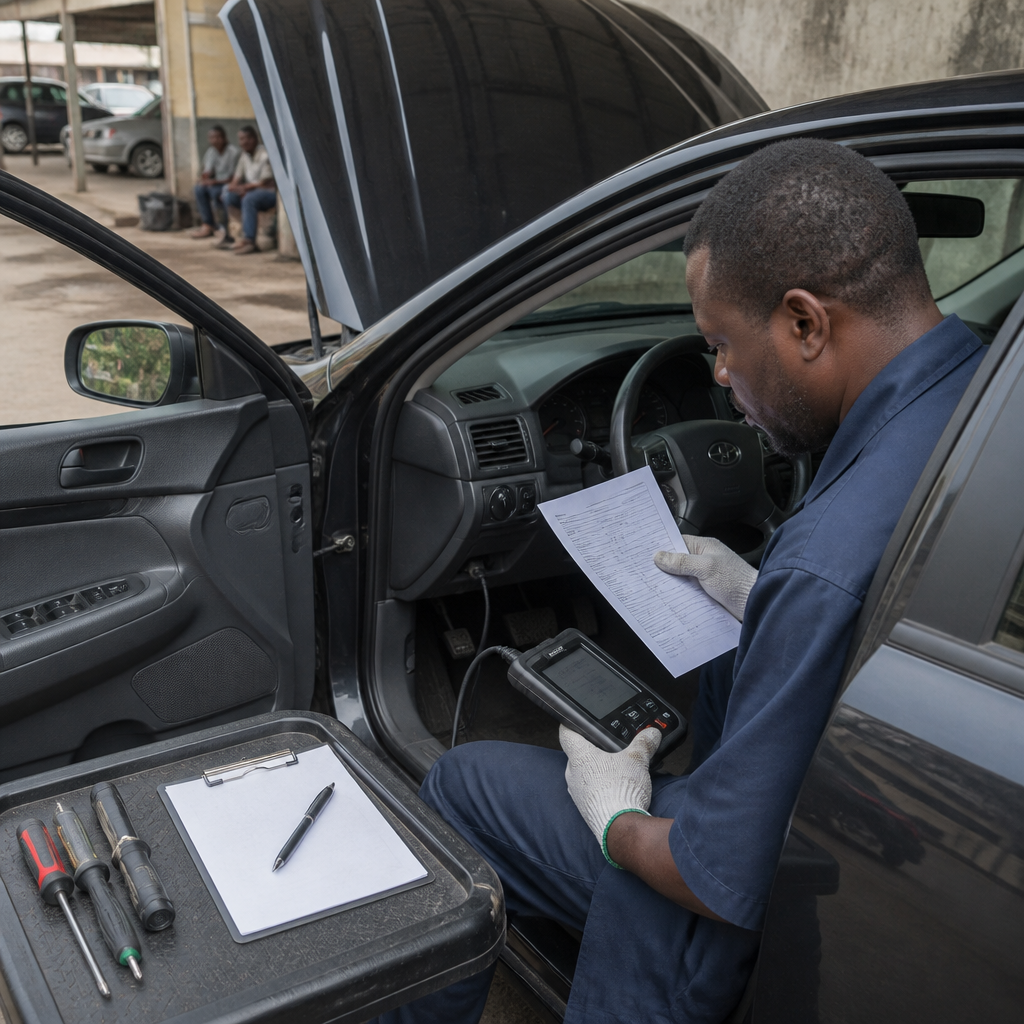
Ask a technician to scan the vehicle with suitable diagnostic equipment. A scan can reveal stored or pending fault codes, but it is not a complete inspection. Codes may have been cleared, and some mechanical problems do not appear electronically.
How vehicle history changes the buying decision
History helps you understand why a car looks the way it does. It can reveal previous owners, service events, mileage readings, accident records, auction descriptions, insurance damage, or periods when the vehicle was inactive. Yet no single report is perfect. Records may be incomplete, delayed, or unavailable for a particular market.
For imported used cars, ask for every available document from the overseas seller, auction, exporter, shipping process, and Nigerian importer. A photograph of an auction listing can be useful, but confirm that the VIN on the listing matches the vehicle. Look for descriptions of damage, airbag deployment, flood exposure, missing keys, mechanical faults, and odometer readings.
For Nigerian-used cars, ask for workshop invoices, maintenance dates, replaced parts, tyre purchases, and previous inspection reports. Speak with the owner about how the car was used. A vehicle driven short distances in heavy traffic may have different wear from one used mainly for longer highway journeys.
Be cautious when a history report appears unusually clean but the vehicle shows physical evidence of significant repairs. The inspection should take priority over a report that cannot explain what you can see.
Compare total ownership cost, not just the asking price
The cheapest vehicle at the point of sale may not be the cheapest vehicle to own. Calculate the likely immediate repairs and running costs before you negotiate. Include registration or transfer expenses, insurance, inspection fees, tyres, battery, fluids, filters, brakes, suspension work, air-conditioning repairs, and any known electrical faults.
Imported used cars may require special parts, software support, or components for a market-specific specification. That does not make them a bad choice, but you should confirm parts availability and technician experience before buying. Ask at least one independent workshop what it would cost to maintain the exact engine, transmission, and trim.
Nigerian-used cars may already have worn items due to local roads and traffic. On the other hand, some parts may be easier to source because the model has been common in Nigeria for years. Confirm availability instead of relying on assumptions about the badge or model name.
Use a simple comparison table when making your decision:
- Purchase price: What the seller wants today.
- Immediate repairs: Work required before dependable daily use.
- Documentation cost: Transfer, verification, registration, or correction expenses.
- Parts and service cost: Availability of suitable parts and qualified technicians.
- Risk allowance: Money reserved for faults that the inspection cannot completely rule out.
- Resale prospects: How clearly you can document the vehicle’s ownership and condition.
For example, an imported car that costs less than a comparable local vehicle may need tyres, a battery, air-conditioning work, and suspension repairs. Once added together, the apparent saving may disappear. Conversely, a Nigerian-used car with cosmetic marks may need only routine maintenance. The numbers should come from inspection findings, not guesswork.
How to conduct a safe inspection and test drive
Arrange the inspection at a neutral location or an independent workshop. Avoid relying only on a mechanic chosen by the seller. If you do not know a qualified inspector, ask for a written report that lists observed defects, recommended repairs, and issues that could not be tested.
- Confirm the seller’s identity and authority: Ask who owns the vehicle and who has the right to sell it.
- Inspect the documents first: Do not spend hours negotiating a car that cannot be transferred properly.
- View the car cold: Confirm that the engine has not been warmed up before arrival.
- Perform a body and interior inspection: Look for accident, flood, fire, corrosion, and tampering clues.
- Use diagnostic equipment: Scan relevant systems and record any codes before clearing anything.
- Lift the vehicle: Inspect the underbody, leaks, suspension, brakes, and structural areas.
- Take a controlled test drive: Test starting, acceleration, shifting, braking, steering, air-conditioning, and warning lights.
- Obtain a written estimate: Price the repairs before making an offer.
- Verify the final paperwork: Match the VIN and agreed vehicle details on the sales documents.
Do not allow pressure to replace inspection. Statements such as another buyer is coming, pay now to reserve it, or the fault is very minor should not change your process. A genuine seller should understand that a used vehicle needs reasonable checks.
Red flags that should make you pause
- The seller refuses an independent inspection.
- The VIN is missing, difficult to read, or different across documents.
- The vehicle is already warm when you arrive without a clear reason.
- The seller cannot explain a gap in ownership or importation history.
- Fresh paint appears beside old, damaged, or poorly aligned panels.
- The airbag warning light does not behave normally during the ignition self-check.
- There is damp odour, corrosion, mud, or water staining inside the cabin.
- The dashboard mileage conflicts with service records or physical wear.
- The seller demands payment to an unrelated person or account.
- The price is far below comparable vehicles without a convincing explanation.
- The seller promises to fix major defects only after full payment.
- There is no written agreement describing the vehicle, price, payment, and outstanding obligations.
One red flag may have an innocent explanation. Several together should lead you to delay, seek professional advice, or leave the deal.
Questions to ask the seller
Good questions encourage specific answers. Ask when the vehicle was acquired, how it was used, why it is being sold, where it was serviced, and which parts were recently replaced. Then compare the answers with the condition you observe.
For an imported vehicle, ask when it arrived in Nigeria, whether it was damaged before export, whether its airbags were deployed, and whether the seller has overseas records. For a Nigerian-used vehicle, ask whether it served as a commercial or ride-hailing vehicle, whether it has experienced flooding or major accidents, and which workshops have maintained it. Car AC Not Cooling: 10 Possible Causes and What to Check
Do not ask questions only to hear a reassuring answer. Ask for evidence. A service invoice, inspection report, matching VIN, or verifiable ownership document is more valuable than confidence or a long sales story.
Which option is better for you?
Imported used cars may suit buyers who want a wider selection, newer features, or a particular specification and who are prepared to verify overseas history carefully. They can be a strong choice when the VIN, documents, history, inspection, and repair budget all make sense.
A Nigerian-used car may suit buyers who value local road experience, easier physical inspection, available maintenance records, and familiar parts. It can be a strong choice when the vehicle has a transparent ownership history and has received timely maintenance.
Neither category should receive an automatic advantage. Choose the vehicle with the clearest identity, strongest evidence, best inspection result, and most manageable total cost. A modest car with honest records is usually a better purchase than a highly specified car with unexplained damage.
Final checklist before you pay
Before completing the purchase, review the following list without rushing:
- Have you matched the VIN on the vehicle with every relevant document?
- Have you confirmed that the seller can legally transfer the vehicle?
- Have you inspected the car in daylight and checked for accident repairs?
- Have you looked for signs of flood, fire, corrosion, or severe water exposure?
- Have you started the engine cold and completed a controlled test drive?
- Have you tested warning lights, electronics, air-conditioning, and safety equipment?
- Has an independent technician inspected the engine, transmission, suspension, brakes, and underbody?
- Have you checked the mileage against records and physical wear?
- Have you priced immediate repairs and routine ownership costs?
- Have you agreed in writing on the vehicle, price, payment terms, documents, and delivery?
If the answer to any important question is no, postpone payment until you have reliable information. A careful buyer does not need to know every mechanical detail, but should know when evidence is missing and when professional help is necessary.
Frequently asked questions
Are imported used cars better than Nigerian-used cars?
Not automatically. Imported used cars may have newer specifications or more available history, but they can also have hidden overseas damage, flood exposure, or altered mileage. A properly maintained Nigerian-used car may be the safer purchase. Compare verified condition and records rather than relying on the category.
How can I check whether a used car has been in an accident?
Look for inconsistent paint, uneven panel gaps, overspray, damaged fasteners, unusual welds, replaced airbags, steering or alignment problems, and mismatched lights. A vehicle history report may help, but an independent body and structural inspection remains important.
Is low mileage proof that a car is good?
No. Low mileage can be genuine, but it can also be altered or misunderstood. Compare the odometer with service invoices, inspection records, tyre and pedal wear, seat condition, steering-wheel wear, and diagnostic information.
Should I buy a car without complete documents if the price is attractive?
Usually, you should not. Missing or inconsistent documents can create ownership, transfer, registration, customs, or legal problems. Confirm the situation with the relevant authority or a qualified professional before paying.
Can a mechanic guarantee that a used car will never develop a fault?
No. An inspection reduces uncertainty but cannot predict every future repair. Ask the mechanic to identify current defects, signs of previous damage, systems that were not tested, and likely near-term maintenance needs.
What is the most important check before buying?
There is no single check that replaces the others. Confirm the vehicle identity and documents first, then combine history verification with an independent mechanical, body, electrical, and road inspection. This approach gives you a much clearer basis for negotiation.
Conclusion
Choosing between imported used cars and Nigerian-used cars is not a decision based on appearance or origin alone. It is a process of checking identity, ownership, history, bodywork, flood exposure, mechanical condition, electronics, tyres, documents, and total cost.
Take your time, use an independent inspector, and treat unclear information as a risk rather than a minor inconvenience. When the paperwork matches the vehicle and the inspection supports the seller’s claims, you can negotiate with greater confidence and choose a car that fits your budget and daily needs.