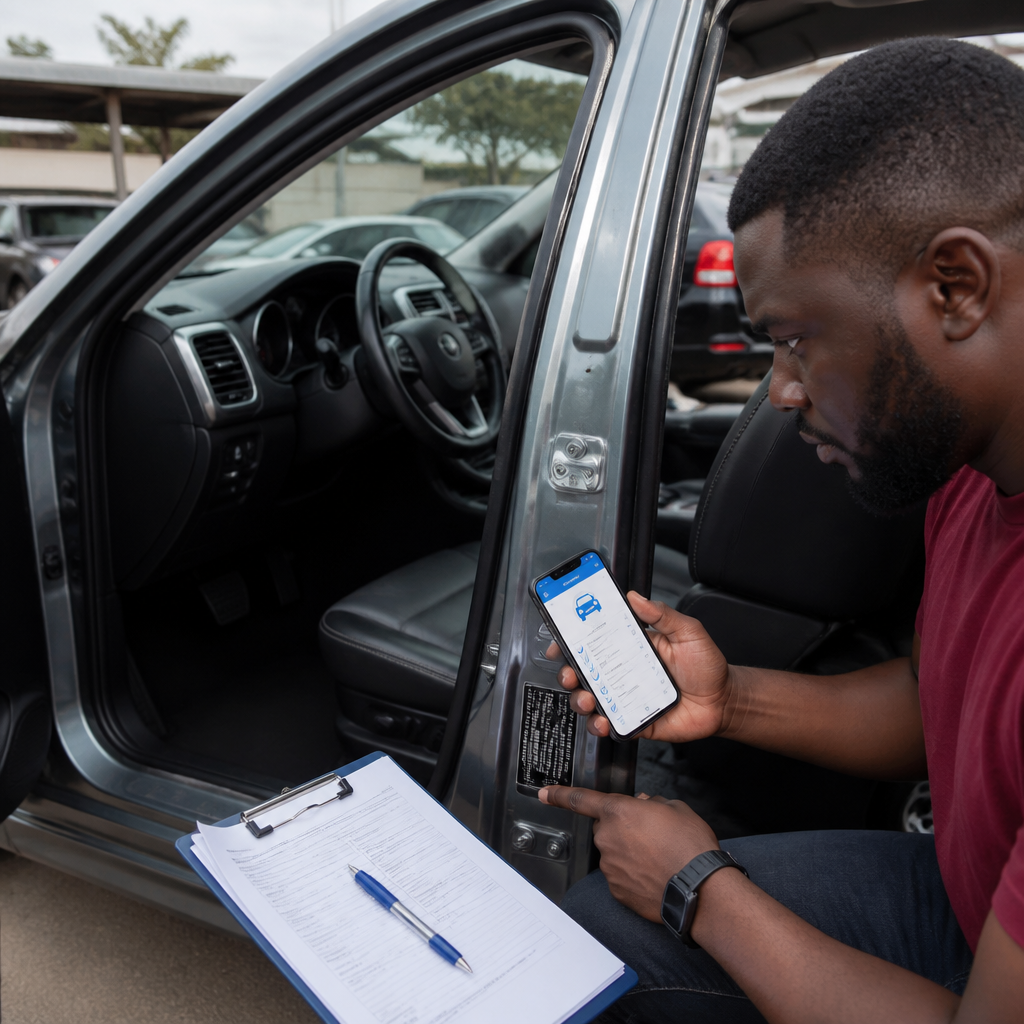
Checking the used car year is one of the most important steps before buying a pre-owned vehicle. A seller may describe a car as a certain year because that year attracts a better price, yet the vehicle may have been built earlier, registered later, or imported under a different model-year description. You can reduce this risk by comparing the VIN, documents, manufacturer labels, service records and physical evidence before making payment.
The goal is not simply to find one date and accept it. A car can have several relevant dates, including the manufacturing date, model year, first registration date, import date and year of local registration. These dates can all be genuine, but they do not mean the same thing. Understanding the difference helps you negotiate fairly and avoid buying a vehicle that has been misrepresented.
Why the used car year matters
The vehicle year can affect its market value, insurance assessment, import classification, spare-parts selection and future resale. Buyers often compare vehicles by year first. A car advertised as a 2018 model may attract more interest than a similar car advertised as a 2016 model, even when the two vehicles share the same body style. How to Check Tokunbo Car Mileage Before Buying in Nigeria
However, the year alone does not determine a car’s condition. Maintenance history, accident damage, mileage, engine condition, gearbox performance and the quality of previous repairs may matter more than a one-year difference. Even so, you need an accurate year before you compare prices or decide whether a vehicle is a good deal.
- Manufacturing date: The month and year when the vehicle was assembled.
- Model year: The year assigned to the vehicle specification by the manufacturer or relevant market system.
- First registration year: When the vehicle was first registered for road use.
- Import or arrival year: When the vehicle entered the country where you are buying it.
- Local registration year: When it received local registration or number-plate records.
For example, a vehicle built in late 2017 could be sold as a 2018 model if the manufacturer assigned it to the 2018 model year. Another car built in 2018 could remain a 2017 model if its model-year designation was different. That is why a registration date should not automatically replace the manufacturer’s model-year information.
Start with the vehicle identification number
The vehicle identification number, usually called the VIN, is the best starting point for checking a modern used vehicle. It is a unique identifier assigned to the car. A standard VIN is often 17 characters long, although older vehicles and vehicles made for different markets may use other formats.
Locate the VIN in more than one place. Common locations include the lower corner of the windscreen on the driver’s side, the driver-door frame, a plate in the engine compartment and vehicle documents. The exact location depends on the make, model and market.
Record the VIN carefully
Write the VIN down exactly as it appears. Then compare every character with the number on the vehicle. A single incorrect character can produce the wrong result in a decoder or make a document appear to belong to another vehicle.
VINs commonly avoid some letters that can be confused with numbers. For example, the letters I, O and Q are generally avoided in many VIN systems. Still, you should not guess a character. Ask the seller to clean the area or provide better lighting if the stamping is difficult to read.
Check for signs that a VIN plate has been removed, replaced, scratched, painted over or attached with unusual fasteners. A dirty VIN is not automatically suspicious. Fresh damage around the plate, mismatched fonts, uneven spacing or different rivets deserve closer inspection.
Use a reliable VIN decoder
Enter the VIN into a reputable decoder or vehicle-history service. The result may show the manufacturer, vehicle type, plant, series, engine information and model year. Treat the result as an important piece of evidence, not as the only inspection you need.
For vehicles sold in the United States, the National Highway Traffic Safety Administration provides a public VIN decoder. You can use it to compare the information returned by the VIN with the car in front of you. The result may not provide every detail for every vehicle, especially where the car was built for another market.
In many North American VIN systems, the tenth character identifies the model year. Do not apply this rule blindly to every vehicle. Imported cars, older vehicles and market-specific VIN systems may use different conventions. A decoder and the manufacturer’s documentation are safer than relying on a memorised character chart.
The year code can also repeat in a cycle. Therefore, a character may represent more than one possible year when viewed without the rest of the VIN and supporting records. The vehicle’s body design, equipment, production information and history should confirm which cycle is plausible.
Check the manufacturer’s build label
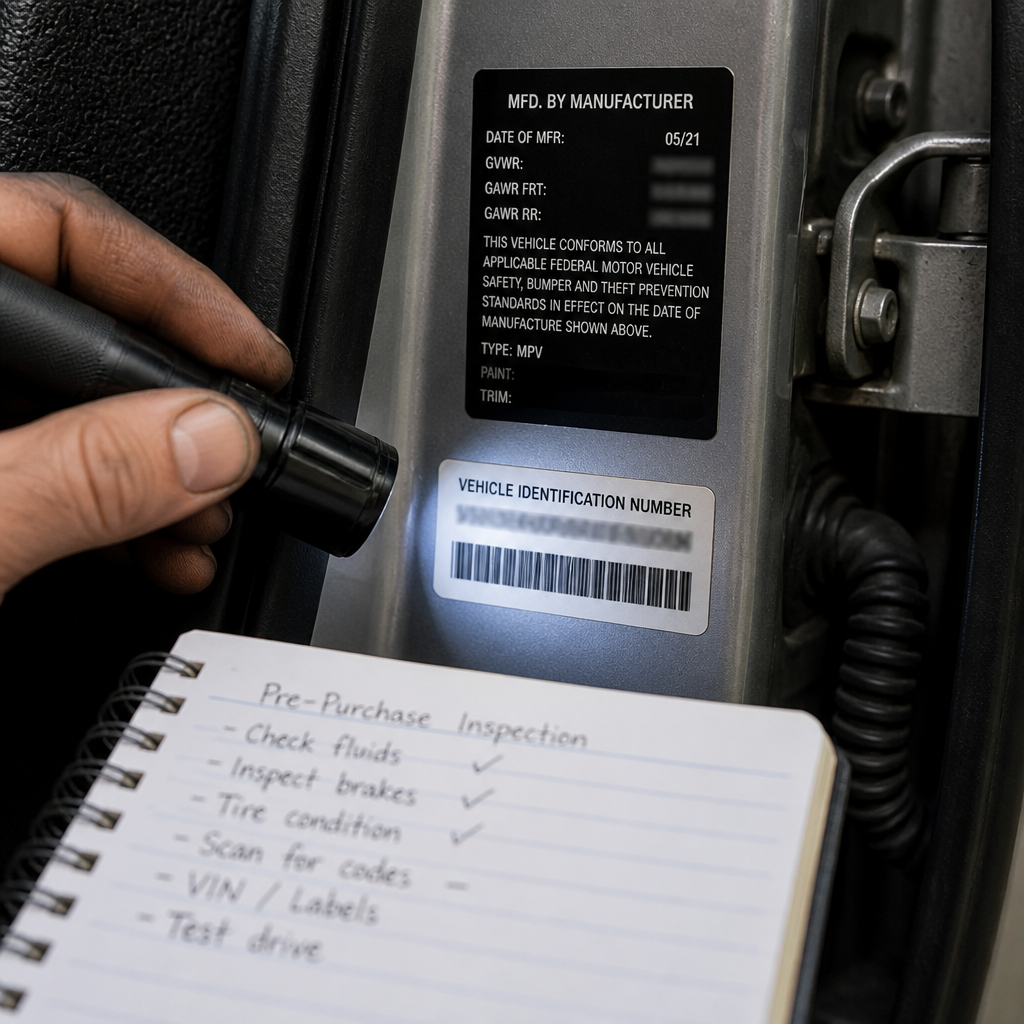
Many vehicles have a manufacturer label showing the production month and year. It may be located on the driver-door jamb, door pillar, inside the door, under the bonnet or in another area selected by the manufacturer. The label can also include weight ratings, paint information and compliance details.
A label showing a month and year usually identifies when the vehicle was built. That is valuable, but it may not be identical to the model year. A car manufactured near the end of one calendar year may be assigned to the next model year. Use the label to understand the production timeline, then compare it with the VIN and documents.
Look closely at the label without damaging it. It should appear consistent with the vehicle’s age and other factory markings. A label that is peeling, covered with fresh adhesive, printed in a different style from the rest of the vehicle or positioned unusually may require further investigation.
Do not assume that an absent label proves the car is fraudulent. Labels can fade, become damaged during accident repairs or be removed during replacement of a door or body panel. Instead, regard the missing label as a reason to seek another confirmation.
Compare the VIN with every document
Once you have the VIN and build information, compare them with all available documents. Depending on the vehicle’s history and country of origin, these may include a registration certificate, title, customs record, auction sheet, export certificate, inspection report, insurance record, service invoice or previous sale document.
The VIN should match across the documents. Also compare the make, model, body type, engine details and colour where those details are recorded. If the registration document says one year and the VIN decoder indicates another, do not ignore the difference. Ask the seller to explain it and verify the explanation independently.
- Check whether the VIN has the same number of characters everywhere.
- Look for missing characters, transposed numbers or typing errors.
- Compare the stated model with the vehicle’s actual body and equipment.
- Check whether the recorded first-registration date makes sense beside the build date.
- Ask why a document describes the car as a different year.
- Keep copies or clear photographs of important records before completing the purchase.
A document can contain an administrative error, especially when information has passed through several systems. That possibility does not make a mismatch harmless. You need a clear paper trail before you buy, because correcting records after payment can be expensive and difficult.
Understand model year versus registration year
One of the most common sources of confusion is the difference between model year and registration year. A vehicle may be manufactured in one year but first registered in another. It may then be imported several years later and receive a local registration record that reflects the import process rather than its original production date. Car Detailing vs Car Washing: What’s the Difference?
Consider this example: a car is built in November 2016, assigned to the 2017 model year, first registered in March 2017, exported in 2021 and registered locally in 2022. A seller might call it a 2017 car, while a buyer may notice the 2016 build label. Both dates can be accurate when described correctly.
The problem begins when a seller presents a local registration year as the model year without explaining the difference. Ask precise questions:
- What is the vehicle’s build month and year?
- What model year does the manufacturer assign to the VIN?
- When was the vehicle first registered?
- When did it arrive in the current country?
- What year appears on the current registration document?
Record the answers in writing. If the advertisement says one year but the documents use another, ask the seller to correct the description before negotiations continue. A transparent seller should be willing to explain the dates without pressuring you to pay immediately.
Inspect the car for physical evidence
Physical inspection cannot prove the exact year by itself, but it can support or challenge the records. Vehicle designs often change during a production cycle. Headlights, grilles, bumpers, dashboard layouts, infotainment systems, steering wheels and safety equipment may help identify an approximate generation.
Use these clues carefully. Parts are replaceable, and accident repairs may have changed the car’s appearance. A newer grille does not turn an older vehicle into a newer model. Likewise, an older replacement headlamp does not automatically prove that the vehicle is older than advertised.
Look for age clues inside the vehicle
Inspect the seat-belt tags, window markings, instrument cluster, airbag labels, carpets, seat fabric and dashboard controls. Glass often carries a manufacturing code or date marking, although the format varies. Several original glass panels with dates close to one another can support the vehicle’s production timeline.
A single replacement windscreen may have a later date, so do not treat it as the car’s build date. The same caution applies to tyres, batteries and other replaceable parts. Their dates can show when those components were made, not when the car was assembled.
Check the odometer and service records together. A very low mileage reading on an older vehicle is not impossible, but it deserves evidence. Look for consistent mileage entries on inspection reports, maintenance invoices and previous registration records. A sudden decrease or a long unexplained gap may indicate odometer tampering or incomplete records.
Inspect body panels and factory markings
Open the bonnet, doors and boot. Look for factory labels, part numbers and date marks on original components. Compare gaps between panels and examine paint texture for signs of replacement or repainting. A repaired panel may have lost its original label, making the physical evidence less complete.
Do not use paint thickness or panel condition as a direct year calculator. These checks are more useful for identifying repairs that could explain why certain parts or labels do not match. A professional inspection can help distinguish normal wear from structural repair.
Review the vehicle’s history
A vehicle-history search can reveal records that clarify the timeline. Depending on the country and the available database, records may include title changes, insurance claims, salvage events, odometer entries, inspections, theft reports and registration events.
For vehicles connected to the United States, the National Motor Vehicle Title Information System provides consumer information and identifies approved providers of vehicle-history reports. The National Insurance Crime Bureau also offers a VINCheck service that can help identify certain theft or salvage records. These services do not replace a physical inspection, and a clean result does not guarantee that a car has never been damaged.
Imported vehicles may have limited records in the country where you are buying them. For example, a vehicle that spent years in another country may have a useful history there but little local data. Ask for export paperwork, auction records and maintenance documents from the country of origin when available.
Review the timeline rather than focusing on one entry. The following sequence can be helpful:
- Manufacture or assembly date.
- First registration in the original country.
- Ownership or auction events.
- Accident, insurance or inspection records.
- Export and shipping documents.
- Customs clearance or import documentation.
- Local registration and subsequent maintenance.
Look for gaps and contradictions. A gap does not prove wrongdoing, because records are often incomplete. However, a seller who cannot explain a major gap, a suspicious mileage change or a different VIN should not receive your money until the issue is resolved.
Ask the seller the right questions
Good questions can expose confusion before it becomes a costly dispute. Ask the seller to state the year in a precise way. Instead of asking only whether the car is a certain year, ask which date they mean.
- Is that the manufacturing year, model year or registration year?
- Can I see the VIN and check it independently?
- Do you have the original registration or export document?
- Was any body panel, glass, dashboard or VIN plate replaced?
- Has the car been imported, rebuilt, salvaged or previously written off?
- Can I arrange an independent inspection before payment?
- Will the written sales agreement identify the VIN and the stated year?
Pay attention to the response as well as the words. A careful seller may need time to find records, but should not object to reasonable verification. Pressure to pay a deposit before you inspect the VIN, refusal to share documents or repeated changes to the story are warning signs. Harmattan Dust Car Care: Protect Your Vehicle
Do not accept statements such as newer shape, foreign used, tokunbo, clean title or accident-free as proof of a particular year. These descriptions may be useful in conversation, but they do not replace a VIN check and document comparison.
Use official records and professional help
If the car is registered locally, contact the relevant vehicle-registration authority through its official channel to learn what verification is available. Procedures vary by country and state. Some authorities may confirm registration details, while others may require the registered owner’s consent or a formal request.
For a vehicle imported into Nigeria, examine the available customs and registration documentation carefully. Do not assume that a customs value, clearing year or local registration year is the same as the car’s model year. If you are unsure, use a licensed clearing professional, reputable inspection company or qualified automotive technician.
A professional inspector should examine more than the year. Ask for checks on structural damage, flood exposure, engine condition, transmission operation, suspension, braking, steering, electronic systems, airbags and signs of odometer alteration. A vehicle can have a genuine year and still be a poor purchase.
Take the inspection yourself or choose the inspector independently. An inspection arranged and paid for only by the seller may still be useful, but it creates a possible conflict of interest. Request a written report with photographs and the VIN recorded on the report.
Common mistakes when checking a used car year
Relying on the advertisement
Online listings are useful for finding cars, not for proving their identity. Sellers may copy a description, use a registration year, round up the year or make an honest mistake. Treat the advertisement as an initial claim that you must verify.
Reading only the tenth VIN character
The tenth character can be useful in certain VIN systems, but it is not a universal shortcut. Market differences, older vehicles, repeated year codes and damaged VINs can lead to an incorrect conclusion. Decode the full VIN and compare it with the documents.
Confusing facelift with a newer year
Manufacturers sometimes update a model’s bumpers, lights, grille or interior without changing the underlying generation. A facelifted vehicle may look newer than its actual model year. Conversely, an older-looking car may contain later replacement parts.
Using component dates as the final answer
Tyres, batteries, windscreen glass and replacement panels have their own manufacturing dates. They can support a timeline, but they cannot independently establish the vehicle’s model year.
Ignoring inconsistent paperwork
Some buyers notice a mismatch and proceed because the car looks good or the price seems attractive. That approach can create problems during registration, insurance, resale or a later ownership dispute. Resolve the mismatch before payment, not after.
Paying before completing verification
A deposit can make it harder to walk away. If you must pay one, ensure the terms are written clearly and state what happens if the VIN, documents or inspection do not match the seller’s description. Avoid cash payments without a receipt and avoid sending money to an unrelated person.
A practical used car year verification checklist
Use this checklist when inspecting a vehicle at a dealership, private seller’s location, auction yard or port-related sales site.
- Ask for the complete VIN before travelling to view the vehicle.
- Run the VIN through a reliable decoder or history service.
- Compare the decoded make, model and year with the advertisement.
- Locate the VIN on the vehicle and compare every character.
- Photograph the VIN only when permitted and keep a clear record.
- Find the manufacturer’s build label and record its month and year.
- Inspect the door frame, windscreen, engine bay and body for tampering.
- Compare the VIN with registration, title, export and customs records.
- Separate the build date, model year, first registration and import year.
- Check service, auction, insurance and inspection records for timeline gaps.
- Arrange an independent mechanical and structural inspection.
- Write the VIN and agreed vehicle description into the sales agreement.
- Pay only after the identity and documentation satisfy you.
If the seller will not provide the VIN or refuses an independent inspection, consider leaving the deal. There are many used vehicles available, but your ability to recover money after a disputed purchase may be limited.
What to do when the dates do not match
First, identify exactly which dates conflict. A build label from December 2017 and a 2018 model-year VIN may not be a contradiction. A registration document showing 2016 while the VIN identifies a 2014 model year requires more explanation, but it may still reflect an earlier first-registration record.
Next, ask for primary evidence. Request the original document, not only a screenshot or verbal explanation. Compare the VIN, document issuer, dates and owner information. Where possible, verify records through the issuing authority or an established history provider.
Then decide whether the difference affects the transaction. If the seller advertised the car as a 2018 model but reliable records identify it as a 2016 model, the price and written agreement should reflect the verified information. If the seller refuses to correct the description, walk away. Car Suspension Noise: Common Causes and Fixes
Do not alter documents, remove VIN labels or ask someone to change a record. Incorrect information can create legal, registration and insurance problems. Keep a written record of what the seller promised and what your inspection found.
How the verified year affects negotiation
Once you confirm the year, use it as one part of a broader valuation. Compare vehicles with similar engine specifications, trim level, mileage, condition, accident history, import status and maintenance quality. A newer car with poor repairs may be less attractive than an older, well-maintained example.
Ask the seller to explain any premium attached to the advertised year. If the verified model year is lower, calculate the effect on comparable listings and future resale. Keep the discussion factual rather than emotional. Your evidence should include the VIN result, build label, documents and inspection report.
Also consider parts availability. A small year difference may affect headlights, bumpers, sensors, electronic modules, suspension components or interior trim. Confirm the exact model code and engine specification before ordering parts. Using the wrong year or trim can lead to incompatible components and unnecessary expense.
Frequently asked questions
Can I know the exact year from the VIN?
Often, the VIN can identify the model year or provide information that leads to it. However, the method depends on the vehicle’s market, age and VIN system. Use a reputable decoder and confirm the result with the manufacturer label and documents.
Is the registration year the same as the car’s model year?
No. Registration may happen months or years after manufacture. A vehicle can also be registered in one country, exported and registered again elsewhere. Always ask whether a stated year refers to manufacture, model designation or registration.
Does a newer-looking body mean a newer vehicle?
No. A car may have received a facelift, replacement panels or imported parts from a later version. Appearance can support an inspection, but it cannot replace the VIN and records.
Can the build label be wrong?
A genuine factory label is useful evidence, but it may be missing, damaged or replaced after repairs. A label usually shows production timing, not necessarily the model year. Compare it with the VIN and documents.
What if the seller says the VIN decoder is wrong?
Ask the seller to provide manufacturer or registration evidence that supports the alternative information. You can also consult a dealer or qualified inspector familiar with that make. Do not accept a contradiction without independent proof.
Should I reject a car with different build and registration years?
Not automatically. Different dates are normal when they are clearly explained. Reject the vehicle when the seller hides the difference, the VIN does not match, records appear altered or the explanation cannot be verified.
Can an inspection prove the exact model year?
An experienced inspector can identify physical clues and detect mismatched parts, but the VIN and official records remain more reliable for year verification. Use inspection and documentation together.
What should appear in the sales agreement?
Include the full VIN, make, model, body type, engine details where available, verified model year, stated mileage, sale price, payment terms and any known damage or repair history. Record the seller’s identity and the date of sale. A written agreement cannot fix false records, but it creates a clearer record of what was represented.
Final advice before you buy
Checking the used car year is a process of matching evidence. Start with the VIN, then compare the decoder result with the manufacturer’s build label, registration records, import documents, service history and the vehicle’s physical condition. No single clue deserves more trust than a consistent set of records.
Keep the terms separate: build year tells you when the vehicle was assembled, model year describes the manufacturer’s designation, and registration year tells you when an authority recorded it for road use. These dates can differ without fraud, but the seller should explain the difference clearly.
Finally, never let urgency replace verification. Walk away from a vehicle with an unexplained VIN mismatch, altered documents, suspicious labels or pressure to pay before inspection. A careful check can protect your money, simplify future registration and give you a more accurate basis for maintenance and resale.
3 thoughts on “How to Check the Used Car Year Before You Buy”