
Learning how to check a used car engine can save you from buying a vehicle that needs expensive repairs soon after purchase. In Nigeria, a car may look clean, start quickly, and still have overheating, oil-pressure, transmission, or previous accident problems. A careful inspection helps you separate normal wear from warning signs that deserve further testing.
You do not need to be a professional mechanic to carry out a useful first inspection. However, you should combine your own checks with a proper diagnostic scan and an independent inspection by a qualified technician. Never rely only on the seller’s description, a short drive around the street, or a freshly washed engine bay.
Why the engine inspection matters
The engine is one of the most expensive parts of a used car to repair or replace. A vehicle can have attractive paint, a comfortable interior, and valid documents while hiding a damaged cylinder head, worn bearings, failed sensors, or a badly repaired engine. These faults may not become obvious during a very short viewing. Car Detailing vs Car Washing: What’s the Difference?
Used vehicles also have different histories. Some have spent years in heavy traffic. Others have travelled on rough roads, operated with delayed servicing, or experienced overheating. A car imported into Nigeria may have been repaired before shipment, while a locally used vehicle may have had several owners. The key issue is not where the car came from. It is whether its current mechanical condition matches the asking price.
An inspection cannot predict every future repair. It can, however, reveal clues. Low oil, thick sludge, blue exhaust smoke, unstable idling, warning lights, and unexplained coolant loss should all affect your decision. If the seller refuses a reasonable inspection, treat that refusal as a serious warning.
Prepare before you inspect the car
Good preparation makes the inspection more reliable. Arrange to see the vehicle during daylight, preferably on a dry day. Ask the seller not to warm up the engine before you arrive. A cold start reveals more than a warm engine because some faults disappear after the oil circulates or the engine reaches operating temperature.
Tell the seller in advance that you want to inspect the car properly and take a test drive. This gives you a fair opportunity to check the engine and reduces arguments at the viewing. If the seller says the car must be started before you arrive, ask why. There may be an innocent reason, but you should still proceed carefully.
Items to take with you
- A small torch for looking around the engine bay and under the vehicle.
- Clean paper towels or a cloth for checking oil and other fluids.
- Disposable gloves if you expect to examine dirty components.
- A phone or camera for recording the engine bay, dashboard lights, and VIN.
- A simple OBD-II scanner that is compatible with the vehicle.
- A notepad for recording mileage, symptoms, and questions.
- A trusted mechanic or vehicle inspector, if possible.
Do not touch belts, fans, pulleys, or other moving parts while the engine is running. Also avoid opening a hot radiator or coolant reservoir. Pressurised coolant can cause serious burns. Wait for the engine to cool before removing any cap.
First, inspect the vehicle from the outside
Before opening the bonnet, walk around the car. Look at the way it sits on the ground and check whether the body panels appear evenly aligned. This is not an engine test, but it may reveal accident repairs or neglect that deserve closer attention.
Check the mileage on the dashboard and compare it with service records, inspection documents, and the general condition of the cabin. A low mileage reading in a heavily worn vehicle does not prove fraud, but it calls for questions. Look at the steering wheel, pedals, driver’s seat, gear selector, and door handles. Their wear should broadly make sense with the stated use.
Look underneath the front of the vehicle for fresh oil, coolant, or transmission fluid. A few old stains do not automatically mean the engine is failing. Fresh wet spots, active drips, or a strong fluid smell are more concerning. Ask the seller to move the car so you can inspect the ground after the test drive.
How to check a used car engine under the bonnet
Open the bonnet only when the engine is cool enough to examine safely. Do not be distracted by a shiny engine bay. Some sellers clean an engine before showing it, and a wash can temporarily hide leaks. Look for both dirt patterns and fresh wetness around seals, hoses, the oil pan, and the area below the engine.
Inspect the engine bay condition
Start with a general visual inspection. A little dust is normal. Excessive oil covering, broken plastic, loose wiring, missing clips, or non-standard fittings may indicate poor maintenance or previous repairs. Check whether the engine appears to match the vehicle and whether major components show signs of replacement.
Look for oil around the valve cover, timing cover, front crank seal, and lower engine area. Some engines develop minor seepage with age. A serious leak may leave wet oil, drops on the ground, or a burning-oil smell when the engine is hot. The repair cost depends on the source, accessibility, and engine design, so ask a technician to identify it before you negotiate.
Inspect coolant hoses for cracks, swelling, soft sections, or obvious leaks. The hoses should not look severely deteriorated. Examine the radiator, expansion tank, and nearby connections. White, green, pink, or brown crust around a joint can indicate dried coolant, although the colour depends on the coolant type and contamination.
Check the drive belts for severe cracking, fraying, missing ribs, or loose tension. Some vehicles use timing chains, while others use timing belts. You should confirm the manufacturer’s service requirements for that particular engine. Do not assume that a chain never needs attention or that a belt problem will always make noise.
Check the engine oil
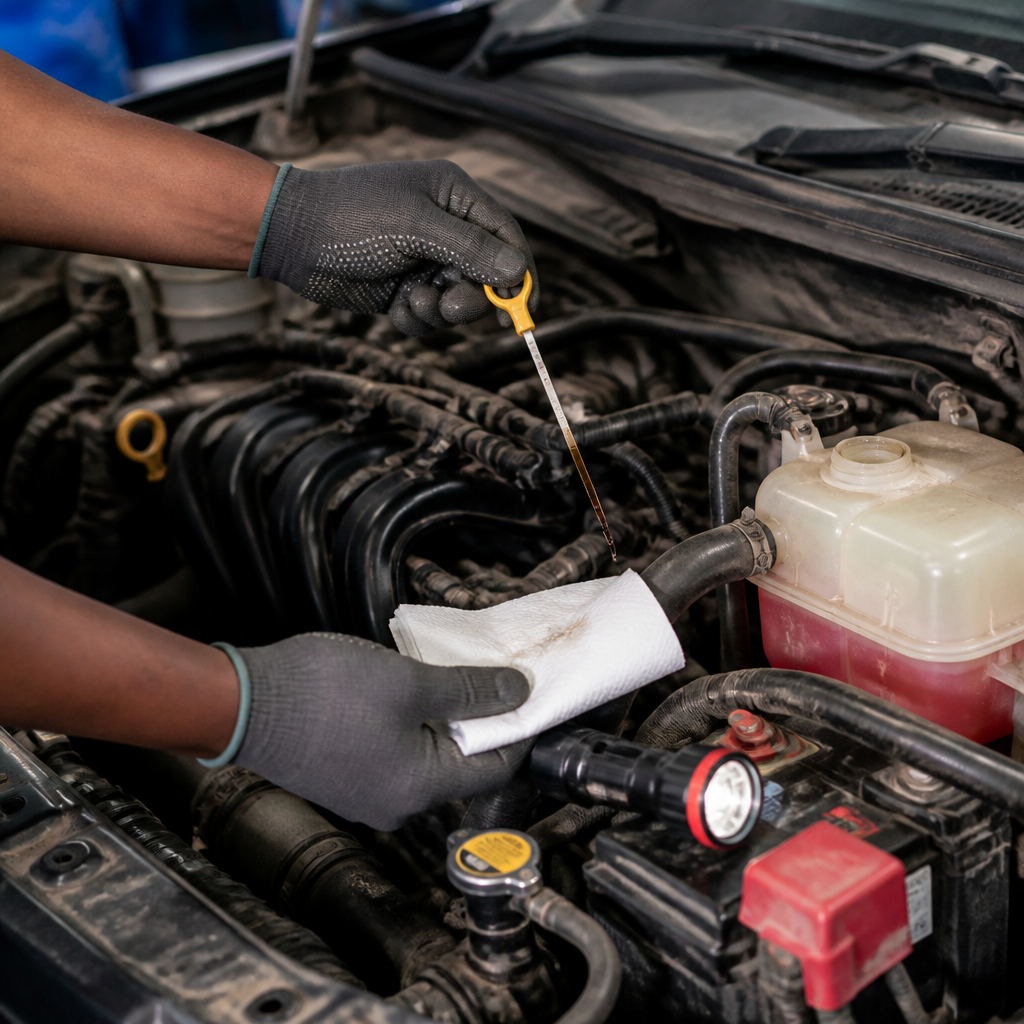
Remove the dipstick, wipe it clean, reinsert it fully, and remove it again. The oil level should sit within the marked range. Low oil may result from neglect, consumption, or an active leak. Oil that is slightly dark may be normal, especially if the service interval is ending. The colour alone cannot diagnose the engine.
Be cautious if the oil looks thick, tar-like, or heavily sludged. Sludge can form when oil changes are neglected, when the engine operates under severe conditions, or when contamination occurs. A creamy or milky substance under the oil cap can indicate moisture. A small amount may sometimes result from condensation, particularly with short trips, so a mechanic should investigate rather than make a diagnosis from one observation.
Rub a small amount of oil between your fingers only if you can do so safely and hygienically. Gritty particles, a strong fuel smell, or an unusually thin texture deserve attention. Do not treat this simple test as a substitute for laboratory analysis or a professional inspection.
Check the coolant carefully
Only inspect the coolant reservoir when the engine is cold. The level should generally sit between the indicated marks. The coolant should look reasonably clean for the vehicle’s design. Oil floating in the coolant, thick contamination, or an empty reservoir is a warning sign.
Ask whether the car has ever overheated. A seller may describe a previous overheating event as a minor issue, but overheating can damage a cylinder head or head gasket. Look for repeated coolant loss, bubbles in the reservoir after the engine warms up, a sweet smell, white exhaust smoke, or a temperature gauge that rises above its normal position.
Do not open a hot radiator cap to check the coolant. If the seller has already driven the vehicle, wait until the system cools. A proper workshop can perform cooling-system pressure tests when needed.
Perform a proper cold-start test
A cold start is one of the most useful ways to check a used car engine. Place your hand near the bonnet before starting, without touching hot parts. If the engine is already warm, ask why. The seller may have been moving the vehicle, but you should record that the cold-start test was not possible. How to Check Tokunbo Car Mileage Before Buying in Nigeria
Watch the dashboard as you turn the ignition on. Several warning lights should appear briefly as the vehicle performs its self-check. After the engine starts, the oil-pressure and charging lights should normally go out. The check-engine light should also behave consistently with the vehicle’s system. A light that stays on, flashes, or disappears suspiciously requires further diagnosis.
Listen during the first few seconds. A brief click or rattle may occur on some engines, especially after sitting. Persistent knocking, deep tapping, grinding, squealing, or chain rattle is more concerning. The sound’s location and timing matter. A mechanic should identify whether it comes from the top of the engine, the bottom end, an accessory, or the exhaust system.
Observe how quickly the engine starts. A healthy engine may start promptly, but starting time varies by engine type, battery condition, temperature, and fuel system. Repeated cranking, stalling, rough shaking, or the need to press the accelerator can indicate problems with fuel delivery, ignition, compression, sensors, or air intake.
Watch the exhaust immediately after starting. Thin white vapour on a cool morning can be normal condensation. Persistent thick white smoke after the engine warms up may indicate coolant entering the combustion chamber. Blue smoke often suggests oil burning. Black smoke can point to an overly rich fuel mixture or incomplete combustion. However, exhaust colour alone is not a final diagnosis.
Watch the engine at idle
Let the vehicle idle without pressing the accelerator. The idle should settle rather than repeatedly rise and fall. Some engines have a naturally uneven character, but pronounced shaking, stalling, or a strong vibration through the steering wheel and seats requires investigation.
Listen with the bonnet open, keeping your clothing and hands away from moving components. Pay attention to hissing, air leaks, belt squeals, ticking, and unusual knocking. Turn the air conditioner on and off. A small change in idle speed can be normal, but the engine should not nearly stall or develop severe vibration.
Check the temperature gauge as the engine warms. It should move toward its normal operating range and remain stable. A gauge that stays unusually low may indicate a thermostat issue. A gauge that climbs too high, fluctuates sharply, or approaches the red zone is a major warning. Stop the test if the engine overheats.
Inspect the exhaust again after several minutes. Ask a friend to press the accelerator gently while you observe from a safe distance. Do not stand directly behind the exhaust if smoke or debris is emerging. Persistent smoke deserves a professional compression, leak-down, or combustion-gas check, depending on the symptoms.
Use an OBD scan, but understand its limits
An OBD scanner can read diagnostic trouble codes stored by the vehicle’s computer. It may identify faults related to emissions, ignition, sensors, misfires, or other systems. However, a scan is not a complete engine inspection. A car can have mechanical wear without storing a code, and a stored code does not always identify the failed part.
Plug the scanner in with the ignition off or as the device instructions recommend. Record any codes before clearing them. Never allow a seller to erase codes just before you arrive. Also check whether the readiness monitors are complete. If many monitors show as not ready, the battery may have been disconnected or the codes may have been cleared recently.
A missing check-engine light can also be misleading if the warning bulb has been removed or modified. Compare the dashboard’s self-check behaviour with the scanner results. A reputable technician can interpret the code in context and perform additional tests.
Some older vehicles may not support the same diagnostic functions as newer models. The connector, software, and available data vary. If you are buying a vehicle with a complex electronic system, use a scan tool suitable for that manufacturer rather than relying on a basic generic reader alone.
Take a careful test drive
Drive the vehicle on a route that includes slow traffic, smooth pavement, a rough section, and a safe open road. Obtain the owner’s permission and make sure the vehicle is legally and safely driven. If possible, let the mechanic sit in the car and observe the engine, transmission, and dashboard.
From a stop, accelerate gently. The engine should respond without hesitation, severe vibration, or a cloud of smoke. Try moderate acceleration when safe. Misfiring, loss of power, surging, or an unusual metallic sound can indicate engine or fuel-system problems.
Monitor the temperature gauge throughout the drive. Heavy traffic and air-conditioner use can expose cooling weaknesses. If the temperature rises, stop safely and switch off the engine. Do not continue driving to see whether the problem gets worse.
Listen when you lift off the accelerator and when the engine pulls uphill. Some noises appear only under load. A deep knock that becomes louder under acceleration is particularly concerning. A ticking sound may come from valve-train components, injectors, exhaust leaks, or low oil pressure. A technician should assess it before you proceed.
Notice how the engine behaves when restarting after a short stop. Hot-start difficulty can point to battery, starter, fuel, sensor, or heat-related problems. Again, no single symptom proves one specific fault. The value comes from combining the test-drive observations with the visual inspection and scan.
Check for overheating and head-gasket warning signs
Head-gasket and overheating repairs can become costly, so treat related symptoms seriously. Possible signs include persistent white exhaust smoke, unexplained coolant loss, a sweet smell, contaminated oil, repeated bubbling in the cooling system, and an engine that overheats under load.
Some symptoms have other causes. White vapour may be condensation. Brown coolant may result from old coolant or rust. A rough idle may come from an ignition fault rather than a head-gasket failure. Therefore, avoid accusing the seller based on one sign. Instead, request a cooling-system pressure test, combustion-gas test, compression test, or leak-down test when appropriate. How to Check the Used Car Year Before You Buy
Ask for evidence of previous overheating repairs. Invoices, parts receipts, and workshop records can help. A recently replaced radiator does not automatically mean the engine is healthy. The reason for the replacement matters. If the seller cannot explain repeated cooling repairs, budget for a more detailed inspection.
Review service history and maintenance evidence
Service records are more useful when they contain dates, mileage, work descriptions, and identifiable workshop information. Look for evidence of oil changes, filter replacement, coolant servicing, spark plugs, timing-belt work, and major repairs. The exact maintenance schedule depends on the make, model, engine, climate, and operating conditions.
Do not assume that a stamped service booklet proves every service occurred. Compare the records with the odometer and the vehicle’s condition. Check whether the engine oil grade and parts listed are suitable for the engine. A seller may not have every receipt, especially for an older car, but a complete absence of maintenance evidence should affect your risk assessment.
Ask direct questions. When was the last oil change? Has the engine ever overheated? Has the cylinder head been removed? Does it use oil between services? Has the timing belt or chain been inspected? Has the engine been replaced? Honest answers are useful even when the answer is not perfect.
If the engine has been replaced, request documentation showing the work and the replacement unit’s identity where available. A replacement engine is not automatically bad. Poor installation, mismatched electronics, unknown mileage, or missing paperwork are the greater concerns.
Inspect the engine with an independent mechanic
The seller’s mechanic may be experienced, but an independent inspection reduces the conflict of interest. Choose a technician who is familiar with the vehicle’s make and engine type. If the car is a diesel, turbocharged model, hybrid, or premium vehicle, use someone with relevant diagnostic experience.
Ask the mechanic to inspect more than the engine bay. A useful pre-purchase inspection can include the cooling system, oil leaks, compression or cylinder balance where necessary, engine mounts, transmission, suspension, brakes, steering, electrical systems, air conditioning, underbody, and signs of accident repair.
Request a written report or at least a clear list of findings. Separate the results into three groups:
- Immediate safety or reliability concerns: faults that make the car unsafe or unsuitable to drive.
- Likely near-term repairs: items that may need attention soon after purchase.
- Normal wear: minor issues that fit the vehicle’s age and condition.
Ask for repair estimates from a reputable workshop. Estimates vary by location, parts quality, labour, engine design, and the extent of the damage. Use them as decision-making information rather than as guaranteed prices.
Interpret common warning signs
Many buyers become alarmed by normal used-car characteristics, while others overlook serious symptoms. The following guide can help you decide what deserves more testing.
Low oil level
Low oil may reflect a delayed service, an external leak, or oil consumption. Check the level again after the inspection and ask whether the seller has been topping it up. A low level is not proof of engine failure, but it shows that maintenance needs attention.
Oil around the engine
A light seep can be a manageable repair. Fresh oil running down the engine, oil reaching the exhaust, or drops on the ground are more serious. Find the leak’s source before agreeing on a price.
Rough idle
Rough running can come from spark plugs, ignition coils, injectors, vacuum leaks, sensors, engine mounts, low compression, or other causes. A scan and physical diagnosis are necessary. Do not accept “it only needs tuning” without evidence.
Blue smoke
Blue smoke usually suggests that the engine is burning oil, although the exact cause varies. Worn piston rings, valve seals, turbocharger problems, or other faults may be involved. Persistent blue smoke should be treated as a significant concern.
Knocking or tapping
Noise descriptions are subjective. Some injectors and valve trains naturally make a ticking sound. A deep knock that increases under load can be much more serious. Do not buy an engine with unexplained knocking unless a qualified technician confirms the cause and you accept the repair risk.
Overheating
Overheating may result from a thermostat, fan, radiator, water pump, hose, sensor, or head-gasket problem. Because the consequences can be severe, stop the test and arrange a proper cooling-system diagnosis.
Questions to ask the seller
Ask questions calmly and record the answers. A seller who is willing to provide information and allow an inspection gives you a better basis for a decision. How to Inspect a Used Car Transmission Before You Buy
- How long have you owned the car?
- Why are you selling it?
- Has the engine ever overheated?
- Has the engine, cylinder head, turbocharger, or transmission been replaced?
- How often do you change the oil?
- Does the engine consume oil or coolant?
- Are any dashboard warning lights currently on?
- Can I see the vehicle start from cold?
- Can I take the car for an independent inspection?
- Are there outstanding ownership or documentation issues?
Pay attention to consistency. The answers should broadly match the records, inspection findings, and vehicle condition. A confident seller may still be mistaken, so verify important claims instead of relying on confidence.
Do not ignore documentation and ownership checks
Mechanical condition is only one part of a safe purchase. Verify the vehicle identification number on the car and compare it with the available documents. Check that the VIN appears consistent on the dashboard, body label, chassis area, or other manufacturer-approved locations. Do not buy a vehicle if the identification marks appear altered.
Confirm the seller’s authority to sell the vehicle. Review the relevant ownership and registration documents, and ensure that the transaction process is clear. If the vehicle is imported, ask for the available import and customs documentation. Requirements can change, so use the appropriate official Nigerian authorities or a qualified documentation professional for current guidance.
Do not hand over the full purchase amount simply because the engine starts. A clean physical inspection does not resolve ownership disputes, outstanding finance, forged papers, or identity problems. Mechanical checks and documentation checks should happen together.
How inspection results should affect your decision
Not every used car needs to be perfect. Older vehicles naturally show wear, and replacing tyres, belts, hoses, fluids, or filters may be reasonable. The question is whether the total condition matches the price and your ability to maintain the car.
Use three possible decisions:
- Proceed: The engine starts cold, runs smoothly, shows no major leaks or smoke, passes a diagnostic scan, and receives a satisfactory independent inspection.
- Renegotiate: The vehicle has manageable repairs, and you can verify the cost before agreeing on a revised price.
- Walk away: The seller blocks inspection, the engine overheats, warning signs are hidden, documents are questionable, or the likely repair risk is too high.
Do not let urgency control the decision. Another vehicle will become available. A deposit or emotional attachment should not persuade you to accept an engine problem that you cannot afford to repair.
Common mistakes buyers make
- Inspecting only a warm engine: Warm oil and a warm idle can hide starting and running problems.
- Judging the engine by appearance: A clean engine bay does not prove good maintenance.
- Believing every dashboard light is harmless: A warning light may represent a costly fault.
- Using only a scanner: Codes provide clues, but they do not replace mechanical testing.
- Skipping the test drive: Some problems occur only under load or after warming up.
- Accepting vague repair promises: Ask what failed, what was replaced, and whether there are receipts.
- Ignoring oil and coolant levels: Fluids provide important clues about care and leaks.
- Letting the seller choose the mechanic: An independent inspection protects your interests.
- Focusing only on the engine: A reliable engine cannot compensate for unsafe brakes, damaged steering, or invalid documents.
Frequently asked questions
Can I check a used car engine without a mechanic?
You can perform useful basic checks yourself. Look at the oil, coolant, leaks, warning lights, exhaust, idle quality, and temperature gauge. However, you may miss internal wear, compression problems, electrical faults, or hidden accident damage. Use a qualified mechanic before completing the purchase.
Is dark engine oil a sign that the engine is bad?
Not necessarily. Oil naturally becomes darker as it circulates and collects contaminants. The oil level, texture, smell, service history, and engine symptoms matter more than colour alone. Thick sludge, fuel contamination, metal particles, or very low oil require further investigation.
Should I buy a car with a replaced engine?
A replacement engine can work well if it was correctly selected, installed, tested, and documented. Ask why the original engine failed and whether the replacement’s condition is known. Have a mechanic inspect the installation, wiring, cooling system, mounts, and diagnostic data.
What does white smoke from the exhaust mean?
Light vapour during a cold start can be normal condensation. Thick, persistent white smoke after the engine warms may indicate coolant entering the combustion chamber. Other causes are possible, so request professional testing before making a decision.
Is a small oil leak acceptable?
It depends on the source and severity. Minor seepage may be manageable, while a leak that reaches the exhaust, reduces the oil level, or leaves fresh drops can become expensive. Identify the source and obtain a repair estimate.
What should I do if the seller refuses a cold start?
Ask for a clear explanation and arrange another viewing when the vehicle has been parked long enough to cool. If the seller still refuses, consider walking away. A serious buyer should have a reasonable opportunity to inspect the vehicle fairly.
Can a test drive prove that an engine is healthy?
No. A test drive shows how the vehicle behaves at that time and under those conditions. It cannot rule out hidden or developing faults. Combine it with fluid checks, a cold start, diagnostic scanning, service-history review, and an independent inspection.
Final checklist before you pay
Before making payment, review your notes and confirm that you have inspected the vehicle without pressure. The following checklist is a practical final filter:
- The engine was inspected from cold, or you understand why that was not possible.
- Oil and coolant levels were checked safely.
- There were no unexplained major leaks.
- The engine started without excessive cranking, smoke, or abnormal noise.
- The temperature remained stable during the test drive.
- The dashboard warning lights behaved normally.
- An OBD scan was completed where compatible.
- An independent mechanic inspected the car.
- The service history and mileage appear reasonably consistent.
- The VIN and ownership documents match the vehicle.
- You know which repairs may be needed and what they could involve.
- The final price reflects the vehicle’s actual condition.
When you check a used car engine carefully, you improve your chance of buying a dependable vehicle and reduce the risk of an expensive surprise. Take your time, insist on a cold start, verify the warning signs, and use an independent professional. In Nigeria’s varied driving conditions, disciplined inspection is one of the best protections a used-car buyer can create.