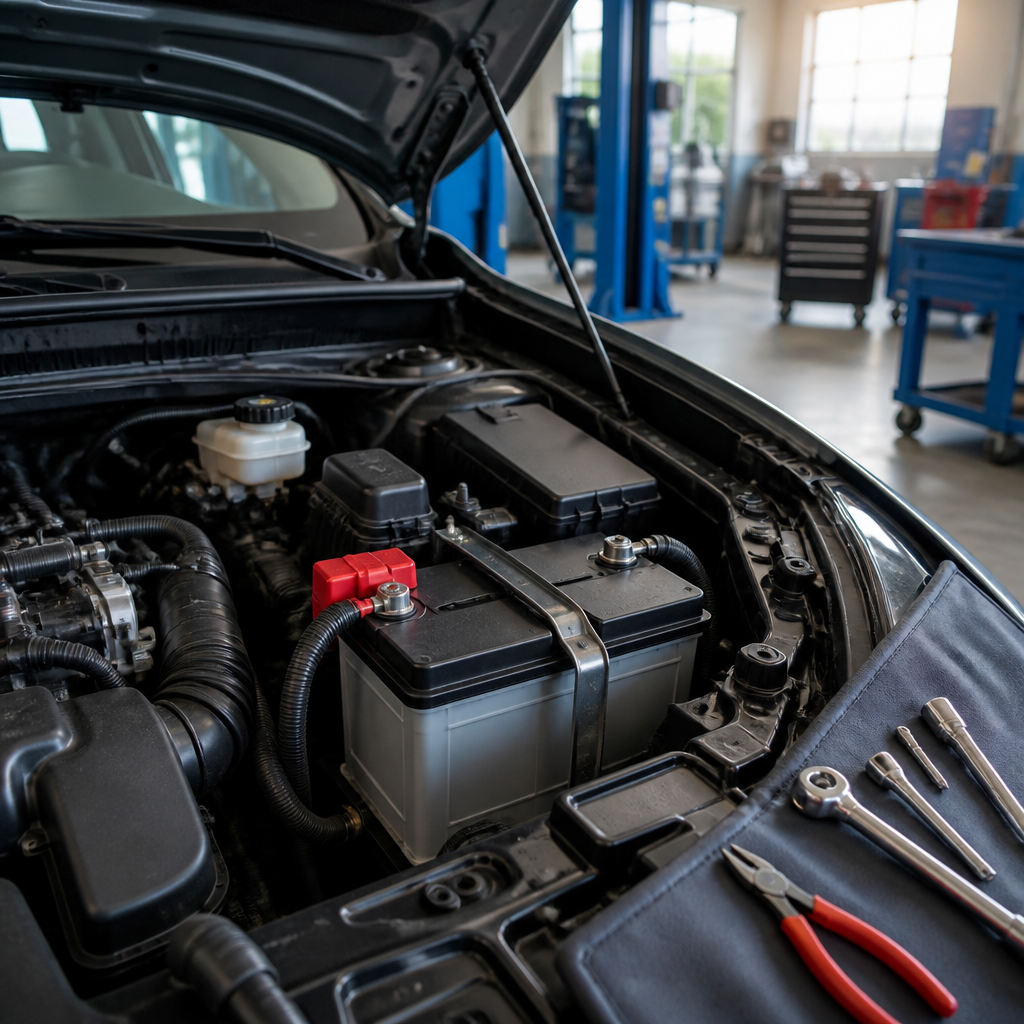
Learning how to choose the right car battery can save you from starting problems, electrical faults, and an expensive wrong purchase. The best battery is not always the largest or most powerful option on a shop shelf. It must match your vehicle’s physical dimensions, terminal layout, electrical requirements, engine type, driving conditions, and charging system.
A battery may look suitable and still fail to fit the tray, connect to the cables, or provide enough starting power. Some modern vehicles also need battery registration or electronic configuration after replacement. Therefore, careful checking matters before you hand over your money.
This guide explains the process in practical steps. You will learn how to read battery specifications, compare conventional and advanced battery types, check compatibility, avoid common buying mistakes, and dispose of an old battery responsibly. Car Detailing vs Car Washing: What’s the Difference?
Why choosing the correct battery matters
Your car battery performs more than one job. It supplies the initial electrical power needed to crank the engine. It also supports lights, security systems, computers, audio equipment, sensors, and other electrical accessories when the engine is off or the alternator cannot instantly meet demand.
If the battery is too weak, the starter motor may turn slowly or fail to turn at all. A battery with the wrong dimensions may move inside its tray. Movement can damage the case, terminals, or cables. Incorrect terminal placement can also make the cables too short or create a risk of accidental contact with metal components.
Using the wrong battery technology creates another problem. A vehicle designed for frequent stop-start operation may need an AGM or EFB battery. Replacing it with a basic flooded battery can lead to short service life and charging problems. Likewise, fitting an expensive AGM battery to a simple vehicle may offer little practical benefit if the vehicle cannot use its capabilities.
Battery selection also affects reliability in hot or demanding conditions. High under-bonnet temperatures can accelerate battery wear. Frequent short trips may prevent the alternator from fully replenishing the energy used during starting. Heavy traffic, aftermarket accessories, long periods of parking, and intense air-conditioner use can add further strain.
Start with your vehicle’s exact requirements
The safest starting point is your vehicle’s documentation. Check the owner’s manual, service records, the battery currently fitted, or the vehicle manufacturer’s parts information. Record the vehicle’s make, model, model year, engine size, fuel type, and transmission. These details help narrow the correct battery group and specification.
Do not rely on the vehicle model alone. One model may use different batteries depending on the engine, market, trim level, factory options, or production period. A petrol version can require a different battery from a diesel version. Hybrid and start-stop vehicles often have additional requirements.
Information to collect before shopping
- Vehicle make, model, year, and engine size.
- Fuel type and whether the vehicle has automatic stop-start technology.
- The battery group size or part number recommended by the manufacturer.
- Battery chemistry or technology, such as flooded, EFB, or AGM.
- Required cold cranking amps, often shown as CCA.
- Required reserve capacity, if specified.
- Terminal position and terminal type.
- Battery dimensions and hold-down or base configuration.
- Whether the vehicle requires battery registration or electronic reset after replacement.
If the existing battery is still fitted, photograph its label before removing it. Take a clear picture of the top, front, terminals, and any side label. The label may show the group number, voltage, capacity, CCA, technology, and manufacturer part number.
Use the old battery as a reference, not the only authority
The old battery can provide useful clues, but it may not be the correct specification. A previous owner or workshop may have installed an unsuitable replacement. For that reason, compare the battery label with the owner’s manual or a reliable vehicle-specific catalogue.
Also check whether the old battery has been modified to fit. An improvised spacer, loose clamp, extended cable, or unusual terminal adapter may indicate a previous mismatch. Do not copy a poor installation simply because it is already in the vehicle.
Understand the main battery specifications
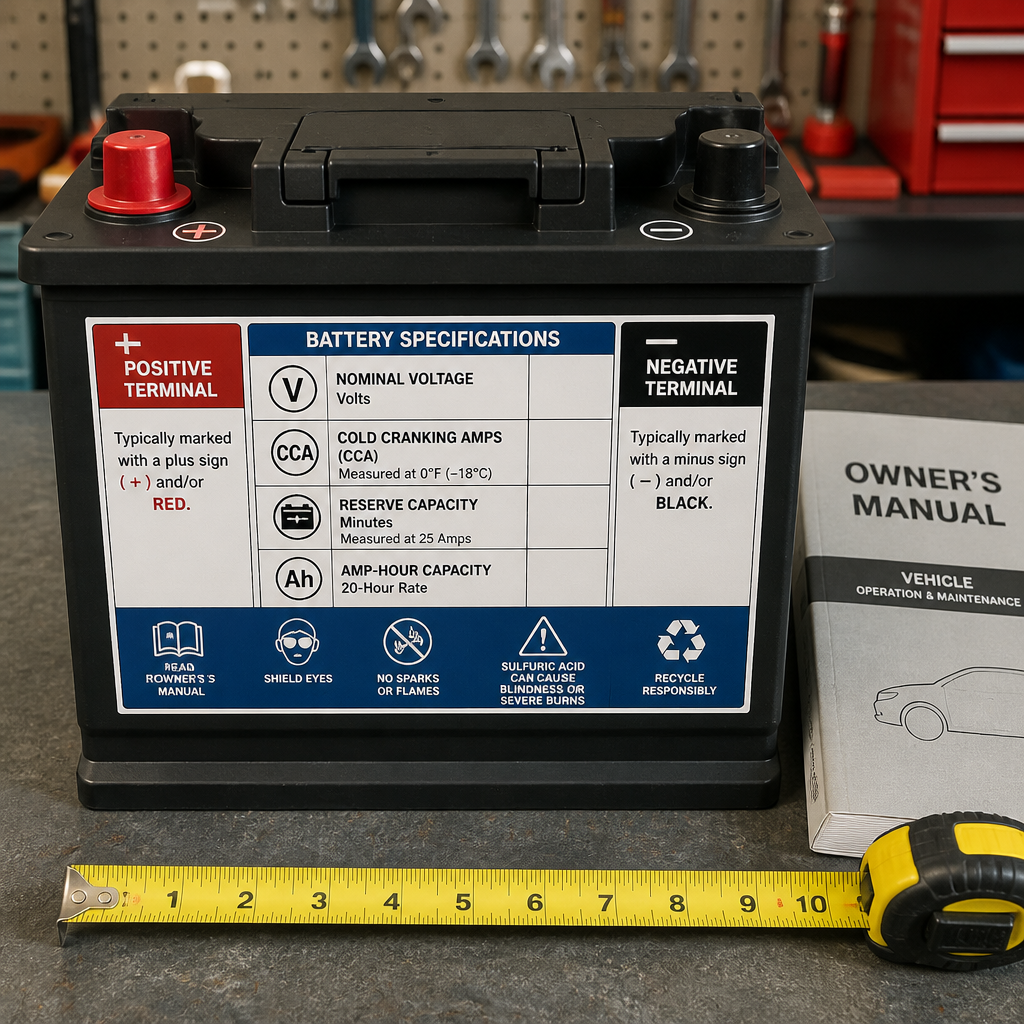
Battery labels contain several numbers and terms. They can appear confusing, but each one answers a different question. The most important specifications are voltage, physical size, capacity, starting power, reserve capacity, terminal arrangement, and battery technology.
Voltage
Most conventional passenger cars use a 12-volt battery. That does not mean every 12-volt battery is suitable. Voltage is only the first basic requirement. Heavy commercial vehicles and some specialist applications may use different systems, while some vehicles use more than one battery.
Never assume that a battery with the correct voltage automatically fits your car. You still need to confirm its dimensions, terminal layout, capacity, and construction.
Group size and physical dimensions
Battery group size is a standard reference used to describe a battery’s dimensions, terminal arrangement, and sometimes its hold-down design. The exact system can vary by market and battery manufacturer. Use the group number recommended for your vehicle rather than selecting one that merely looks close.
Measure the old battery if necessary. Check its length, width, height, terminal position, and the space available above it. Height matters because an overly tall battery may touch the bonnet or another component. Length and width matter because a battery that does not sit correctly can shift during braking or on rough roads.
The hold-down mechanism deserves special attention. Some vehicles use a top clamp, while others use a lower lip or side mounting arrangement. The battery must be secured firmly with the correct restraint. Never treat the hold-down as optional.
Cold cranking amps
Cold cranking amps, or CCA, indicate the battery’s ability to deliver starting current under a standardised cold-temperature test. A higher CCA rating generally provides more starting reserve, but the figure must be compared using the same testing standard. Different standards can produce different numbers.
Follow the vehicle manufacturer’s recommendation. A modest increase may be acceptable if the battery still matches the vehicle’s size, charging system, and technology. However, chasing the highest CCA can waste money and may lead you to ignore more important fitment details.
In warm climates, people sometimes assume CCA does not matter. It still matters because the starter motor requires substantial current, especially when the engine oil is thick, the engine is worn, or the battery is partly discharged. High temperatures also shorten battery life, so a strong and correctly specified battery remains valuable.
Capacity and ampere-hours
Battery capacity is often expressed in ampere-hours, or Ah. It describes the amount of electrical charge the battery can provide under a defined test. Capacity is not the same as starting power. A battery can have a strong CCA rating but a different capacity from the one your vehicle needs.
Capacity becomes particularly important for vehicles with many electronic systems, frequent stop-start operation, or long periods when accessories operate without the engine running. Do not select a much larger capacity without confirming that the vehicle’s charging system and battery management system can support it.
Reserve capacity
Reserve capacity indicates how long a battery can provide a specified amount of current before its voltage falls to a defined level. This measurement gives an idea of how well the vehicle can continue to power essential electrical systems if the alternator stops working.
Not every manufacturer presents reserve capacity in the same way. If your vehicle manual lists a required value, use that information. Otherwise, focus first on the recommended battery type, group size, capacity, and CCA.
Choose the correct battery technology
Battery construction affects cost, durability, charging behaviour, and suitability. The main types found in passenger vehicles are conventional flooded lead-acid batteries, enhanced flooded batteries, and absorbent glass mat batteries. How to Protect Car Paint From Nigeria’s Harsh Sun
Conventional flooded batteries
Flooded lead-acid batteries remain common in many vehicles. They contain liquid electrolyte and are often less expensive than advanced alternatives. They can be suitable for cars with conventional charging systems and moderate electrical demands.
Although many modern flooded batteries are described as maintenance-free, that does not mean they can be installed carelessly. Keep the case clean, check for damage, and ensure the battery remains securely mounted. Some batteries may still require inspection according to the manufacturer’s instructions.
Enhanced flooded batteries
EFB batteries are designed for greater cycling ability than standard flooded batteries. They are often used in vehicles with basic stop-start systems or higher electrical loads. These vehicles may switch the engine off at traffic lights and restart it repeatedly during a journey.
An EFB battery may be an appropriate replacement for another EFB battery. In some applications, an AGM upgrade may be possible, but compatibility must be confirmed. Do not make the change based only on price or appearance.
Absorbent glass mat batteries
AGM batteries hold the electrolyte in a glass-fibre separator. They can support high electrical demand and repeated cycling. Many vehicles with advanced stop-start systems, brake energy recovery, or extensive electronics use AGM technology.
AGM batteries often cost more, but the higher price can be justified when the vehicle requires one. Replacing an AGM battery with a standard flooded unit may cause poor performance and early failure. Always match the replacement technology to the vehicle’s design.
Do not confuse deep-cycle and starting batteries
Starting batteries deliver a powerful burst of current for a short time. Deep-cycle batteries are designed to provide a smaller current for longer periods. A leisure battery, marine battery, or auxiliary battery may not be suitable as the main starting battery in a normal car.
If your vehicle has a special auxiliary system, consult the manufacturer or a qualified battery specialist. The main battery and auxiliary battery may have different functions and specifications.
Check the terminal layout and connection details
Terminal position is one of the easiest details to overlook. Batteries with similar dimensions can have positive and negative terminals in different locations. If the polarity is reversed, the cables may not reach correctly. Connecting a battery incorrectly can damage fuses, electronic modules, alternators, and other components.
Stand at the same side and orientation used by the battery diagram or catalogue. Confirm which terminal is positive and which is negative. Do not rely on memory or assume that the positive terminal is always on the same side.
Inspect the terminal design as well. Some batteries use standard posts, while others use recessed terminals, threaded connections, or vehicle-specific fittings. The clamps should fit tightly without excessive force. A loose connection can create heat, voltage drops, intermittent starting, and electrical faults.
Before installation, ensure the cable ends are clean and free from corrosion. Do not apply excessive grease between the electrical contact surfaces. If you use terminal protection, follow the battery or vehicle manufacturer’s guidance and keep the main contact area secure.
Consider your driving conditions and climate
Real-world use affects battery life. A car driven long distances several times a week generally gives its charging system more time to replenish starting energy. A car used for short trips may consume more energy during starting than the alternator replaces.
Frequent short journeys are common in urban areas. Starting the engine, running the air conditioner, using lights, and operating heated accessories can place a heavy load on the battery. If possible, combine short trips or take an occasional longer drive. A suitable smart charger can also help, especially when the vehicle is parked for long periods.
Heat is another concern. High temperatures can speed up internal battery deterioration. A battery may fail during a hot period even if its first obvious symptom appears during a later start. Keep the battery and surrounding area clean, and make sure heat shields or protective covers are correctly installed.
Cold weather increases starting demand because engine oil becomes more viscous. If you operate a vehicle in a cold region, pay close attention to the recommended CCA. In hot regions, focus on heat exposure, ventilation, correct charging voltage, and battery quality.
Vehicles used on rough roads also need secure mounting. Vibration can damage internal components and loosen connections. A correctly sized battery with a firm hold-down is more reliable than a larger battery that does not sit properly.
Check the alternator and charging system first
A new battery cannot repair a faulty charging system. If the alternator is undercharging, overcharging, or producing unstable voltage, it can damage a replacement battery. Similarly, a parasitic drain can discharge even a high-quality battery while the vehicle is parked.
Before buying, consider whether the old battery failed suddenly or gradually. Slow cranking often points to low charge, ageing, poor connections, or internal battery wear. A battery that repeatedly goes flat may indicate a charging fault, an electrical drain, or a vehicle that is not driven long enough to recover its energy.
A qualified technician can test the battery, alternator output, starter current, and resting electrical drain. Ask for a proper diagnosis if the battery has failed more than once. Replacing batteries repeatedly without finding the underlying fault becomes expensive.
Inspect the visible connections yourself. Look for loose clamps, white or green corrosion, damaged cables, cracked insulation, and signs of heat. Do not touch damaged high-voltage components on hybrid or electric vehicles. Those systems require technicians with the appropriate training and equipment. Car Suspension Noise: Common Causes and Fixes
How to choose the right car battery in a shop
Once you know the vehicle requirements, compare products in a consistent way. Price should not be your only measure. A cheaper battery may have a shorter warranty, lower starting reserve, a different technology, or an unsuitable fit.
- Confirm the application. Give the seller the complete vehicle details, including engine and model year.
- Match the battery group or dimensions. Check length, width, height, terminal position, and hold-down design.
- Match the technology. Replace AGM with AGM and EFB with EFB unless a confirmed alternative is approved.
- Compare CCA and capacity. Ensure the product meets the manufacturer’s minimum requirements.
- Check the manufacturing or stock date. Ask how the battery has been stored and whether it has been properly charged before sale.
- Inspect the case. Avoid batteries with cracks, swelling, leaks, damaged terminals, or loose labels.
- Review the warranty terms. Understand what proof of purchase, testing, exclusions, and replacement conditions apply.
- Confirm installation requirements. Ask whether the vehicle needs battery registration, coding, or a reset.
Battery age matters because lead-acid batteries gradually lose condition in storage. A battery that has sat discharged may suffer permanent damage before you buy it. A reputable seller should be able to explain storage and preparation practices.
Do not buy a battery solely because it has the highest advertised number. The label may use a different testing standard, and the battery may not physically fit. A correctly matched mid-range product is usually a better choice than an unsuitable premium product.
Battery warranty and seller support
Read the warranty before purchase. Check its coverage period, conditions, and exclusions. Some warranties require the battery to be tested by the seller or an approved service centre. Others may exclude damage caused by incorrect installation, vehicle faults, over-discharge, or commercial use.
Keep the receipt and record the installation date. If possible, keep the battery label or take a photograph of its identification code. This information can make a later warranty assessment easier.
Seller support also matters. A knowledgeable battery supplier can check fitment, test the old battery, identify charging problems, and explain safe installation. Online listings can be useful for comparison, but verify the final part number with a vehicle-specific catalogue.
Safe battery replacement basics
Car batteries contain corrosive electrolyte and can deliver very high current. They may also release flammable gas during charging. Work in a ventilated area, keep flames and sparks away, and wear suitable eye protection and gloves.
Switch off the engine and all electrical accessories. Follow the vehicle manual because some cars require a memory-saving procedure or a specific disconnection sequence. Modern vehicles can lose settings or record faults when power is removed.
- Park on a stable surface and apply the parking brake.
- Turn off the ignition and remove the key or follow the vehicle’s shutdown instructions.
- Identify the positive and negative terminals before loosening anything.
- Disconnect the negative cable first, unless the vehicle instructions specify another procedure.
- Disconnect the positive cable and remove the hold-down.
- Lift the battery carefully. It can be heavy and awkward to handle.
- Clean the tray and inspect the cables, clamps, and hold-down.
- Place the new battery in the correct orientation and secure it firmly.
- Connect the positive terminal first, then the negative terminal, unless the manufacturer states otherwise.
- Check that the connections are tight and that no cable can contact moving or hot components.
- Start the vehicle and check for warning lights or unusual electrical behaviour.
Never place a metal tool across the two terminals. Keep jewellery, watches, and loose metal objects away from the battery. Do not smoke while working around it.
Some vehicles need battery registration after replacement. Registration tells the battery management system that a new battery has been fitted. Without the correct procedure, the charging strategy may remain calibrated for the old battery. This can reduce the new battery’s life or cause charging problems.
Hybrid and electric vehicles require extra caution. Their high-voltage systems are separate from the ordinary 12-volt battery, but the 12-volt system still performs important functions. Use the manufacturer’s instructions or a qualified technician rather than attempting unfamiliar work.
Common battery-buying mistakes to avoid
Choosing by price alone
The lowest price may not represent the lowest ownership cost. Consider fit, technology, warranty, expected use, and seller support. A battery that fails early can cost more through towing, repeated installation, and lost time.
Buying the biggest battery that fits
A physically larger battery may not match the charging system or vehicle electronics. It may also have the wrong terminal arrangement. Bigger is not automatically better.
Ignoring battery technology
Do not replace an AGM or EFB battery with a standard flooded unit without confirming compatibility. Stop-start vehicles are designed around repeated cycling, and the wrong technology may wear out quickly.
Forgetting the hold-down
A battery that moves can suffer vibration damage. It may also place strain on the cables. If the hold-down is missing or broken, replace it before using the vehicle regularly.
Assuming a flat battery only needs charging
A flat battery may recover if it was accidentally discharged once. However, repeated deep discharge can cause permanent damage. Find out why the battery went flat before deciding that a charger is the complete solution.
Installing a new battery without testing the vehicle
A weak alternator, poor ground cable, starter fault, or parasitic drain can destroy a new battery. Test the complete starting and charging system when the cause is uncertain.
How to maintain your replacement battery
Maintenance begins with regular use. If the car sits for weeks, the battery may gradually discharge because alarms, computers, and tracking devices continue to draw small amounts of power. A suitable maintenance charger can help, but use one designed for your battery technology.
Keep the top of the battery dry and clean. Dirt and moisture can create a path for small electrical leakage. Check the terminals for corrosion and make sure the clamps remain tight. Do not remove vent caps or add water unless the battery manufacturer specifically instructs you to do so. Car Maintenance Rainy Season: A Practical Nigeria Guide
Watch for warning signs. Slow cranking, flickering lights, repeated jump-starts, swelling, leaks, a sulphur smell, and battery warning lights all deserve attention. Stop using a visibly swollen or leaking battery and arrange professional assistance.
Do not leave lights, chargers, entertainment systems, or other accessories running when the engine is off. Modern vehicles can still drain a battery quickly even when the accessories seem modest.
When the vehicle has been parked for a long time, inspect it before starting. Confirm that no rodents have damaged wiring and that the battery remains secure. If the battery has fully discharged, use a proper charger rather than repeatedly relying on jump-starts.
Responsible disposal of an old car battery
Lead-acid car batteries should not go into household rubbish or be abandoned. They contain lead, acid, and other materials that require controlled handling. Many battery retailers, automotive workshops, recycling facilities, and waste collection services accept used vehicle batteries, although availability varies by location.
Transport an old battery upright and secure it so it cannot tip over. Keep it away from children, food, heat, and metal objects. Do not pour out the electrolyte or attempt to break open the case.
Ask the seller about take-back or recycling arrangements before purchase. Proper recycling allows valuable materials to be recovered and reduces the risk of environmental contamination. Follow the disposal rules that apply where you live.
A simple decision checklist
Use this checklist before you buy:
- Have you confirmed the exact vehicle, engine, and model year?
- Have you checked the manufacturer’s recommended group size or part number?
- Do the new battery’s dimensions match the available space?
- Are the positive and negative terminals in the correct positions?
- Does the hold-down fit securely?
- Does the battery technology match the vehicle’s requirements?
- Does the CCA meet the recommended level?
- Is the capacity suitable for the vehicle?
- Has the battery been stored and prepared correctly?
- Have you reviewed the warranty conditions?
- Does the car need registration, coding, or a battery-management reset?
- Has the charging system been checked if the old battery failed unexpectedly?
If you can answer these questions confidently, you are much less likely to make a poor purchase. When information conflicts, give priority to the vehicle manufacturer’s specification and advice from a qualified technician.
Frequently asked questions
Can I use a battery with a higher CCA rating?
Sometimes, but only when the battery matches the required size, terminal layout, technology, capacity, and charging system. A higher CCA rating alone does not guarantee compatibility. Confirm the alternative with a reliable battery catalogue or qualified specialist.
Can I fit an AGM battery instead of a standard battery?
An AGM battery may be suitable for some vehicles, but it is not automatically a universal upgrade. The charging system and battery management system must support it. Confirm the change before buying.
Why does my new battery keep going flat?
Possible causes include a weak alternator, parasitic electrical drain, poor cable connection, frequent short trips, accessories left on, or a defective battery. Have the complete starting and charging system tested instead of repeatedly replacing the battery.
How long should a car battery last?
Service life varies widely. Climate, driving habits, charging condition, vibration, battery quality, and vehicle electrical demand all affect performance. Treat general lifespan estimates as guidance rather than a guarantee. Test the battery when symptoms appear.
Does a battery need to be fully charged before installation?
A reputable seller should prepare the battery correctly, but the answer depends on the product and vehicle. A battery that has been stored for a long time may need charging before use. Follow the manufacturer’s instructions and ask the seller to test it.
Can I replace the battery myself?
Some vehicles allow straightforward replacement, while others need memory support, battery registration, coding, or special procedures. If you are unsure, use a qualified technician. Incorrect connection can damage expensive electronic components.
Is a maintenance-free battery completely maintenance-free?
The term usually means the battery does not require routine electrolyte topping under normal conditions. It still needs correct installation, secure mounting, clean connections, suitable charging, and periodic inspection for damage or warning signs.
Final advice before you buy
To choose the right car battery, start with verified vehicle information rather than a guess based on appearance or price. Match the battery’s size, terminals, hold-down, technology, starting power, and capacity to the vehicle’s actual requirements.
Then consider how you drive. Short journeys, heavy traffic, extreme heat, long periods of storage, and extensive accessories can change what represents good value. A reliable seller should help you compare suitable options and identify charging-system problems.
Finally, treat installation and disposal as part of the purchase. Secure the battery correctly, follow the vehicle’s electronic procedures, and send the old unit to an appropriate recycling or collection point. These simple steps improve safety, protect the vehicle’s electrical system, and help the replacement battery deliver dependable service.