
Choosing the right tyres for Nigerian roads can improve your vehicle’s grip, braking, comfort and overall safety. The best choice is not always the most expensive tyre or the one with the deepest-looking tread. You also need to consider your vehicle’s approved size, the roads you use, Nigeria’s heat and rainfall, the load you carry, and the condition of the tyre before purchase.
Tyres are the only parts of your vehicle that touch the road. That small contact area must handle acceleration, steering, braking, standing water, potholes, rough shoulders and long journeys. A poor match can make the vehicle unstable, increase stopping distances and expose the tyre to avoidable damage.
This guide explains how to select suitable tyres with practical steps. It also covers tyre markings, road conditions, buying checks, maintenance, common mistakes and warning signs that mean replacement is necessary. Best Long-Distance Cars for Nigerian Roads
Why the right tyre choice matters in Nigeria
Nigerian driving conditions vary widely. A driver in Lagos may spend most of the week on busy paved roads and encounter heavy rain, standing water and traffic. Someone travelling regularly between towns may face broken pavement, gravel, road repairs and long distances between service points. Drivers in northern areas may deal with intense heat, dust and rough surfaces, while users of rural roads may need more resistance to stones and sharp edges.
No single tyre is perfect for every route. A tyre designed mainly for quiet highway driving may not provide the sidewall protection you want on badly damaged roads. Conversely, an aggressive all-terrain pattern may be unnecessary for a small car that spends nearly every day on smooth urban streets.
The correct tyre helps the vehicle work as the manufacturer intended. It supports the correct ride height, steering response, braking balance and load capacity. It can also reduce irregular wear caused by an unsuitable size, under-inflation or overloading.
However, a suitable tyre cannot compensate for dangerous driving or poor maintenance. Speed, tyre pressure, wheel alignment, worn suspension parts and vehicle loading still matter. Think of tyre selection as one part of a complete safety system.
Start with the vehicle manufacturer’s specifications
Before comparing brands, confirm the tyre size and performance requirements for your particular vehicle. The usual places to check are the driver’s door-jamb label, fuel-filler flap, glovebox area, owner’s manual or the vehicle manufacturer’s official information.
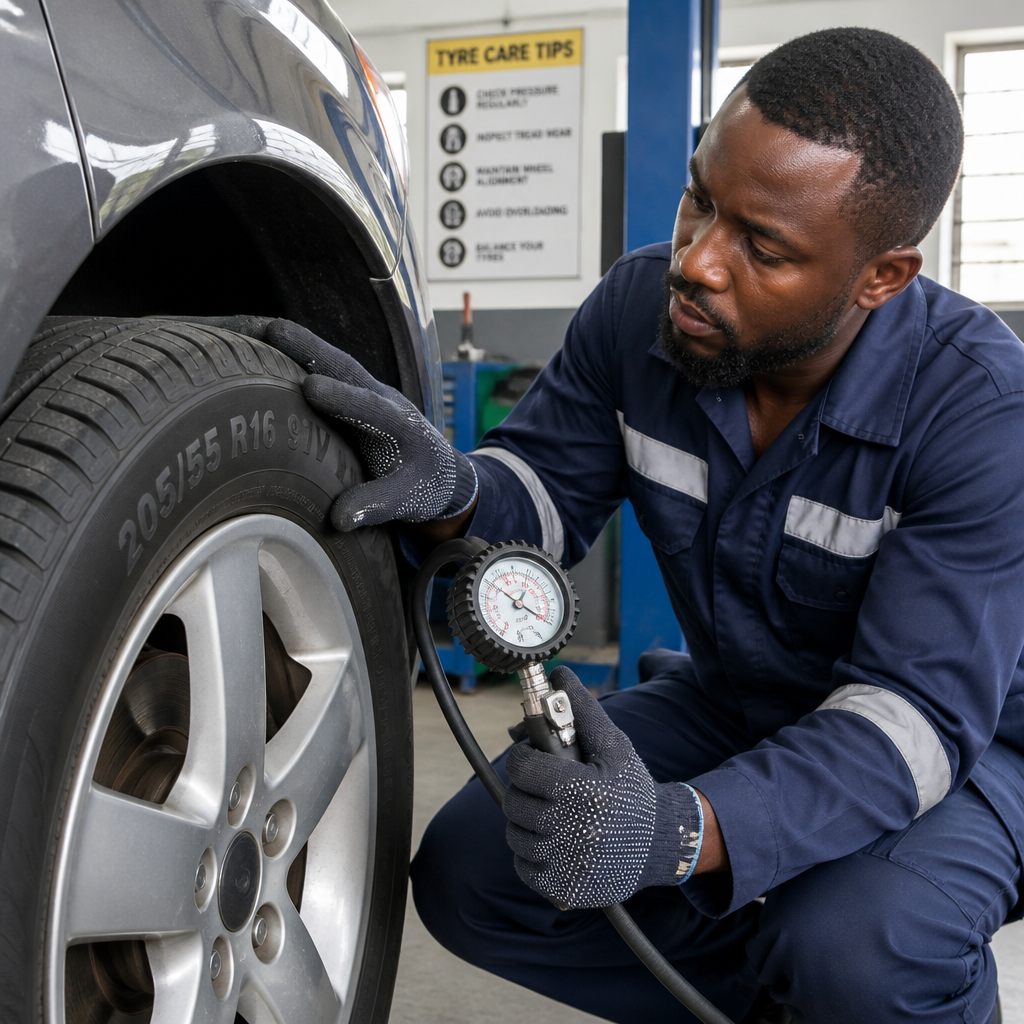
A tyre sidewall may show a marking such as 205/55 R16 91V. Each part communicates important information:
- 205 is the nominal width of the tyre in millimetres.
- 55 is the aspect ratio. The sidewall height is approximately 55 percent of the tyre width.
- R identifies radial construction, which is common on modern passenger vehicles.
- 16 is the wheel diameter in inches.
- 91 is the load index. It corresponds to a specified maximum load under the relevant tyre standard.
- V is the speed rating. It indicates the tyre’s rated speed capability under specified conditions, not a recommended driving speed.
Do not change these details casually. A tyre that is wider, narrower, taller or lower-profile may affect clearance, steering feel, speedometer accuracy and suspension behaviour. It may also create problems if it rubs against the wheel arch or suspension components.
Check the recommended pressure, not just the tyre sidewall
The pressure printed on a tyre sidewall is usually a maximum permitted pressure or a pressure related to the tyre’s rating. It is not necessarily the correct everyday pressure for your vehicle.
Use the vehicle manufacturer’s recommended cold pressure. Some vehicles have different front and rear pressures. Others specify a higher pressure when carrying passengers or luggage. Check the information label and follow the vehicle maker’s instructions rather than guessing.
Measure pressure when the tyres are cold, ideally before a journey. Driving heats the air inside the tyre and raises the reading. If you check a hot tyre, do not release air simply to reach the cold-pressure figure.
Do not reduce pressure to make a rough road feel softer
Some drivers lower pressure because the vehicle feels more comfortable on potholes. That may increase sidewall flex, heat build-up and the chance of impact damage. It can also make steering less precise and cause the tyre edges to wear quickly.
If a road is severely damaged, slow down and avoid obstacles where it is safe to do so. Do not use incorrect pressure as a substitute for speed control and careful driving.
Match the tyre to the roads you actually use
The best tyres for Nigerian roads depend on your normal route, not only the road you use on an occasional trip. Make a realistic list of your driving conditions. Consider how much time you spend in the city, on motorways, on unpaved roads, in construction zones and on wet surfaces.
Urban roads
Urban tyres should provide predictable braking, good wet-road grip and stable steering. They should also cope with frequent stops, tight turns, speed bumps and occasional potholes.
For a city vehicle, a quality touring or grand-touring tyre may be suitable. These patterns often aim to balance comfort, handling, noise and wet performance. Look for a construction appropriate to the vehicle and a reputable product with clear markings.
Do not select a tyre only because it looks sporty. Very low-profile tyres may have shorter sidewalls and less cushioning against sharp pothole impacts. They can be suitable on some vehicles, but they require greater care on damaged roads.
Highways and long-distance travel
Drivers who frequently travel between Nigerian cities should prioritise stability, wet braking, heat management and resistance to uneven wear. Long journeys expose tyres to sustained speed, heavy loads and high road temperatures.
A highway-oriented tyre with the correct load and speed rating can offer a comfortable and controlled drive. Before a long trip, inspect all four tyres, the spare and the valve stems. Check pressure when cold and remove mud or stones that may hide damage.
Remember that a tyre’s speed rating does not make high speed safe. Traffic, road quality, weather, visibility, vehicle condition and legal requirements still determine a safe speed. Stay within sensible limits for the road and conditions.
Rough roads, gravel and unpaved routes
If you regularly use gravel, laterite, broken pavement or roads with sharp edges, sidewall protection and durability become more important. A tyre with a stronger construction may be better suited than a delicate performance tyre.
All-terrain tyres can be useful for vehicles that divide their time between paved and unpaved surfaces. Their tread may provide better traction on loose ground. However, they can be noisier, less economical and less comfortable on smooth asphalt. They are not automatically the best choice for every SUV.
For a vehicle that spends almost all its time on tarmac, a road tyre may still be the better option. It can provide more predictable wet handling and lower noise. Choose based on your actual percentage of rough-road use.
Wet roads and heavy rainfall
Rain changes the available grip. Water can hide potholes, reduce visibility and create a layer between the tyre and road surface. Tyre tread channels help move water away from the contact area, but they cannot prevent aquaplaning at any speed or in every depth of water. Best Used Cars for Lagos Traffic: A Practical Buying Guide
For wet-weather use, look for a reputable tyre with a tread pattern designed for water evacuation and a current, undamaged construction. Keep the tread above the legal or manufacturer-recommended replacement point, but do not wait until the minimum indicator is the only reason to replace the tyre.
Reduce speed in heavy rain, increase following distance and avoid sudden steering or braking. Good tyres improve the margin of safety; they do not eliminate the risk created by standing water.
Understand tyre size, load index and speed rating
Many buying mistakes happen because drivers focus on brand names and ignore the numbers. The size must fit the wheel and vehicle. The load index must support the vehicle’s maximum permitted load. The speed rating should meet the manufacturer’s specification.
Never assume that a tyre with the same width will fit your vehicle. The aspect ratio, wheel diameter, load index, speed rating and construction also matter. In addition, wheel width and offset affect fitment. If you are unsure, ask a qualified tyre professional to confirm the complete combination.
Load capacity matters even more when you carry passengers, business equipment, tools or luggage. A tyre that is acceptable for a lightly loaded car may be unsuitable when the vehicle is regularly used at its maximum load.
Do not overload the vehicle to test the tyre’s capacity. Check the vehicle’s maximum permitted mass and axle limits. These figures are separate from the tyre’s load index. The vehicle remains the limiting factor when its capacity is lower.
For vans, pickups, minibuses and commercial vehicles, pay close attention to the tyre type and service description. Passenger-car tyres may not be appropriate for a vehicle that carries heavy loads every day. Follow the manufacturer’s specification and obtain professional advice if the vehicle has been modified.
Choose between new, used and retreaded tyres carefully
New tyres usually give you the clearest history and the most predictable remaining service life. They should still be inspected before purchase. Confirm the size, markings, tread, sidewalls and date information. Ask for an invoice or other proof of purchase where available.
Used tyres can appear attractive because they cost less initially. However, their history may be unknown. A used tyre may have suffered overloading, under-inflation, a severe impact or prolonged storage. Some damage is internal and cannot be seen from the outside.
If you consider a used tyre, have an experienced professional inspect the inside and outside before fitting. Reject any tyre with bulges, cuts, exposed cords, cracks, bead damage, repairs in unsafe areas or uneven wear that suggests serious structural stress. A low price is not a saving if the tyre fails or causes a crash.
Retreaded tyres can be appropriate for certain commercial applications when produced and inspected under suitable standards. Their suitability depends on the tyre type, casing condition, retreading process and vehicle use. Do not assume that every retread is equal. Ask questions about the supplier, application and inspection process.
Check the tyre’s age and storage condition
Rubber changes over time, even when a tyre has not been fitted. Heat, sunlight, humidity, ozone and poor storage can accelerate deterioration. A tyre’s manufacturing date is commonly represented by a four-digit code on the sidewall. The first two digits indicate the production week, and the last two indicate the production year.
For example, a code ending in 2423 generally indicates production in the 24th week of 2023. Confirm the complete marking with the seller or manufacturer if it is unclear.
Age alone does not tell the whole story, and recommendations vary by manufacturer and application. Still, older stock deserves closer inspection. Ask how it was stored and check for hardening, cracks or other signs of deterioration. If the seller cannot explain the tyre’s history, choose a clearer and better-documented option.
Inspect the tyre before you pay
A careful inspection can identify obvious problems before the tyre is fitted. Use good lighting and examine the entire circumference, not only the part visible from above.
- Confirm that the size matches your vehicle’s specification.
- Check that the load index and speed rating are suitable.
- Look for cuts, cracks, bulges, punctures and exposed cords.
- Inspect the bead area for damage or distortion.
- Check that the tread is evenly moulded and free from serious defects.
- Look for treadwear indicators and signs of previous irregular wear.
- Read the manufacturing date code and ask about storage.
- Make sure the sidewall markings are clear and consistent.
- Ask whether the tyre has been repaired, if it is not new.
- Confirm that the seller will fit and balance it correctly.
Reject a tyre with a visible bulge. A bulge commonly indicates internal cord damage, often caused by an impact. It is not safely repaired by adding air or applying an external patch.
Also reject tyres with deep sidewall cracks, exposed reinforcement, severe flat spots or damage around the bead. If you cannot identify a defect, ask a qualified technician before making a purchase.
Compare brands without relying on advertising alone
Brand reputation can help, but it should not replace specification and inspection. A well-known brand may offer several product lines with different purposes. The cheapest line and premium line from the same company may have different performance priorities.
Compare tyres using factors that matter to your driving:
- Wet grip: Important during rainfall and on roads with standing water.
- Durability: Useful for high mileage, heavy loads and challenging surfaces.
- Ride comfort: Relevant when roads are rough or journeys are long.
- Noise: Important for frequent highway and urban driving.
- Fuel efficiency: Rolling resistance can influence energy use, although it should not override safety.
- Sidewall strength: Valuable where potholes, kerbs and rough shoulders are common.
- Availability: A common size may be easier to replace during a journey.
- Warranty and support: Understand what the seller or manufacturer actually covers.
Be cautious about claims such as “puncture-proof”, “all-weather” or “best for every road”. Marketing language may simplify complex performance differences. Ask for the tyre’s intended application, specification and maintenance requirements.
Do not mix tyres with very different characteristics on the same axle. Ideally, use matching tyres across an axle, and follow the vehicle manufacturer’s instructions for replacement. If replacing only two tyres, professionals commonly consider fitting the pair with better remaining grip to the rear axle, but the vehicle maker’s guidance and the technician’s assessment should come first. Why Your Car Vibrates While Driving and What It Could Mean
Do not ignore wheel alignment and balancing
New tyres cannot correct a vehicle that has worn suspension components, bent wheels or incorrect alignment. If the steering wheel is off-centre, the vehicle pulls to one side, or the tread wears more on one edge, investigate the cause.
Wheel alignment adjusts the direction and angles of the wheels. Poor alignment can scrub away tread quickly and make the vehicle wander. Balancing corrects uneven weight distribution in the wheel and tyre assembly. A balance problem often appears as vibration at certain speeds.
Ask the fitter to inspect the wheel, valve and suspension before installation. Replace damaged valves where appropriate. Tighten wheel fasteners to the vehicle manufacturer’s specification, not simply by guesswork.
After fitting, check that the tyres are seated correctly and that there is no contact with the wheel arch, brake parts or suspension. Turn the steering from lock to lock when safe and stationary, then perform a cautious test drive.
Maintain your tyres after purchase
Even the best tyres for Nigerian roads can become unsafe if neglected. Create a simple inspection routine. Check pressure at least monthly and before long trips. Inspect the tread and sidewalls whenever you wash the vehicle or refuel.
Use the correct pressure
Under-inflation increases flex and heat. It can damage the sidewall, reduce fuel efficiency and wear the shoulders. Over-inflation can reduce the contact area and make the ride harsh. It may also make the vehicle less settled on uneven surfaces.
Use a reliable gauge. Do not rely only on appearance because a tyre can look normal while pressure is significantly low. Check the spare as well. A spare that has been forgotten for years may not be ready for emergency use.
Rotate tyres when appropriate
Tyres may wear differently depending on whether they are fitted to the front or rear axle, the vehicle’s drivetrain and your driving style. Rotation can help promote more even wear when the vehicle manufacturer permits it.
Not all tyres can be rotated in every pattern. Directional tyres must continue pointing in the correct direction. Some vehicles use different front and rear sizes, which may prevent rotation. Follow the vehicle manual or ask a qualified technician.
Inspect after pothole impacts
A hard impact can damage the tyre, wheel or suspension even when no immediate air loss occurs. After hitting a deep pothole or kerb, check for a bulge, vibration, steering change or pressure loss.
If the vehicle behaves differently, stop in a safe place and inspect it. Do not continue a long journey at speed with a suspected impact-damaged tyre. A professional may need to remove the tyre to inspect the inner liner and sidewall.
Keep tyres away from harmful contamination
Oil, fuel, solvents and some chemicals can damage rubber. Clean tyres with mild soap and water. Avoid aggressive dressings or products that leave the sidewall excessively slippery. If a tyre has been exposed to fuel or a chemical spill, seek professional advice.
Know when a tyre needs replacement
Replace a tyre when it reaches the manufacturer’s wear limit or shows damage that compromises its structure. Do not wait for a blowout or complete loss of tread.
Important warning signs include:
- Visible treadwear indicators across the tread.
- Repeated pressure loss without an obvious removable puncture.
- Bulges or bubbles on the sidewall.
- Deep cuts, exposed cords or severe cracking.
- Vibration that remains after balancing.
- Uneven wear caused by alignment or suspension problems.
- Separation, deformation or unusual noise.
- Damage after a major pothole or collision.
- Age-related deterioration or hardening.
A puncture is not always a reason to discard a tyre. Repairability depends on the puncture’s location, size, angle, tyre condition and repair method. Damage to the sidewall or shoulder is generally more serious than a small puncture in the repairable central tread area. Have a qualified professional assess it from the inside.
Do not use a plug as a permanent answer to every puncture. A proper repair requires the tyre to be removed and inspected, where the applicable repair practice permits it. Follow the tyre maker’s guidance and local professional standards.
A practical buying process for Nigerian drivers
Use this process before placing an order or visiting a tyre shop.
- Record the vehicle details. Note the make, model, year, engine version, current tyre size and any manufacturer-approved alternatives.
- Confirm the correct specification. Check width, aspect ratio, construction, wheel diameter, load index and speed rating.
- Describe your driving. Explain how often you use highways, city roads, gravel, rough routes and heavy loads.
- Set a realistic budget. Include fitting, balancing, valves, alignment and disposal of old tyres.
- Compare suitable options. Consider wet grip, durability, comfort, noise, sidewall protection and local availability.
- Inspect the actual tyres. Do not rely only on a photograph or a verbal description.
- Check age and condition. Read the date code and look for cracks, damage or poor storage.
- Use a competent fitter. Confirm correct mounting direction, pressure, balancing and wheel-fastener torque.
- Keep your paperwork. Retain the invoice and any warranty information.
- Monitor the first few weeks. Check pressure, handling, noise and wear after installation.
If a seller cannot confirm the tyre’s specification, date or condition, consider another seller. Transparency matters because tyres are safety-critical products.
Common tyre-buying mistakes to avoid
Choosing the cheapest available tyre
Price matters, especially when replacing four tyres. However, a low purchase price may not represent good value if the tyre has poor wet performance, unknown storage history or limited durability. Compare the full service value rather than the price alone. How to Compare Used Cars Before Making a Decision
Buying a larger size without checking fitment
Larger wheels or wider tyres can change handling and ride quality. They may also rub against the vehicle or reduce sidewall protection. Never assume that a size used by another vehicle is safe for yours.
Using different tyres on one axle
Significant differences in tread pattern, grip and wear can affect handling. Follow the vehicle manufacturer’s guidance and use matching pairs where possible.
Ignoring the spare tyre
The spare may be under-inflated, cracked or unsuitable for the vehicle. Inspect it regularly. If the vehicle uses a temporary spare, understand its speed and distance limitations before an emergency occurs.
Driving fast through potholes
Speed increases the force of an impact. Slow down before damaged sections, keep both hands ready on the steering wheel and avoid sudden swerves into another lane. If you cannot avoid a pothole, reducing speed is usually safer than striking it quickly.
Assuming deep tread means high quality
Tread depth is only one part of performance. Compound, construction, age, pressure, alignment and damage also matter. A very old tyre with deep tread may be less suitable than a newer tyre with a well-matched design.
Questions to ask a tyre seller or fitter
A professional seller should be able to answer basic questions clearly. Ask:
- Is this the correct size and specification for my exact vehicle?
- What load index and speed rating does it have?
- When was it manufactured?
- How was it stored?
- Is it intended mainly for paved roads, mixed surfaces or off-road use?
- What pressure should I use according to the vehicle maker?
- Will you inspect the wheels, valves and suspension?
- Is balancing included?
- Should the vehicle receive an alignment check?
- What does the warranty cover, and what exclusions apply?
Be wary of pressure to buy immediately, unexplained markings or claims that a tyre fits every version of a vehicle. A good seller should welcome reasonable questions because correct fitment protects both the driver and the business.
Frequently asked questions
What are the best tyres for Nigerian roads?
There is no single best tyre for every Nigerian driver. The suitable option must match your vehicle, road surfaces, rainfall exposure, load and driving distance. A quality touring tyre may suit mainly urban and highway use, while a suitable all-terrain model may make more sense for frequent gravel or rough-road driving.
Should I buy run-flat tyres?
Run-flat tyres are designed for limited travel after a loss of air, under specified conditions. They require compatible wheels, monitoring systems and correct vehicle approval. They may also have a firmer ride and higher replacement cost. Use them only when the vehicle manufacturer supports them.
Can I mix different tyre brands?
Mixing brands is not automatically unsafe, but tyres on the same axle should generally have compatible size, construction, load index and performance characteristics. Follow the vehicle maker’s instructions. Avoid mixing significantly different tyres if you can replace them as a matching set.
Should I buy tyres online?
Online buying can be convenient, but verify the seller, exact specification, manufacturing date, return terms and fitting arrangement. Do not accept a delivery without checking the tyres before installation. Make sure a competent fitter will inspect the wheels and balance the assemblies.
How often should I check tyre pressure?
Check pressure at least monthly and before long journeys. Check sooner if the vehicle carries a heavy load, has suffered an impact, or shows unusual handling. Always measure when the tyres are cold and include the spare.
Can tyre pressure improve fuel economy?
Correct pressure can reduce unnecessary rolling resistance and help the vehicle operate as intended. However, never over-inflate beyond the recommended pressure to chase fuel savings. Safety, handling and tyre life should remain the priority.
Are wider tyres better?
Wider tyres are not automatically better. They may change steering response, ride comfort, fuel use, wet-road behaviour and pothole vulnerability. Use a width approved for the vehicle and wheel, rather than choosing by appearance.
What should I do after fitting new tyres?
Confirm cold pressure, balancing and wheel-fastener tightening. Drive carefully for the first few kilometres while checking for vibration, pulling, rubbing or unusual noise. Recheck pressure soon after fitting and monitor the tread for even wear.
Final checklist
Before buying, confirm the vehicle’s approved tyre size and pressure. Choose a load index and speed rating that meet the specification. Match the tyre to your real roads, including rain, heat, potholes, gravel and long-distance travel.
Inspect the date code, sidewalls, tread and bead. Avoid damaged or poorly documented tyres. Use a competent fitter for mounting, balancing and any necessary alignment work. Then maintain pressure, inspect regularly and respond quickly to warning signs.
The right tyres for Nigerian roads are the ones that fit your vehicle, suit your driving environment and remain in good condition. A thoughtful purchase can improve control and reduce avoidable tyre problems. Just as importantly, careful maintenance helps preserve that performance throughout the tyre’s service life.
2 thoughts on “How to Choose the Right Tyres for Nigerian Roads”