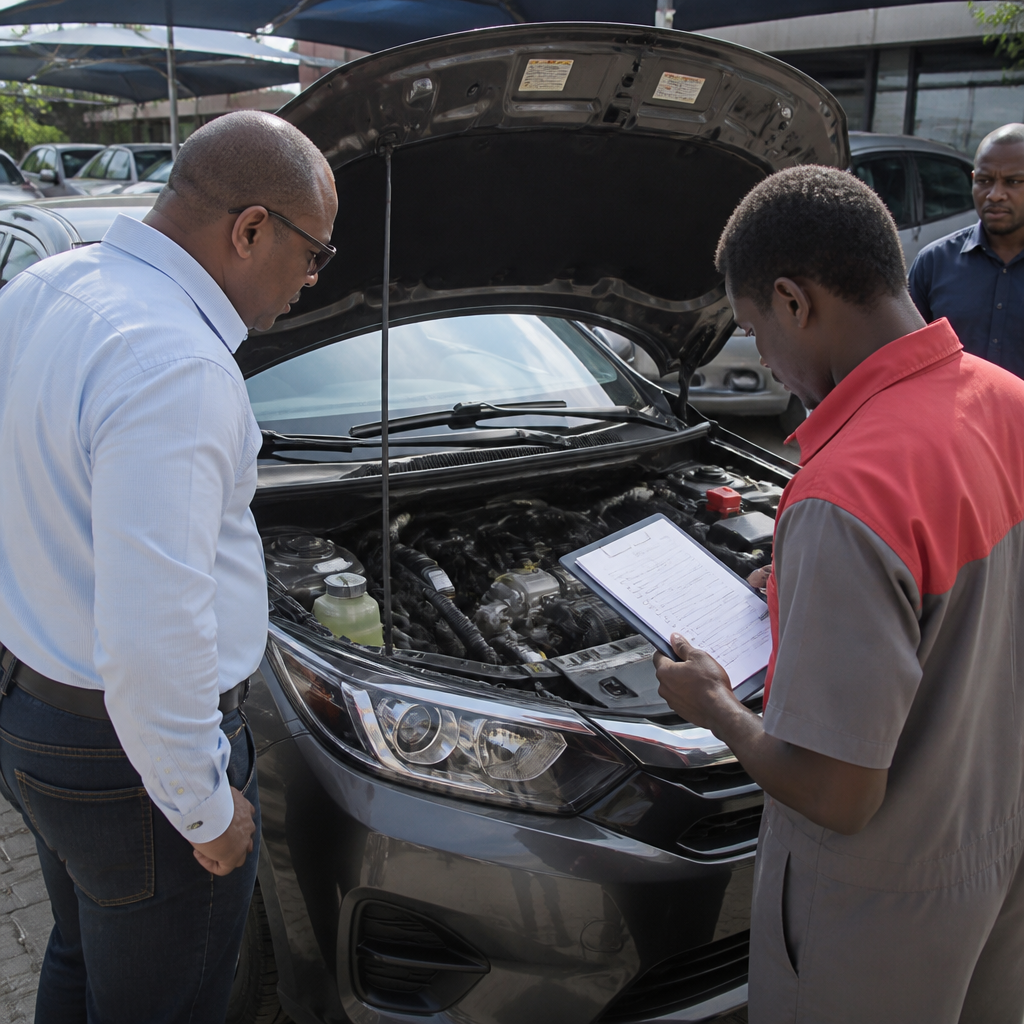
If you want to inspect a tokunbo car before paying a dealer in Nigeria, do not rely on a clean body, a short test drive or the seller’s assurances. A proper inspection checks the car’s identity, history, documents, mechanical condition, accident repairs, electrical systems and road behaviour before money changes hands.
Tokunbo cars can offer good value, but every imported used vehicle has a story. It may have been maintained well, repaired after an accident, exposed to floodwater, stored for months or altered before sale. Your job is not to find a perfect car. Your job is to understand its condition, identify expensive risks and decide whether the price matches what you are buying.
Arrange the inspection in daylight and choose a location where you can examine the car without pressure. If possible, take a trusted mechanic who has no relationship with the dealer. You should also keep enough time for checks, because a rushed inspection usually benefits the seller rather than the buyer. For a broader comparison framework covering price, condition and ownership costs, read this guide to comparing used cars before you buy if you are still considering more than one vehicle. comparing used cars before you buy
Before You Inspect a Tokunbo Car: Prepare Properly
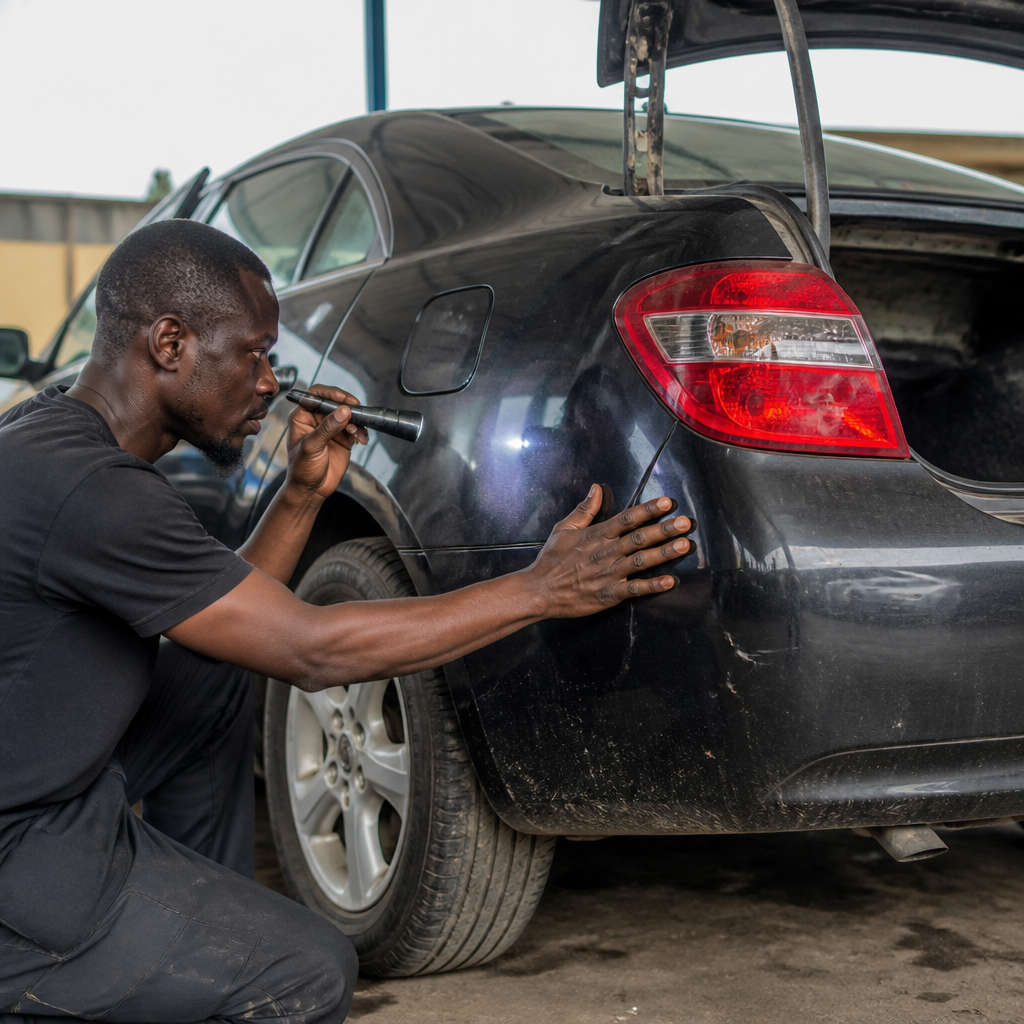
Good inspection starts before you meet the dealer. Ask for the vehicle identification number, commonly called the VIN, and request clear photographs of the available documents. You can also ask whether the car has been cleared, registered, repaired or driven in Nigeria. A dealer who refuses to provide basic information may be creating room for surprises.
Do not send a large deposit merely because the dealer says another buyer is waiting. If you must pay a small, refundable inspection or reservation fee, put the terms in writing first. The agreement should state the vehicle, amount, refund conditions and the person receiving the money. Avoid paying into an unrelated account without confirming who owns it.
Take simple inspection tools. Useful items include a small flashlight, clean cloth, tyre-pressure gauge, phone charger, notebook, phone camera and, if available, a basic OBD scanner. A paint-depth gauge can help identify repaired panels, but it is not essential. Never use a scanner as a substitute for a qualified mechanic.
Plan to inspect the car when its engine is cold. Ask the dealer not to start it before you arrive. A warm engine can hide difficult starting, excessive smoke, rough idle and some cooling-system problems. Place your hand near the bonnet rather than touching hot engine parts. If the engine is already warm, record that fact and ask why. checking VIN and verifying car history before payment
The vehicle’s history matters as much as its current appearance. A VIN search may reveal information about previous records, but no single online check is guaranteed to show every accident, repair or ownership event. Use the VIN as one part of a wider investigation. You can learn more about checking VIN and verifying car history before payment before you visit the dealer.
Confirm the Car’s Identity and Documents
Start with the VIN. Locate it on the dashboard near the windscreen, the driver-side door pillar, the engine bay or another manufacturer-designated position. The exact location varies by vehicle. Compare the VIN displayed on the car with the VIN on the customs documents, bill of sale, registration records and any available import paperwork.
Every character matters. A changed letter or number can indicate a documentation mistake, a replacement body part or a more serious identity problem. Be cautious if the plate appears scratched, poorly fixed, covered with fresh paint or different from the manufacturer’s stamping style. Do not buy until the discrepancy has been explained and independently verified. checking whether a car is stolen or has a police case
Documents to request from the dealer
- Evidence of customs clearance or the relevant import documentation.
- Current vehicle registration and proof of ownership where applicable.
- A properly completed sales agreement showing the seller and buyer.
- Valid identification for the person or business selling the vehicle.
- Any available service records, auction documents, inspection reports or repair invoices.
- Spare keys, manuals and security codes, if available.
The document names and processes can vary depending on the vehicle’s status and the responsible authority. Do not assume that a photocopy, screenshot or dealer receipt proves ownership. Verify important records through the appropriate official channel and confirm that the person selling the car has the legal authority to transfer it.
Vehicle identity and ownership checks are especially important when a car is being sold by an agent. Ask to see the owner’s authority to sell and confirm the seller’s identity. If the dealer says the owner is unavailable, insist that the final paperwork identifies the actual owner and explains the dealer’s role.
Before payment, you should also investigate whether the car has a theft concern, police case or unresolved ownership issue. A dealer’s confidence is not proof of a clean history. Use the available VIN and ownership information, then seek appropriate verification. This guide on checking whether a car is stolen or has a police case can help you structure that part of the inspection. detecting accident and repainted tokunbo cars
Inspect the Exterior for Accident Repairs and Flood Damage
Stand several metres away from the car and view it from different angles. Look for differences in colour, gloss and panel alignment. Inspect the bonnet, boot, doors, bumpers, wings, roof and quarter panels. A panel that looks newer or duller than neighbouring panels may have been repainted.
Check the gaps between panels. The gaps should usually look reasonably even from one end to the other. Uneven gaps, doors that sit too high or low, and a bonnet that does not close smoothly may indicate previous impact damage or poor reassembly. These signs do not automatically make the car unsafe, but they justify a more detailed structural inspection.
Where to look for repair evidence
- Overspray on rubber seals, plastic trims, glass edges or door locks.
- Fresh bolts, tool marks or chipped paint around hinges and fenders.
- Weld marks, ripples or uneven metal inside the boot and engine bay.
- Different manufacturing labels or dates on windows and lighting units.
- Cracked brackets, loose bumper mounts or missing underbody covers.
- Tyres with different brands, sizes or unusual wear patterns.
Open the boot and lift the floor covering. Check the spare-wheel well for standing-water marks, rust, mud, dampness or a strong musty smell. Inspect the carpet under the seats and around the door sills. Flood exposure may also leave corrosion on seat rails, electrical connectors, fuse-box areas and low-mounted modules.
Do not judge flood damage only by smell. Sellers may clean, perfume or replace carpets. Look for corrosion in places that are difficult to clean, such as beneath seats, inside connectors and around wiring. Operate every electrical feature later, because water damage can appear as intermittent faults rather than an obvious failure.
Inspect the glass and lights. Cracks, heavy condensation and moisture inside headlights may require replacement. Check that all doors, the bonnet, the boot and the fuel flap open and close correctly. A car that needs force to latch may have alignment or body-structure problems.
Tyres reveal useful information about suspension, alignment and previous neglect. Compare tread depth across each tyre and inspect the inner edges, which are easy to miss. Uneven wear may point to worn suspension components, incorrect alignment or accident damage. Also check the age and condition of the spare tyre if one is supplied.
If the car has been repainted, that is not automatically a reason to reject it. Many used cars receive cosmetic repairs. The important questions are why the panel was repaired, whether the structure was affected, how well the work was completed and whether the price reflects the condition. For a deeper inspection approach, see this guide on detecting accident and repainted tokunbo cars.
Check the Engine, Transmission and Cooling System
Inspect the engine bay before starting the vehicle. Look for fresh oil around the engine, gearbox, power-steering components and air-conditioning lines. A clean engine bay is not necessarily good news. It may have been washed to hide leaks, so ask whether the engine was recently cleaned.
Check the oil level and appearance according to the manufacturer’s procedure. Milky oil may suggest contamination, although condensation and incorrect checking methods can confuse the result. Very low oil, thick sludge or a strong fuel smell deserves professional attention. Do not open a hot radiator or coolant reservoir because pressurised coolant can cause severe burns.
When the engine is cold, start it yourself if the dealer permits. Listen for knocking, tapping, grinding, rattling or a prolonged cranking sound. Watch the exhaust after startup. Blue smoke may suggest oil burning, while thick white smoke after the engine is fully warm or persistent black smoke can indicate problems that require diagnosis. Exhaust appearance also depends on engine type, temperature and operating conditions.
Let the engine idle. The rev counter should settle without repeated surging or stalling. Turn on the air conditioner and observe whether the idle remains reasonably stable. Check for warning lights on startup and confirm that they go out after the engine runs. A warning light that never appears may have been disabled, so a scan and professional inspection are valuable.
Transmission checks
For an automatic transmission, select each gear with the brake firmly applied. Delayed engagement, harsh clunks, slipping, whining or a strong burnt smell may indicate a transmission problem. During the road test, check whether the car changes gear smoothly under light and moderate acceleration.
For a manual transmission, test the clutch during take-off and while changing through the gears. Excessive slipping, shuddering, grinding or difficulty selecting gears can lead to expensive repairs. A high clutch biting point alone does not prove failure, but it should prompt a qualified assessment.
Look underneath the car after it has been parked for a while. Small amounts of clear water under the front of the car may come from air-conditioning condensation. Dark oil, coloured coolant or transmission fluid requires investigation. Do not crawl beneath a vehicle supported only by a jack. Ask a workshop to raise it safely on a lift.
Inspect the cooling system carefully. Check the temperature gauge during the test drive and watch for overheating, coolant smells or a fan that runs unusually often. A vehicle that overheats can suffer serious engine damage. Never accept a dealer’s suggestion that you should simply top up coolant after purchase.
Test the Suspension, Steering, Brakes and Drive System
A road test should cover smooth roads, rough surfaces, gentle turns and controlled braking. Choose a safe route and obey traffic rules. Do not allow the dealer to rush you through the test. If the seller refuses any meaningful test drive, ask why and treat the refusal as a risk factor.
On a straight, reasonably safe road, check whether the car pulls to one side. Pulling can result from tyre pressure, alignment, brake drag, worn suspension or accident damage. Keep your hands on the wheel and avoid aggressive testing. The steering should not feel excessively loose, heavy, notchy or accompanied by unusual knocking.
Drive over a small bump at low speed and listen for clunks. Repeat with care on different surfaces. Noise from the front or rear may come from bushings, links, shock absorbers or other components. A car that bounces repeatedly after a bump may have weak dampers, although a mechanic must confirm the cause.
Test the brakes gradually, then with a firmer stop in a safe area. The pedal should not sink continuously or feel unusually soft. Vibration during braking can indicate disc or wheel problems. A grinding sound may mean the brake pads are severely worn. Do not test emergency stopping in traffic or at high speed.
Check four-wheel-drive or all-wheel-drive functions if fitted. Confirm that relevant indicators operate and that the system engages according to the manufacturer’s instructions. Do not force controls or test specialised systems on unsuitable surfaces. A warning message or unexplained drivetrain noise requires diagnosis.
Test the Interior, Electrical Features and Safety Equipment
Sit in every seat and inspect the interior for dampness, excessive wear and poor repairs. Compare the condition of the steering wheel, pedals, driver’s seat and gear selector with the claimed mileage. Wear does not prove mileage fraud, but a very low odometer reading combined with heavy wear deserves closer scrutiny.
Turn on the ignition and watch the dashboard warning lights. Airbag, ABS, traction-control and other safety warnings should be investigated rather than ignored. An airbag light may indicate a system fault, missing component or previous collision repair. Do not allow anyone to remove a bulb or reset a warning without identifying the underlying cause.
- Test the headlights, high beam, indicators, brake lights and hazard lights.
- Operate every window, mirror, lock, wiper and washer.
- Check the horn, reverse lights, interior lights and dashboard controls.
- Test the air conditioner at different fan speeds and temperature settings.
- Check the audio system, charging ports, camera and parking sensors.
- Confirm that all keys, remote controls and immobiliser functions work.
Check the seat belts for smooth movement and secure locking. Inspect the belt webbing for cuts, fraying or stains. Look at the seatbelt mounting points and airbag covers for signs of removal. Do not assume that an intact dashboard means every safety system is present.
If the car has a sunroof, open and close it and inspect the headliner for water marks. Check the boot release, fuel-door release and bonnet release. Small faults may not be deal-breakers, but you need a complete repair list before negotiating.
Use a Diagnostic Scan Without Treating It as a Final Answer
An OBD scan can identify stored or pending fault codes in systems supported by the vehicle. It may also show whether monitors are ready after recent code clearing. However, a clean scan does not guarantee a healthy car. Some problems are mechanical, intermittent or outside the scanner’s coverage.
Ask the mechanic to record the codes rather than simply clearing them. If a code appears, find out which component it relates to, whether it affects safety or drivability, and what further testing is required. Never accept a statement that a warning light is normal for every car of that model.
Pay attention to readiness monitors. If many monitors are not ready, the car may have had its diagnostic memory cleared recently or its battery disconnected. That does not prove deception, because a battery replacement or repair can also cause it. It does mean that more driving and testing may be needed before you make a decision.
A proper pre-purchase inspection may include a lift inspection, battery test, cooling-system test, compression or leak-down testing, suspension checks and a review of live diagnostic data. The correct tests depend on the vehicle’s engine, age, symptoms and service history.
Ask a Mechanic to Complete a Pre-Purchase Inspection
Choose an independent workshop rather than the dealer’s preferred mechanic. The mechanic should be paid for an inspection, not for approving the sale. Tell the mechanic to provide findings in writing, with photographs where possible. A verbal statement such as the car is fine is difficult to use during negotiation.
Ask for the inspection to cover the engine, transmission, suspension, steering, brakes, underbody, electrical systems, air conditioning, accident repairs, flood signs and warning lights. Also ask the mechanic to separate urgent safety defects from items that can wait. This distinction helps you calculate a realistic ownership budget.
What a useful inspection report should show
- The vehicle identification number checked against the car and documents.
- Observed leaks, noises, smoke, warning lights and driveability concerns.
- Condition of tyres, brakes, suspension, battery and cooling components.
- Evidence of repainting, panel replacement, welding or structural repair.
- Recommended repairs and an indication of their urgency.
- Items the mechanic could not test because of time, access or missing equipment.
Do not ask the mechanic to guarantee the vehicle. An inspection is a condition report at a particular time. Components can fail later, and hidden defects may not be visible without dismantling. Still, an independent report can reduce avoidable risk and give you evidence for a fair negotiation.
If the dealer will not allow an independent inspection, ask whether the vehicle can be taken to a reputable workshop before final payment. A refusal, aggressive behaviour or insistence that inspection is unnecessary should make you reconsider the transaction.
Calculate the Real Cost Before You Negotiate
Write down every defect and divide the list into three groups: immediate safety repairs, near-term maintenance and cosmetic improvements. Immediate repairs may include defective brakes, dangerous tyres, steering faults, overheating or serious leaks. Near-term items may include a weak battery, worn suspension parts or overdue fluids. Cosmetic items include scratches, dents and faded trim.
Request repair estimates from an independent workshop. Do not rely only on the dealer’s estimate, especially when the dealer says a problem is cheap to fix. Add reasonable allowance for inspection, transportation, registration-related costs, insurance, servicing and replacement keys where needed.
Use the findings to negotiate the vehicle price or request specific repairs before completion. If the dealer agrees to repair something, write down the exact repair, parts or standard expected, completion date and who will inspect the work. Avoid vague promises such as everything will be sorted.
A lower purchase price is not always a bargain. For example, a car with a cheap cosmetic issue may be a better purchase than one with an apparently attractive body but a failing transmission. Compare the total expected cost and risk, not just the amount written on the price tag.
Complete the Payment and Handover Safely
Pay only after the inspection, identity checks, documentation review and negotiation are complete. Confirm the final amount, payment method and recipient. Keep evidence of payment, including bank records, receipts and written messages.
Sign a detailed sales agreement. It should identify the buyer, seller, vehicle make and model, VIN, registration details where applicable, agreed price, payment status, known defects, items included and the date of handover. Read every clause before signing, especially language about as-is sales, refunds or responsibility for outstanding obligations.
Collect the documents and items promised during the sale. These may include keys, customs records, registration documents, proof of ownership, maintenance records, manuals and receipts. Compare every document with the vehicle and the seller’s identity. If a document is missing, record it in writing and agree on a clear delivery process.
Take photographs and a short video at handover. Record the vehicle’s exterior, interior, dashboard mileage, fuel level, existing damage, VIN location and the items received. These records do not replace a contract, but they can help prevent disagreements about the vehicle’s condition.
After purchase, arrange an early service even if the dealer claims the car has just been serviced. Ask a mechanic to inspect fluids, filters, belts, tyres, brakes, battery and cooling components. Do not assume that a dashboard service reminder or dealer sticker proves that maintenance was completed.
Warning Signs That Should Make You Walk Away
- The VIN on the vehicle does not match the VIN on the documents.
- The dealer refuses an independent mechanical inspection.
- The engine is warm despite your request for a cold start.
- The seller pressures you to pay immediately or discourages questions.
- Important documents are missing, inconsistent or available only as screenshots.
- The vehicle has unexplained welding, severe corrosion or flood indicators.
- Airbag, ABS or engine warning lights remain on or have suspiciously disappeared.
- The seller will not provide a written agreement or valid identification.
- The bank account receiving payment does not relate clearly to the seller.
- The price is unusually low and the explanation does not withstand verification.
One minor defect should not automatically end a purchase. Several unrelated warning signs are different. When identity, documentation, mechanical condition and seller behaviour all raise concerns, walking away is usually cheaper than trying to recover money later.
Common Mistakes Buyers Make
Many buyers inspect only the exterior because appearance feels easier to judge. They notice a shiny paint job but ignore tyres, underbody leaks, warning lights and service history. A polished car can still need major mechanical work.
Another mistake is allowing the dealer to control the inspection. Buyers may accept a short drive, use the dealer’s mechanic and inspect documents after payment. Reverse that order. You should inspect first, verify second, agree on terms third and pay last.
Some buyers also believe a car from a particular country, auction or dealer must be good. Origin can provide context, but it does not guarantee condition. Maintenance, accident history, storage and repair quality matter more than a sales label.
Do not ignore small leaks, unusual noises or intermittent electrical faults. A minor symptom may remain minor, but it may also be the first sign of a costly problem. Record it, diagnose it and price the repair before making your decision.
Finally, do not spend your entire budget on the purchase price. Keep money available for insurance, registration-related needs, servicing, tyres, fluids and unexpected repairs. The right car should remain affordable after you drive it away.
Frequently Asked Questions
Can I inspect a tokunbo car alone?
You can perform a basic visual and functional check alone, but an independent mechanic is strongly recommended. Buyers often miss suspension noise, structural repairs, fluid problems and diagnostic faults. A professional inspection is particularly important for older vehicles, turbocharged engines, automatic transmissions and cars with incomplete records.
Should I reject a tokunbo car that has been repainted?
Not necessarily. Repainting may be cosmetic or may follow a collision. The key issue is whether the repair affected the structure, safety systems or resale value. Check panel alignment, welding, airbags, wheel geometry and the reason for the repair. Negotiate based on confirmed condition rather than paint alone.
Is a clean diagnostic scan proof that the car is good?
No. A scan can miss mechanical wear, poor repairs, leaks, flood corrosion and faults that have not yet triggered a code. It is useful evidence, but it should be combined with a cold start, road test, lift inspection and document verification.
What if the dealer says the documents will come later?
Do not make full payment until you understand exactly which documents are available and which are outstanding. Put any agreed delivery of documents in a written contract. For ownership and registration matters, confirm requirements through the responsible authority rather than relying only on informal advice.
How long should a car inspection take?
There is no single correct duration. A basic check may take less time than a full inspection on a lift with diagnostic testing. Allow enough time to inspect the vehicle cold, test its features, drive it safely, review documents and discuss findings with the mechanic. Rushing because the seller is impatient is a poor reason to accept risk.
What should I do if I discover a serious fault after payment?
Stop using the vehicle if the fault creates a safety risk. Keep photographs, videos, diagnostic reports, receipts, payment evidence and all messages with the seller. Ask for a written resolution and seek appropriate professional or legal advice based on the contract and circumstances. Prevention remains easier than recovery, which is why inspection and documentation should happen before payment.
Final Checklist Before You Pay
- Confirm the VIN on the car and every available record.
- Check the seller’s identity and authority to sell.
- Inspect the body, panel gaps, glass, lights, tyres and underbody.
- Look for accident repairs, welding, corrosion and flood indicators.
- Start the engine cold and check smoke, noises, idle and warning lights.
- Test the transmission, steering, suspension, brakes and cooling system.
- Operate all electrical, air-conditioning and safety-related features.
- Complete an independent diagnostic and mechanical inspection.
- List repairs and calculate the total ownership cost.
- Agree on price and repairs in writing.
- Sign a detailed sales agreement before final payment.
- Collect the vehicle, documents, keys and receipts, then record the handover.
When you inspect a tokunbo car carefully, you replace guesswork with evidence. You may decide to buy, negotiate a better price or walk away. Each outcome can be a good one if the decision protects your money, safety and ability to register and use the vehicle properly in Nigeria.
5 thoughts on “How to Inspect a Tokunbo Car Before Paying the Dealer”