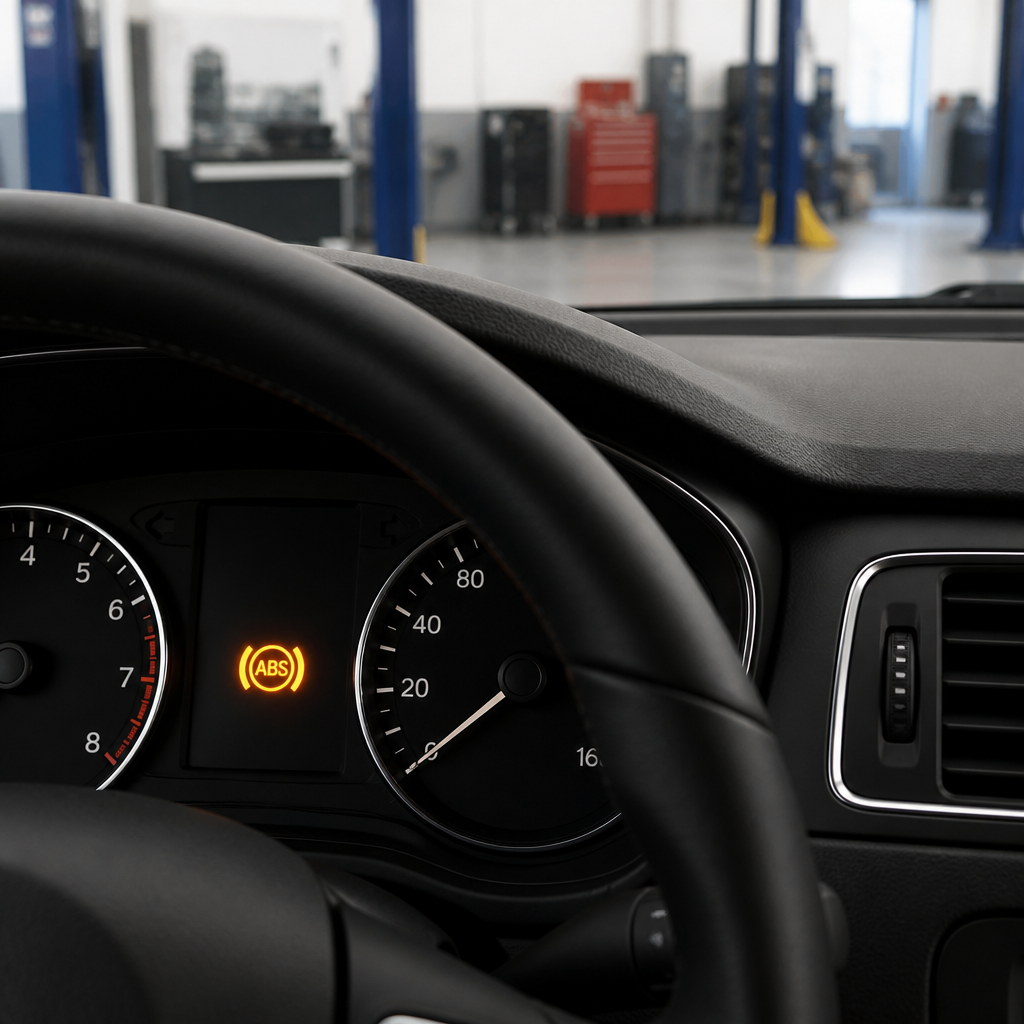
When the ABS warning light appears, your car is telling you that the anti-lock braking system may not be working as intended. You may still have ordinary braking, but the wheels might lock during hard braking, especially on a wet or loose surface. This guide explains the common causes, what to check first, when it is safe to move the vehicle, and when you should arrange a professional inspection.
The warning does not always mean that the entire brake system has failed. A dirty wheel-speed sensor, low brake fluid, a damaged wire, a weak battery, or a stored electronic fault can all trigger the light. However, braking problems deserve careful attention. A dashboard symbol can be a useful early warning before a small electrical or sensor issue becomes a larger safety concern.
What the ABS warning light means
ABS stands for anti-lock braking system. During heavy braking, the system monitors wheel speed and can briefly reduce and restore hydraulic pressure at individual wheels. This process helps prevent the tyres from locking completely, allowing the driver to retain more steering control while braking. How to Sell a Used Car Privately in Nigeria
When the ABS warning light stays on after the engine starts, the vehicle has detected a fault or a condition outside the expected operating range. The exact meaning varies by vehicle, so the owner’s manual remains the best reference for the symbol, start-up checks, and recommended driving procedure.
In many vehicles, the system performs a self-check when you switch on the ignition. Several warning lamps may illuminate briefly and then go out. That short illumination is usually part of the normal check. The concern begins when the light remains on, returns while driving, or appears together with another brake-related warning.
An ABS fault does not always remove all braking ability. In some cases, the normal hydraulic brakes continue to operate without the anti-lock function. Even then, emergency braking may behave differently. The wheels could lock more easily, and electronic stability or traction functions may also be disabled because they share sensors and control systems with ABS.
ABS warning light and the red brake warning lamp
Pay close attention to which lamps are illuminated. A yellow or amber ABS symbol is different from a red brake warning lamp, although both require care. A red brake warning lamp can indicate a low fluid level, a parking brake that remains applied, a hydraulic problem, or another serious condition, depending on the vehicle.
If the ABS symbol appears by itself and the brake pedal feels firm, you may be able to drive slowly to a suitable repair facility. You should avoid unnecessary trips and leave extra distance between your vehicle and others. If the ABS light appears with a red brake warning lamp, take the situation more seriously.
- Stop as soon as it is safe if the brake pedal feels soft, sinks unusually far, or requires repeated pumping.
- Do not continue driving if the vehicle pulls sharply when braking, makes severe grinding noises, or shows visible brake-fluid leakage.
- Arrange recovery or professional assistance if several brake and stability warnings appear together.
- Check the parking brake only after bringing the vehicle to a safe stop. Some vehicles display the red brake lamp when the parking brake is engaged.
Never assume that a normal pedal feel proves the entire braking system is healthy. Some faults affect only the electronic anti-lock function, while others can affect braking control. If you feel unsure, choose safety over convenience.
Common causes of an ABS warning light
There is no single cause that applies to every vehicle. The system contains sensors, wiring, hydraulic components, a control module, fuses, and software. A fault in any of these areas can switch on the dashboard warning.
1. Dirty, damaged, or failed wheel-speed sensor
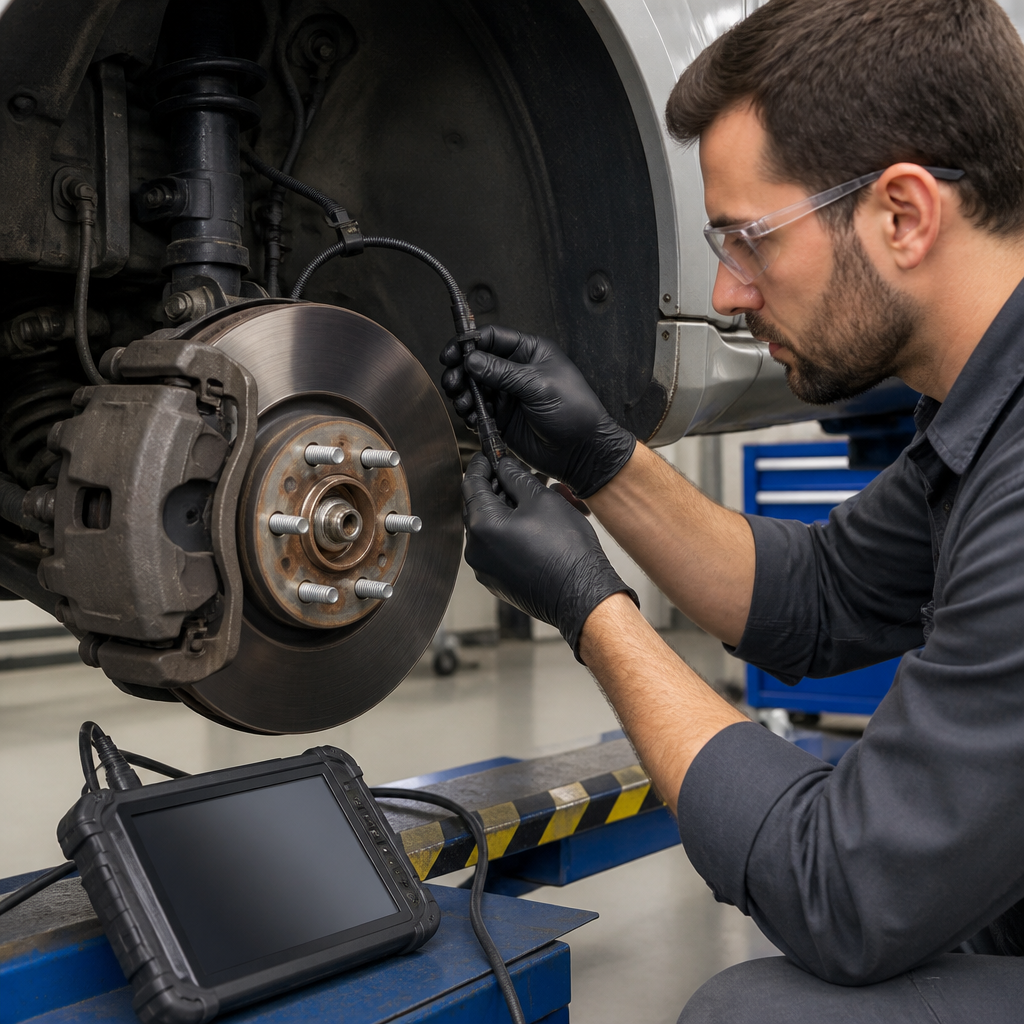
Wheel-speed sensors measure how quickly each wheel rotates. The ABS control unit compares these signals while the vehicle moves. If one sensor sends an implausible signal or stops communicating, the system may disable anti-lock operation and illuminate the warning lamp.
Road dirt, mud, rust particles, and metallic debris can interfere with the sensor or its tone ring. A sensor can also become damaged after contact with a pothole, kerb, stone, or incorrectly fitted brake component. In some cases, the sensor itself works correctly but sits too far from the reluctor ring or encoder built into the wheel bearing.
Sensor failures may appear after suspension work, brake repairs, wheel-bearing replacement, or driving through flooded areas. The dashboard light may switch off temporarily and return later, especially when the wire moves with the steering or suspension.
2. Damaged sensor wiring or connectors
Each wheel-speed sensor relies on a cable and connector. These parts operate close to moving suspension components, road spray, heat, and debris. A stretched wire, broken clip, corroded terminal, or loose connector can interrupt the signal.
Look for obvious signs only if you can inspect the area safely. The cable should not hang loose, rub against the tyre, or become trapped near a rotating drive shaft. Do not reach behind a wheel while the engine is running. Also, do not work beneath a vehicle supported only by a jack.
Wiring faults can be difficult to find because the break may sit inside the insulation. A visual check is useful, but a technician may need a wiring diagram, a multimeter, and a scan tool to identify the problem accurately.
3. Low brake fluid
Some vehicles use the same instrument cluster to warn about low brake fluid and ABS-related problems. The fluid level may fall as brake-pad friction material wears, although a sudden drop can indicate a leak.
Park on level ground and consult the owner’s manual before checking the reservoir. The level should sit between the marked minimum and maximum lines. Do not simply add fluid and ignore the reason for the low level. Brake fluid loss can reduce hydraulic pressure and create a serious braking hazard.
Use only the fluid type specified by the vehicle manufacturer. Mixing incorrect fluids or allowing dirt into the reservoir can damage components. Brake fluid also absorbs moisture over time, so avoid opening the container unnecessarily and keep the reservoir cap area clean.
4. Worn brake pads or a mechanical brake problem
On some vehicles, brake-pad wear sensors or related circuits can illuminate a warning. Other vehicles use a separate brake-pad symbol or rely on noise and pedal feedback. Worn pads, damaged discs, seized callipers, and uneven braking can also create conditions that lead to an ABS or stability warning.
Listen for grinding, scraping, or repeated clicking. Notice whether the vehicle pulls to one side, vibrates through the steering wheel, or develops a burning smell after a short drive. These symptoms need an inspection even if the warning light later disappears.
5. Weak battery or charging-system voltage
Modern braking systems depend on stable electrical power. A weak battery, failing alternator, loose battery terminal, or poor ground connection can cause several warning lights to appear at once.
You may also notice slow engine cranking, flickering interior lights, a clock that resets, or warnings that appear after a cold start. Once the charging system returns to a normal range, some warnings may clear. However, a stored fault can remain, and the underlying electrical problem still needs attention.
Do not replace the battery solely because the ABS light came on. Test the battery, charging system, and connections first. A professional can check voltage under load and determine whether the control module received an unstable supply. What to Do After a Rejected Car Insurance Claim in Nigeria
6. ABS fuse or relay fault
A blown fuse can interrupt power to the ABS pump or control unit. The cause may be a simple electrical overload, but a repeated fuse failure can indicate a short circuit or a failing component.
Your owner’s manual should identify the correct fuse location and rating. Replace a fuse only with one of the same rating. Never install a larger fuse to keep the system operating. That can overheat wiring and create a fire risk.
7. Faulty ABS hydraulic pump or control module
The hydraulic modulator controls brake pressure during an anti-lock event. Its pump, valves, or electronic control module can fail because of internal wear, moisture intrusion, corrosion, or an electrical fault.
This type of problem usually requires a diagnostic scan and specialist testing. The dashboard lamp alone cannot confirm a failed module. Replacing an expensive unit without reading the fault code can waste money, particularly when a sensor or connector caused the original warning.
8. Steering-angle or stability-control fault
ABS often works with traction control and electronic stability control. These systems may share information from wheel-speed sensors, a steering-angle sensor, yaw sensors, and the vehicle’s network communication system.
A recent wheel alignment, steering repair, battery disconnection, or suspension job can sometimes leave a sensor out of calibration. You may see ABS, traction-control, and stability warnings together. The vehicle may still move normally, but the assistance systems may not be available during an emergency manoeuvre.
9. Incorrect tyre size, pressure, or wheel fitment
ABS and stability systems compare wheel rotation. Tyres with significantly different rolling circumferences can confuse the system, especially if one tyre is a different size, badly worn, or incorrectly inflated.
Check that all four tyres match the specification listed by the manufacturer. Confirm the pressures when the tyres are cold. A temporary spare wheel can also trigger warnings because its size may differ from the standard wheel. Follow the restrictions printed in the owner’s manual when using a spare.
What to check first when the light appears
A calm, structured check can help you decide what to do next. These checks are not a substitute for diagnosis, but they can reveal an obvious issue and provide useful information for a technician.
Step 1: Notice when the light appeared
Think about the timing. Did the light appear immediately after starting? Did it come on after hitting a pothole, driving through water, changing a wheel, replacing the battery, or having brake work completed?
Write down any other warning symbols and symptoms. Useful details include the vehicle speed, steering position, weather, road surface, brake-pedal feel, and whether the lamp disappears after restarting. This information can shorten the diagnostic process.
Step 2: Check whether the parking brake is released
Make sure the parking brake is completely released before moving. Some electronic parking-brake systems can generate related warnings if they detect a fault. If a red brake warning lamp remains on after release, stop and consult the manual.
Step 3: Check the brake-fluid reservoir
With the vehicle parked safely and the engine switched off, locate the brake-fluid reservoir. Check whether the level is between the markings. Look around the master cylinder, inside the wheels, and beneath the vehicle for signs of wetness or leakage, but do not touch unknown fluid with bare hands.
If the level is below minimum, do not treat topping up as a permanent repair. A technician should identify whether worn pads, a leak, or another fault caused the level to fall. If you see a leak or the pedal feels soft, do not drive the vehicle.
Step 4: Inspect the tyres and wheels
Check for a flat or visibly underinflated tyre. Look for a mismatched wheel, a temporary spare, severe tread damage, or a tyre that differs noticeably from the others. Correct the pressures according to the vehicle’s recommended values, not the maximum pressure printed on the tyre sidewall.
Do not place your hands near a moving wheel. If you need to remove a wheel, use proper lifting equipment and axle stands on a firm, level surface. If you lack the equipment, ask a qualified technician to inspect it.
Step 5: Look for obvious sensor damage
Turn the steering slightly only if the vehicle is stationary and secure. From a safe position, look for a sensor cable that appears loose, cut, pinched, or rubbed through. Check each corner as far as you can without removing components.
Avoid spraying random cleaners onto electrical connectors. Do not pull on a sensor cable or force a connector apart. Some connectors have locking tabs that break easily, and an improvised repair can create a second fault.
Step 6: Consider the battery and recent electrical work
If several warning lights appeared after a difficult start, battery replacement, jump-start, or electrical repair, the power supply may be relevant. Check that the battery terminals are secure and free from heavy corrosion. Do not short the terminals or attempt electrical testing if you are not familiar with safe procedures. How to Take Better Car Photos for Sale Online
Step 7: Read the fault codes
The most useful next step is often a scan of the ABS control system. A basic engine-code reader may not communicate with ABS, traction-control, or stability modules. Ask for a scan that can access the braking system, not only the engine computer.
A fault code points toward a circuit or condition. It does not always identify the failed part. For example, a wheel-speed sensor code could result from a broken wire, damaged tone ring, bearing play, poor connector contact, or a defective sensor. Diagnosis should confirm the cause before parts are replaced.
Can you drive with the ABS warning light on?
The answer depends on the other symptoms and warning lamps. If the ABS warning is the only concern, the brake pedal feels normal, and the vehicle stops evenly, a short and careful trip to a repair facility may be possible. Drive slowly, avoid harsh braking, leave a large following distance, and avoid wet, loose, or steep roads where practical.
Remember that the anti-lock function may not activate. If you need to brake hard, press the pedal firmly and continuously. Do not pump the pedal in a vehicle with a functioning ABS system. Older vehicles without ABS may require a different technique, so follow the guidance in the owner’s manual.
Stop driving and seek assistance if any of the following signs appear:
- The red brake warning lamp is illuminated with the ABS lamp.
- The brake pedal feels soft, spongy, unusually hard, or lower than normal.
- The pedal sinks while you maintain pressure.
- The vehicle pulls strongly to one side during braking.
- You hear grinding, severe scraping, or repeated mechanical knocking.
- Brake fluid is leaking or the reservoir is nearly empty.
- The vehicle shows a major loss of braking performance.
- Several stability, traction, and brake warnings appear together.
When in doubt, have the vehicle transported. The cost and inconvenience of recovery are usually less serious than losing braking control on the road.
How a professional should diagnose the problem
A proper inspection begins with a safety assessment. The technician should confirm the brake-pedal feel, fluid level, tyre condition, visible leaks, and warning-lamp behaviour. They should then scan the relevant electronic modules and record the fault codes before clearing anything.
The technician may compare live wheel-speed data during a road test or while rotating the wheels on a lift. They may also inspect sensor resistance, signal output, wiring continuity, connector condition, tone rings, wheel-bearing play, battery voltage, and charging performance.
After repairs, the system should be tested again. Clearing a warning without correcting the cause is not a repair. A road test may be necessary to confirm that the warning stays off and that the vehicle behaves normally under controlled conditions.
Ask for an explanation of the failed component and the evidence supporting the diagnosis. If a workshop recommends a costly control module, it is reasonable to ask whether the sensors, wiring, power supply, and grounds were checked first.
Common mistakes to avoid
Ignoring the light because the car still stops
Normal braking during gentle stops does not prove that emergency assistance is available. ABS matters most when braking suddenly or when the road offers uneven grip. Delaying an inspection can leave you without that support when you need it.
Clearing the warning without fixing the fault
Disconnecting the battery or erasing codes may turn the lamp off temporarily. It does not repair a damaged sensor or wire. The warning can return during the next drive, and useful diagnostic information may be lost.
Replacing every wheel-speed sensor
Replacing parts based only on a general warning is an expensive guessing game. Test the affected circuit and inspect the related mechanical parts before approving replacements.
Using the wrong brake fluid
Brake-fluid specifications matter. Use the type stated by the manufacturer and keep the container sealed. If fluid has been contaminated with oil, water, or another substance, the system may need professional attention rather than a simple top-up.
Working under a poorly supported vehicle
Wheel-speed sensors sit near areas that are tempting to inspect at home. Never place your body under a vehicle held only by a jack. Use a level surface, secure the wheels, and follow safe lifting procedures. If you cannot do that, leave the inspection to a qualified professional.
ABS warning light considerations in hot, wet, and dusty conditions
Road conditions can affect the components around the wheels. Heavy rain, standing water, mud, and dust may contaminate connectors or expose existing weaknesses in sensor wiring. A warning that appears after flooding should not be dismissed, especially if other electrical features behave strangely.
High temperatures can also reveal a weak battery, poor electrical connection, or failing module. In areas with rough roads, repeated impacts may damage wheel bearings, tone rings, suspension parts, or sensor cables. These conditions do not prove a particular failure, but they can help explain why the warning appeared.
After driving through deep water, test the brakes gently in a safe location. Water can temporarily reduce friction between the pads and discs. If the warning remains on, the pedal feels different, or the vehicle behaves abnormally, arrange an inspection. Failing Car Alternator: Signs and How to Diagnose It
What the ABS light means when buying a used car
An illuminated ABS warning should be treated as an unresolved fault during a used-car inspection. Do not accept a seller’s explanation that the lamp only needs resetting unless the vehicle receives a documented diagnosis and repair.
Before buying, switch on the ignition without starting the engine. Confirm that the warning lamps illuminate as part of the self-check. Start the engine and make sure the relevant lamps go out as expected. A lamp that never illuminates may have been removed, covered, or electronically disabled.
Take a test drive on a safe route. Check for warning lights, uneven braking, steering pull, vibration, unusual noises, and traction-control messages. Ask for a diagnostic scan that includes the ABS module. Also inspect tyre sizes, wheel condition, brake-fluid level, and evidence of recent suspension or collision repairs.
A pre-purchase inspection by an independent technician can identify faults that are not obvious during a short test drive. If the seller refuses a reasonable inspection, consider that a warning sign. A lower purchase price does not automatically compensate for uncertain braking repairs.
How to reduce the chance of future ABS faults
- Keep tyres inflated to the recommended pressures.
- Use matching tyre sizes and replace damaged or badly worn tyres promptly.
- Have wheel bearings, brakes, and suspension checked during routine servicing.
- Protect sensor wiring during brake, suspension, and wheel-bearing repairs.
- Keep battery terminals secure and address slow starting promptly.
- Avoid driving through water deep enough to reach electrical components.
- Use the correct brake fluid and keep the reservoir area clean.
- Respond to warning lamps early instead of waiting for braking symptoms.
- Choose a workshop with suitable diagnostic equipment for your vehicle.
Good maintenance cannot prevent every electronic failure. It can, however, reduce avoidable problems and make emerging faults easier to identify.
Frequently asked questions
Is it safe to drive if only the ABS warning light is on?
It may be possible to drive a short distance if the brake pedal feels normal, the vehicle stops evenly, and no red brake warning lamp is displayed. Drive cautiously and arrange a prompt inspection. Do not continue if braking performance changes or another warning appears.
Can low brake fluid cause an ABS warning?
Yes, depending on the vehicle. Some systems use related warning circuits, and low fluid can indicate worn pads or a leak. Check the level safely, but do not simply refill and ignore a low reservoir.
Will changing the battery reset the ABS warning?
It might clear a temporary low-voltage event on some vehicles, but it will not fix a failed sensor, damaged wiring, hydraulic fault, or control-module problem. A scan and proper diagnosis are better than replacing the battery without evidence.
Can bad wheel alignment cause the light?
Alignment itself does not usually cause an ABS fault. However, steering-angle calibration, suspension damage, incorrect tyre sizes, or work performed during an alignment may trigger ABS or stability warnings. A scan can separate these possibilities.
Can a dirty wheel-speed sensor be cleaned at home?
Sometimes visible debris can be removed during a proper inspection, but access varies and the sensor may be fragile. Do not scrape the sensor, pull its cable, or use chemicals without checking the manufacturer’s guidance. If the light remains on, professional testing is still necessary.
Why are the ABS, traction-control, and stability lights on together?
These systems often share wheel-speed and vehicle-motion data. One sensor, wiring, power-supply, or communication fault can disable several functions. The combination does not identify the failed part, so the relevant modules should be scanned and tested.
How long can I wait before checking the light?
Do not schedule it as a low-priority issue. Arrange an inspection as soon as practical, preferably before a long journey, heavy rain, rough-road trip, or highway drive. Stop immediately if the pedal or braking behaviour changes.
Final checklist
When the ABS warning light comes on, start with safety rather than guesswork. Check the other warning lamps, brake-pedal feel, fluid level, tyre condition, parking brake, and any recent repair or electrical event. Look for obvious sensor damage only when the vehicle is safely parked.
Next, arrange a scan that can read the ABS and stability-control modules. Remember that a code identifies a system or circuit, not always the exact failed part. A technician should confirm the fault before replacing components.
If the brake pedal feels abnormal, fluid is leaking, the red brake lamp is on, or braking performance has deteriorated, do not drive the vehicle. Have it inspected or recovered. Reliable braking is more important than reaching your destination quickly.
For vehicle owners and used-car buyers, the key lesson is simple: treat a warning lamp as information, not an inconvenience. Early diagnosis can protect your safety, prevent further damage, and help you make a better repair or purchasing decision.