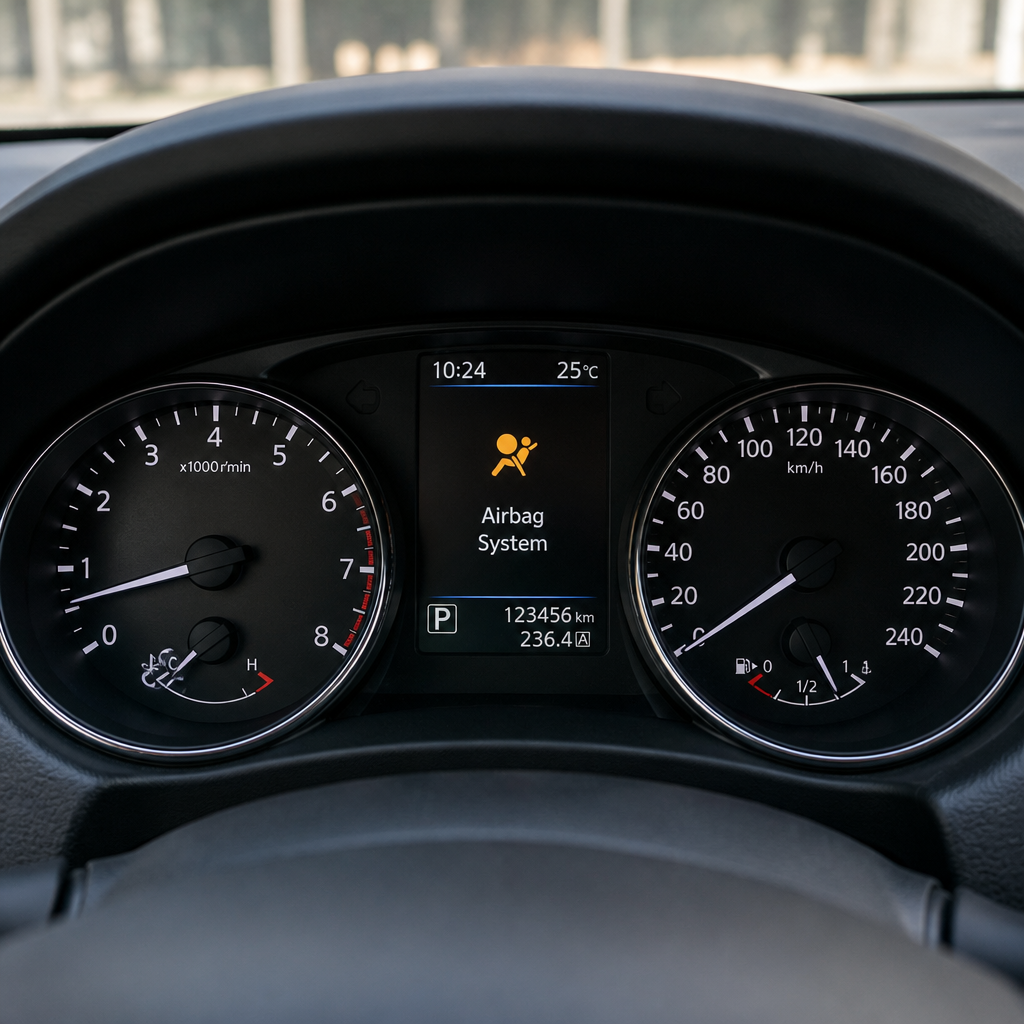
If your airbag warning light stays on after the engine starts, do not ignore it or assume it will clear by itself. The light usually means the supplemental restraint system, commonly called the SRS, has detected a fault. A problem may affect an airbag, seat-belt pretensioner, impact sensor, wiring connection or the system control module. This guide explains what the warning means, what you can safely check, the risks of continuing to drive and when professional diagnosis is necessary.
The first step is to stay calm and look at the exact warning symbol. Some vehicles show a person sitting in front of an inflated airbag. Others display the letters SRS, a seat-belt symbol or a message such as Airbag Service Required. The symbol can vary by manufacturer, but a warning that remains illuminated after the normal start-up check deserves attention.
An illuminated warning does not automatically prove that every airbag has failed. However, it does mean the system may not work as designed in a collision. Because airbags and seat belts work together, even a fault that appears minor should receive proper attention rather than a quick reset. Failing Car Alternator: Signs and How to Diagnose It
What the airbag warning light means
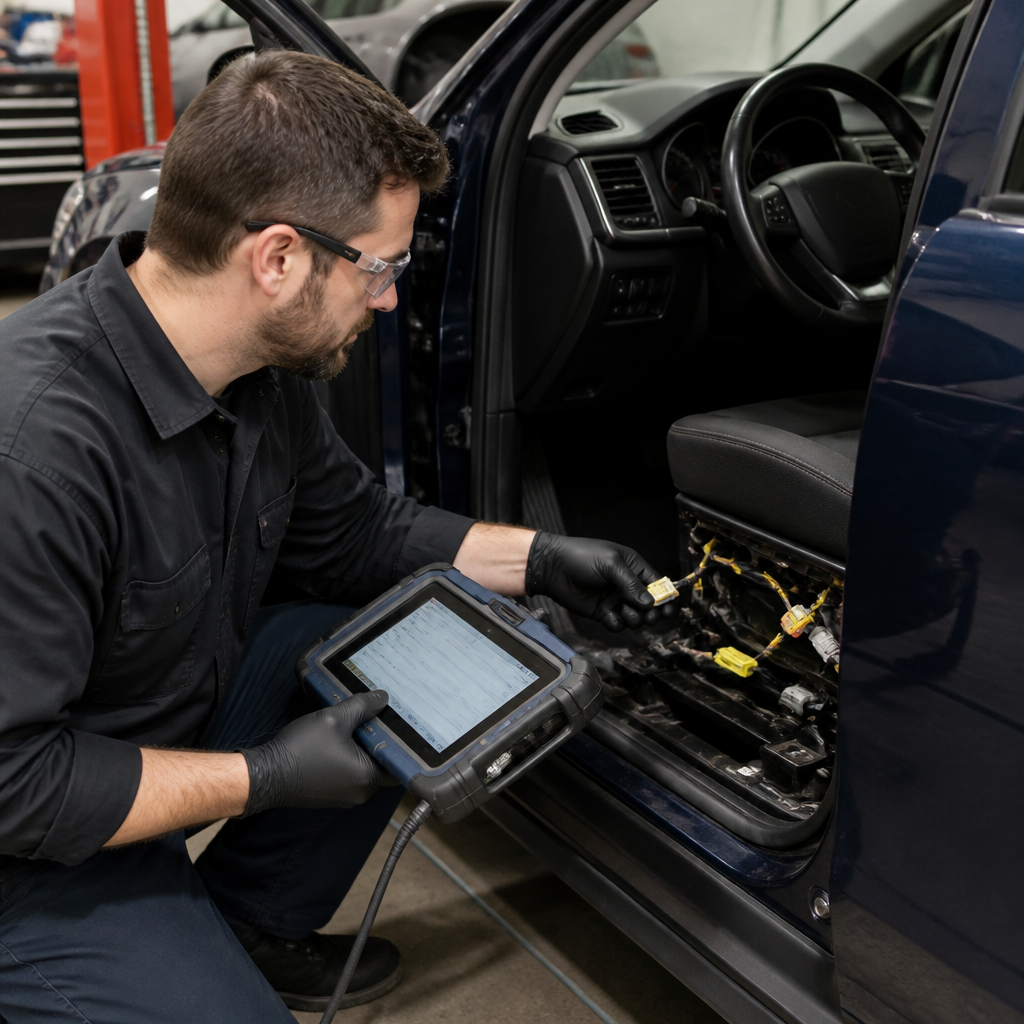
When you switch on the ignition, the vehicle normally performs a brief self-check. During that check, the airbag light may illuminate for a few seconds. If the system finds no stored problem, the light should go out. A light that stays on, flashes repeatedly or returns while driving indicates that the vehicle has recorded a fault.
The SRS includes more parts than the airbags mounted in the steering wheel and dashboard. Depending on the vehicle, it may monitor front, side and curtain airbags, seat-belt pretensioners, buckle switches, occupant sensors, crash sensors, wiring harnesses and a central control unit. A fault in one area can trigger the same dashboard warning.
The light can also appear after a battery problem, a seat adjustment or a previous repair. That does not make the warning unimportant. It means the stored fault needs to be read with equipment that can communicate with the SRS module. A basic engine-code reader may not access this system.
Normal start-up behaviour versus a fault
There is an important difference between a warning light that appears briefly and one that remains on. Brief illumination during ignition is usually part of the self-test. The precise timing differs between vehicles, so check the owner’s handbook for the normal sequence.
A light that flashes in a pattern, remains illuminated, disappears and returns, or appears with a warning message should be treated as a fault. Do not rely on the fact that the vehicle still starts and drives normally. SRS problems often do not affect the engine, steering or braking, so the car may feel normal even when occupant protection has been reduced.
Common causes of an airbag warning light
Several problems can activate the warning. Some are simple connection issues, while others require replacement parts or a complete diagnostic procedure. The visible light alone cannot identify the failed component.
Low or unstable battery voltage
A weak battery, a failed alternator or a battery replacement can create voltage conditions that confuse electronic control modules. In some vehicles, the SRS stores a low-voltage code and keeps the warning on even after the battery has recovered.
This is more likely after a vehicle has been left unused, jump-started, or fitted with a battery that was disconnected during repairs. A technician should test the battery and charging system, then check whether the SRS fault is current or only stored from the earlier voltage event.
Do not assume that clearing a low-voltage code solves the underlying issue. If the battery or alternator remains weak, the warning may return. Proper diagnosis should address both the electrical supply and the SRS code.
Loose or damaged wiring under a seat
Many vehicles have SRS wiring and connectors beneath the front seats. Moving a seat back and forward, fitting accessories, cleaning the interior or carrying large items can disturb these connections. Moisture, corrosion, trapped wiring and previous seat repairs can also cause a poor connection.
These connectors are often brightly coloured, but colour alone does not make them safe to handle. Do not pull apart, probe or repair an SRS connector while guessing. Airbag circuits can contain stored electrical energy, and an incorrect test can create a serious hazard. Ask a qualified technician to inspect the wiring using the manufacturer’s procedure.
Seat-belt pretensioner or buckle fault
Seat-belt pretensioners tighten the belt during certain crashes. They are part of the restraint system and can trigger the same warning as an airbag fault. A damaged buckle switch, wiring fault or pretensioner problem may therefore illuminate the dashboard symbol.
A belt that clicks normally does not prove that its pretensioner and electrical circuit are healthy. Likewise, the warning may appear even though the belt can still be fastened. The vehicle needs a proper SRS scan to identify the affected circuit.
Clock spring failure
The clock spring sits behind the steering wheel and allows electrical connections to remain connected while the wheel turns. It commonly carries circuits for the driver’s airbag, horn and steering-wheel controls. Wear or damage can interrupt one or more of these circuits.
Possible clues include an airbag warning combined with a horn that does not work or steering-wheel buttons that have stopped responding. These symptoms do not prove a clock spring failure, but they provide useful information for the technician. Do not remove the steering wheel as a first attempt to solve the problem.
Crash sensor or impact sensor problem
Crash sensors help the control module identify a severe impact. A sensor can be damaged in a collision, affected by corrosion or disconnected during bodywork. Some vehicles also use pressure or side-impact sensors in doors and other areas.
A previous collision may have caused hidden damage even if the exterior repair looks neat. A vehicle can also retain crash data after airbags have deployed. In that situation, replacing only a visible panel or fitting a new battery will not restore the complete restraint system.
Occupant classification or passenger-seat sensor issue
The passenger seat may contain sensors that help determine whether someone is present and whether the seat position or weight requires a particular restraint strategy. Heavy objects, liquid spills, seat damage or wiring faults can affect this system. How to Write a Car Sales Advert That Gets Serious Buyers
Some vehicles display a separate passenger-airbag message, while others use the main SRS warning. Do not place heavy equipment on a passenger seat and assume the system will correctly classify it. Follow the handbook’s guidance and have persistent warnings checked.
Water, corrosion or interior damage
Water entering through a blocked drain, damaged door seal, windscreen leak or flood can reach SRS wiring and modules. Corrosion may develop slowly, so the warning might appear days or weeks after the original leak.
Flood-damaged vehicles deserve extra caution. Electrical corrosion can affect multiple safety systems and may not be visible during a quick inspection. If the vehicle has been exposed to significant water, obtain a detailed inspection before relying on it for regular transport.
Previous airbag deployment or poor-quality repair
If a vehicle has been in a crash, airbags and pretensioners may have deployed. Correct repairs usually involve more than replacing an airbag cover. The control module, sensors, wiring, seat belts and related trim may also need inspection or replacement.
A warning that remains after a used vehicle repair can indicate incomplete work, incorrect parts, stored crash data or a damaged connector. Be particularly careful if the dashboard, steering wheel, seats or door panels show signs of removal. A clean interior does not confirm that the safety system is complete.
Why an airbag warning light should not be ignored
An airbag is designed to work with a seat belt during a serious crash. If the SRS detects a fault, the vehicle may disable part of the system to prevent an unintended deployment. In other cases, the system may not behave as intended during an impact. You cannot determine the exact result from the dashboard light alone.
The potential risk extends beyond the steering-wheel airbag. A fault may involve a curtain airbag, side airbag or pretensioner. That means the warning can affect protection for the driver, a front passenger or rear occupants, depending on the vehicle’s design and the failed circuit.
Some manufacturers state in their owner information that an SRS warning requires prompt inspection. Read your own handbook because system design, warning messages and permitted checks vary by model. General safety information about airbags is also available from the U.S. National Highway Traffic Safety Administration at NHTSA’s air-bag safety page.
Is it safe to drive with the light on?
The safest answer is to arrange professional diagnosis as soon as possible and avoid unnecessary driving. If you must move the vehicle, drive only the distance needed to reach a suitable repair facility, provided there are no other serious warnings or symptoms.
Do not drive the vehicle if it has suffered a major collision, shows signs of fire or flood damage, has damaged seat belts, or has loose trim around an airbag location. In these cases, ask a qualified recovery provider or technician for advice. A warning light is also more urgent if it appears with smoke, burning smells, exposed wiring or electrical faults.
Never allow the SRS warning to influence a decision to remove or disconnect a seat belt. Seat belts remain a critical part of the restraint system, and every occupant should use the correct belt for the seat.
What to do when the airbag warning light stays on
- Check the symbol and message. Confirm that you are looking at the SRS or airbag warning, rather than a seat-belt reminder or another dashboard symbol. Take a photograph if the message disappears.
- Read the owner’s handbook. Look for the warning-light section and any manufacturer-specific instructions. Do not follow a general online procedure if the handbook warns against it.
- Note when the warning appeared. Record whether it started after a battery change, jump-start, seat movement, accident, interior cleaning, flood, repair or vehicle inspection.
- Check for related symptoms. Note problems with the horn, steering-wheel controls, seat-belt buckles, passenger-airbag indicator or other electrical equipment.
- Do not disturb SRS connectors. Avoid pulling wires, fitting resistors, using test lamps or probing airbag circuits. These shortcuts can create injury risks and may conceal the original fault.
- Book an SRS-capable diagnostic scan. Tell the workshop that the airbag light is on. Ask whether its equipment can read and diagnose the SRS module, not only the engine computer.
- Request an explanation before authorising parts. Ask which code was found, whether it is current or historic, what test confirmed the cause and whether the repair requires calibration or a follow-up scan.
- Confirm that the warning clears correctly. After repair, the technician should verify the system’s self-test and check for returning codes. A light that was merely switched off is not proof of a completed repair.
Can you reset the airbag warning light yourself?
In most cases, resetting the light without finding the cause is the wrong approach. A scan tool may erase a stored code, but the warning will return if the fault remains. More importantly, clearing the light can create false confidence about the vehicle’s protection.
Some basic code readers only access engine and emissions systems. They may not communicate with the SRS module at all. Even an advanced scanner can report a circuit code without identifying the damaged wire, connector or component. Diagnosis still requires the correct wiring information, safety procedure and testing method.
Disconnecting the battery is not a reliable reset. It may erase some temporary electronic symptoms, but it will not repair a broken clock spring, damaged sensor, poor connector or deployed pretensioner. It can also create additional faults in vehicles that require battery-management or steering-angle procedures after power loss.
Why online reset tricks can be risky
Videos and forum posts sometimes recommend bridging terminals, installing a resistor or manipulating a connector. These methods are unsafe because SRS circuits are designed for controlled diagnostic testing. A substitute component may hide a fault or alter how the system responds in a crash.
Airbag modules should not be treated like ordinary switches or lamps. If a repair guide does not match the exact vehicle, engine, model year and restraint-system configuration, do not use it as a basis for electrical work. A trained technician is the better option.
How a professional diagnosis should work
A proper inspection starts with the vehicle history. The technician should ask when the warning began, whether the battery was disconnected, whether the car has had body repairs and whether any seats, carpets or steering components were removed. How to Verify Car Insurance in Nigeria Before You Drive
Next, the technician should inspect the vehicle according to the manufacturer’s safety procedure. This may include checking battery voltage, fuses, visible harness routing, connector condition, seat-belt assemblies and signs of impact or water entry. The exact process differs by vehicle.
An SRS-capable scan tool can retrieve diagnostic trouble codes from the restraint control module. The code is a starting point, not always a final diagnosis. For example, a code indicating an open circuit might result from a damaged wire, an unplugged connector, a failed component or a poor previous repair.
The technician may then carry out measured tests using approved equipment and procedures. After the fault is repaired, the system may need code clearing, calibration or module replacement. The warning should be checked through a complete ignition cycle and, where appropriate, a road test that does not compromise safety.
Ask the workshop to explain whether the repair uses new, approved or properly identified replacement parts. Be cautious if someone offers to make the warning disappear without explaining the fault. A quiet dashboard is not the same as a working restraint system.
What not to do when the warning appears
- Do not cover the light. Tape, stickers, dark film or a modified instrument cluster hide a safety problem instead of repairing it.
- Do not install a cheap bypass device. A resistor or emulator can prevent diagnosis and may leave an airbag or pretensioner inactive.
- Do not remove an airbag casually. Steering-wheel and dashboard modules require careful handling, storage and disposal.
- Do not use a test lamp on an airbag circuit. Use only equipment and procedures approved for the system.
- Do not ignore a recent collision. A vehicle can have hidden restraint damage even when it starts and drives.
- Do not assume a replacement seat is compatible. Seat wiring and occupant sensors can differ between trims and model years.
- Do not buy a vehicle based only on a temporarily dark dashboard. A pre-purchase inspection and scan are important when the car has accident or repair history.
Buying a used car with an airbag warning light
A used vehicle with an illuminated SRS warning should be treated as a safety-repair project, not a minor bargain. The seller may describe it as a sensor issue or a simple reset, but that claim should be verified independently.
Arrange an inspection before paying a deposit where possible. The inspection should include an SRS scan, a visual check for mismatched panels, steering-wheel replacement, seat removal, water damage and repaired crash areas. Look for uneven trim gaps, missing fasteners, unusual dashboard texture and warning lights that do not behave consistently during start-up.
Ask for repair invoices and collision history. A seller who cannot explain why the warning is on may not know whether airbags deployed or whether parts were replaced correctly. If the vehicle is imported, obtain all available documentation and have a qualified local technician confirm that the restraint components match the vehicle.
Do not judge the car by price alone. A low purchase price can be outweighed by the cost of diagnosis, airbags, pretensioners, control modules, wiring, calibration and interior repairs. The final repair cost cannot be estimated responsibly until the stored codes and vehicle condition are known.
Before completing a purchase, sit in every passenger position and inspect each belt. Make sure belts latch correctly, but remember that normal belt operation does not confirm that the pretensioners or SRS control system work. A professional scan remains important.
Airbag warning light after a battery change or jump-start
A warning that appears immediately after a battery replacement or jump-start may have been triggered by low voltage. It may also point to a connection that was disturbed during the work. The timing is useful, but it does not prove that the battery caused the problem.
Check that the battery terminals are secure and that the vehicle has the correct battery specification. Do not work on nearby yellow SRS wiring simply because it is visible. If the warning remains, have the battery and charging output tested and request an SRS scan.
A technician may find a historical voltage code that can be cleared after confirming that the system is healthy. If the code returns, further diagnosis is needed. Repeated battery-related warnings can indicate a deeper charging or electrical problem.
Airbag warning light after seat movement or cleaning
If the light appeared after moving a front seat, cleaning under it or installing seat covers, tell the technician exactly what happened. The work may have strained a harness or affected an occupant sensor. Water or cleaning fluid can also enter connectors, depending on how the interior was treated.
Do not reach under the seat to reconnect a plug while the battery is connected. Even if the vehicle appears switched off, the SRS system may have safety procedures for power isolation and waiting periods. Use the owner’s handbook or professional service guidance rather than guessing.
Seat covers also deserve care. Some vehicles use seat-mounted airbags, and a cover that is not designed for that vehicle may interfere with deployment. Check the handbook and use only accessories that are compatible with the seat and airbag design.
Airbag warning light and vehicle recalls
A recall is different from an ordinary dashboard fault. A recall concerns a known safety-related issue identified by a manufacturer or safety authority. Not every illuminated warning is recall-related, and a vehicle may have a recall even when its dashboard shows no warning. ABS warning light: Common Causes and What to Check First
Use the vehicle identification number, or VIN, to check available recall information in the market where the vehicle was sold or registered. In the United States, the official NHTSA recall search is available at NHTSA Recalls. If the vehicle was imported, recall information may be held by the original manufacturer or another national authority.
Recall coverage and repair arrangements depend on the country, vehicle and issue. Contact an authorised manufacturer representative or appropriate safety authority for confirmation. A recall check should complement, not replace, a physical inspection and SRS scan.
Never assume that a recalled component has been replaced because the vehicle was advertised as repaired. Ask for documentation where available, and allow a technician to inspect the system if warning lights or crash history raise concerns.
How to reduce future SRS problems
- Keep the battery and charging system in good condition.
- Use qualified technicians for steering-wheel, seat, dashboard and body repairs.
- Tell repairers that the vehicle has seat-mounted or curtain airbags before interior work begins.
- Keep liquids away from seats, floor wiring and electrical modules.
- Do not store heavy objects where they can damage seat sensors or wiring.
- Use the correct replacement seat, belt and airbag parts for the vehicle.
- Check the dashboard during every start-up so you notice changes quickly.
- Keep collision, flood and repair records with the vehicle documents.
Routine attention cannot prevent every airbag fault. It can, however, reduce damage caused by careless electrical work and help you identify a problem before an emergency.
Frequently asked questions
Will the airbag warning light turn off by itself?
It may turn off if the system detected a temporary condition, but you should not rely on that possibility. A warning that disappears can leave a stored code or return later. If it appeared at all, note the circumstances and arrange an inspection if it returns or if related symptoms remain.
Can a low battery cause the SRS warning?
Yes, low or unstable voltage can trigger an SRS code in some vehicles. However, the battery may not be the only problem. Test the battery and charging system, then have the SRS module scanned before clearing the warning.
Can I drive a short distance with the light on?
Limit driving and arrange professional diagnosis promptly. If the vehicle has collision, fire, flood or exposed-wiring damage, do not drive it without advice. A short journey to a suitable repair facility may be reasonable only when the vehicle is otherwise safe and the workshop agrees.
Does an SRS scan cost the same as an engine scan?
Prices and workshop equipment vary, so there is no universal answer. Some basic scanners cannot access the SRS module. Ask in advance whether the diagnostic service includes the airbag and restraint system rather than only the engine computer.
Can a mechanic clear the light without replacing anything?
Sometimes a stored low-voltage or connection code can be cleared after testing confirms that the system is healthy. A proper repair may not require a new part in every case. The technician should still identify why the code appeared and confirm that it does not return.
Should I disconnect the battery before checking under the seat?
Do not improvise with SRS work. Battery disconnection procedures, waiting times and post-repair requirements vary by vehicle. A qualified technician should handle connectors and circuits using the correct service information.
Does the warning mean all airbags are disabled?
Not necessarily. The warning identifies a fault in the restraint system, but the dashboard cannot tell you which components are affected. Some functions may remain available while others are disabled or unreliable. Treat the entire system as requiring prompt diagnosis.
Is a flashing light more serious than a steady light?
Both require attention. Flashing may be the vehicle’s method of communicating a specific fault, while a steady light may indicate another stored condition. The exact meaning depends on the manufacturer, so read the handbook and obtain a diagnostic scan.
The safest next step
An illuminated airbag warning light is a request for diagnosis, not a suggestion to cover the dashboard or try an unverified reset. Record when the warning appeared, check the owner’s handbook, avoid handling SRS wiring and arrange an inspection with a technician who has suitable restraint-system equipment.
If the vehicle has crash, flood or electrical damage, use extra caution and consider recovery rather than driving. For a used-car purchase, make the SRS scan and physical inspection part of your decision before money changes hands.
Airbags are a critical part of the vehicle’s occupant-protection design, but they work as part of a complete system that includes seat belts, sensors, wiring and control electronics. Prompt, careful diagnosis gives you the best chance of restoring that system correctly and driving with greater confidence.