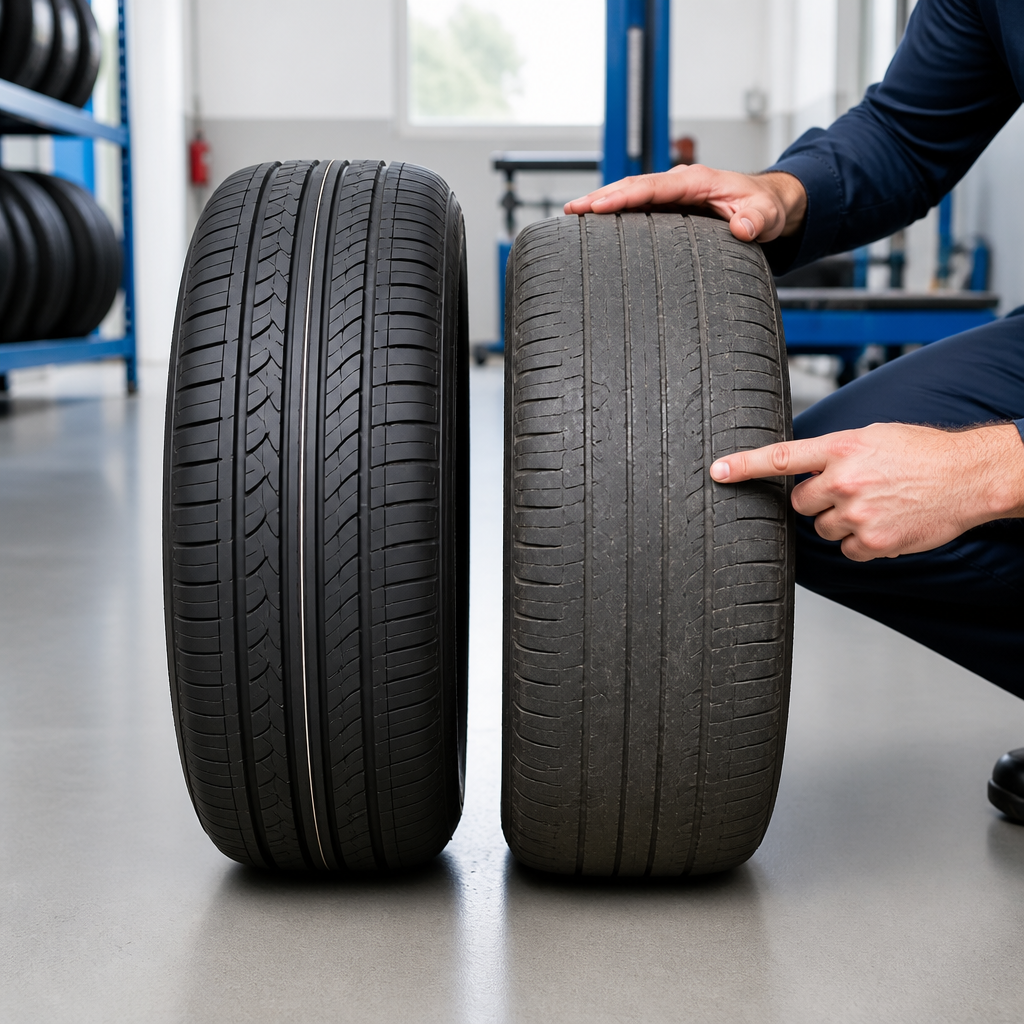
New tyres vs used tyres is an important safety question for every driver trying to control vehicle costs without putting passengers at unnecessary risk. Used tyres can cost less at the point of purchase, but their condition, age, repair history and previous use are not always easy to confirm. New tyres usually offer a clearer safety baseline, although they still need the correct size, proper inflation and regular inspection.
The safest choice is not determined by price alone. A tyre connects your vehicle to the road through a relatively small contact area. Its rubber condition, tread pattern, internal structure and air pressure all affect braking, steering, cornering and resistance to aquaplaning. If any of these factors are compromised, the vehicle may become harder to control, especially during sudden braking or on wet, uneven roads.
This guide compares both options in practical terms. It explains what makes a tyre safe, when a used tyre may be acceptable, which warning signs should stop a purchase and how to inspect tyres before fitting them. It also covers the questions buyers often ask when deciding between a cheaper used set and a more dependable new set. Best SUVs for Nigerian Roads: A Practical Buying Guide
What Makes a Tyre Safe?

A safe tyre is more than a tyre with visible tread. It must have enough usable tread, sound sidewalls, a healthy internal structure and the correct specification for the vehicle. It should also be properly mounted, balanced and inflated.
Several factors work together:
- Tread depth: Tread channels help move water away from the contact patch and support grip on different surfaces.
- Rubber condition: Rubber can harden, crack or lose flexibility as it ages, even when the tread looks acceptable.
- Sidewall integrity: Cuts, bulges and deep abrasions may indicate damage to the tyre’s internal cords.
- Correct size and rating: The tyre must suit the vehicle’s approved dimensions, load requirement and speed rating.
- Inflation pressure: Underinflation can increase heat and wear, while overinflation can reduce the contact area and affect ride and grip.
- Uniformity: Tyres on the same axle should normally be closely matched in size, construction and condition.
Age also matters. Tyres can deteriorate from sunlight, heat, long storage, chemical exposure and repeated loading. The visible tread is only one part of the safety picture. For that reason, a tyre with plenty of tread is not automatically safe if its sidewalls show cracking or if its history is unknown.
New Tyres vs Used Tyres: The Main Safety Difference
The biggest difference between new and used tyres is certainty. A new tyre from a reputable seller has not previously carried a vehicle, experienced road impacts or been exposed to unknown storage conditions. You can check its size, markings and manufacturing date, then begin its service life with a known starting point.
A used tyre has already spent part of its service life. It may still be in good condition, but the buyer must assess more variables. The tyre may have been driven underinflated, overloaded, repaired after a puncture, exposed to extreme heat or removed from a vehicle because of a problem. Some of that history may not be visible during a quick inspection.
That does not mean every used tyre is unsafe. A lightly used tyre that is correctly specified, relatively young and professionally inspected may perform satisfactorily. However, the safety margin is harder to establish. The buyer must rely on a careful inspection and an honest seller rather than assuming that remaining tread tells the whole story.
Why new tyres usually provide a stronger baseline
New tyres normally provide the most predictable starting point. They have full tread, unused rubber and no previous puncture or impact history. They also allow you to select the specification that matches the vehicle instead of accepting whatever is available in the used market.
New does not mean perfect in every situation. A newly purchased tyre can still be the wrong size, incorrectly inflated or poorly fitted. It can also be damaged by a pothole after installation. Therefore, buying new is an advantage, not a replacement for maintenance.
Why used tyres require more investigation
With a used tyre, the price may reflect reduced remaining life. Tread can be uneven, and the tyre may have been rotated, repaired or driven in difficult conditions. Two tyres that look similar may have very different histories.
Used tyres also make it more difficult to create a consistent set. You may find two tyres with good tread but different ages or brands. Mixing tyres can affect how each wheel responds during braking and cornering. A competent tyre professional can explain whether a particular combination is suitable for your vehicle.
Safety Comparison: New and Used Tyres
Braking performance
Tyre grip contributes directly to braking. When you brake suddenly, the tyres must maintain contact with the road while resisting the vehicle’s movement. A tyre with worn tread, hardened rubber or uneven wear may provide less predictable braking performance, particularly on a wet surface.
New tyres generally offer more available tread and a known rubber condition. Used tyres may still brake effectively, but their performance depends on how much tread remains and how the rubber has aged. The difference may not be obvious in a gentle stop. It can become more important during an emergency.
Never judge braking ability only by a short test drive. A quiet road and dry surface may hide weaknesses that appear during rain, heavy traffic or an emergency manoeuvre.
Wet-weather grip
Water on the road can reduce the contact between rubber and asphalt. Tread grooves help channel water away, but their effectiveness decreases as tread wears. A tyre with shallow or irregular tread may lose grip sooner in heavy rain.
Age can also affect wet-weather performance. As rubber hardens, the tyre may become less flexible and less able to conform to small road irregularities. This is one reason a used tyre should be assessed for both tread and age.
Drivers should reduce speed in heavy rain and avoid assuming that a new tyre makes fast driving safe. Good tyres improve the vehicle’s ability to respond, but they cannot overcome excessive speed, standing water or unsafe following distances.
Steering and cornering
Steering response depends on the tyres’ contact with the road, their construction and their pressure. Uneven wear can make a car pull to one side or feel unstable. A damaged tyre may also produce vibration through the steering wheel.
New tyres with matching specifications often make it easier to achieve consistent handling. With used tyres, differences in tread pattern, wear and casing condition can create different responses between the front and rear axles. That does not automatically make a set unusable, but it deserves professional assessment.
Resistance to heat and road damage
Tyres generate heat as they flex. Underinflation, overloading and high speed can increase heat build-up. A tyre with internal damage may be more vulnerable when subjected to these conditions.
Used tyres have already experienced some amount of flexing and impact. If they were driven while underinflated, their internal structure could have been weakened without leaving an obvious mark. A new tyre also needs correct pressure, but its previous operating conditions are not an unknown factor.
Advantages of Buying New Tyres
- Known starting condition: You begin with unused tread and no previous road history.
- Better choice of specification: You can select the correct size, construction, load index and speed rating.
- More consistent performance: A new matching set usually provides similar handling at all four corners.
- Longer expected service life: You are not buying a tyre with an unknown amount of usable life already consumed.
- Easier inspection: Manufacturing markings and condition can be checked before fitting.
- Lower uncertainty: You do not need to guess how the tyre was driven, stored or repaired.
New tyres may also reduce the risk of replacing one tyre repeatedly because another used tyre fails soon after installation. The initial purchase can be higher, but the value should be considered over the expected service period. A tyre that lasts longer and performs consistently may cost less per kilometre than a cheaper tyre that needs early replacement.
Still, buyers should avoid choosing a new tyre solely because it has the lowest price among new options. Compare the specification, seller reputation, manufacturing date, fitting quality and after-sales support. A bargain tyre that does not suit the vehicle is not a safe bargain. How to Calculate Car Ownership Cost Nigeria
When Can Used Tyres Be a Reasonable Option?
Used tyres can be considered when the buyer has a limited budget or needs a temporary replacement. They may also be useful when matching an existing tyre that has been damaged, provided a professional confirms that the replacement is appropriate.
However, the tyre should pass a careful inspection before purchase. The seller should allow you to examine the inner and outer sidewalls, tread surface, bead area and manufacturing markings. If the seller refuses inspection or provides vague answers about the tyre’s condition, walk away.
A used tyre is more reasonable when it has:
- A clear and appropriate size for the vehicle.
- Even tread wear across the surface.
- No bulges, bubbles, cuts or deep sidewall abrasions.
- No exposed cords, separated tread or damaged bead.
- No suspicious repairs or plugs in unsafe areas.
- No severe cracking between tread blocks or along the sidewall.
- A manufacturing date that does not suggest excessive age.
- A seller who provides a proper inspection and fitting service.
Even when these checks are positive, used tyres remain a compromise. The safest decision may be to buy fewer new tyres now, if appropriate for the vehicle and axle arrangement, rather than installing a complete set of questionable used tyres. Ask a qualified technician before mixing new and used tyres.
How to Inspect a Used Tyre Before Buying
Take your time. A quick look at the outside is not enough. If possible, inspect the tyre before it is mounted on a wheel. Once fitted, part of the inner sidewall and bead may be difficult to examine.
1. Confirm the size and markings
Read the full marking on the sidewall. It may include width, aspect ratio, construction type, wheel diameter, load information and speed information. Compare these details with the vehicle handbook, the information label fitted to the vehicle or guidance from a qualified tyre professional.
Do not assume that a tyre will fit safely because it can be mounted on the wheel. A tyre can physically fit while still having an unsuitable load or speed rating. The vehicle’s requirements come first.
2. Check the tread across several points
Look across the inner edge, centre and outer edge of the tread. Uneven wear may indicate poor alignment, worn suspension components, incorrect pressure or previous vehicle problems. Measure or professionally assess the remaining tread instead of relying on appearance alone.
Look for bald areas, isolated smooth patches, saw-tooth wear and cracks between tread blocks. These signs may indicate that the tyre has not worn normally.
3. Inspect both sidewalls
Examine the outer and inner sidewalls. Search for bulges, bubbles, cuts, deep scrapes, fine cracking and areas that look distorted. A bulge can indicate damage to internal cords. Do not buy a tyre with a bulge or any sign of structural damage.
Sidewall damage may be more serious than a small tread puncture because the sidewall flexes continuously. A cosmetic mark should be assessed by a professional, not dismissed automatically.
4. Look for repairs and tread separation
Ask whether the tyre has been repaired. A repair in the central tread area may sometimes be professionally assessed and repaired according to accepted practice. Repairs close to the sidewall or shoulder require particular caution and may make the tyre unsuitable.
Inspect the tread blocks and shoulders for lifting, waves or a visible line between layers. Any sign of tread separation should end the purchase consideration. Do not rely on a seller’s claim that a problem will disappear after balancing.
5. Read the date code
Most tyres carry a date code as part of their sidewall markings. The code helps identify when the tyre was manufactured. Check the complete marking because a tyre’s age affects the assessment, even when its tread looks deep.
A date code does not provide a complete safety verdict. Storage conditions, climate, use and maintenance also matter. If the date is missing, damaged or difficult to interpret, ask the seller to explain it. Treat uncertainty as a reason for caution.
6. Inspect the bead and inner liner
The bead seals the tyre against the wheel. Look for tears, chafing, deformation or tool damage around the bead. Also check the inner liner for patches, exposed material or signs of running while flat.
Some damage cannot be confirmed without specialist equipment. That is why a professional inspection is valuable, especially when buying several used tyres for a family vehicle or long-distance driving.
Warning Signs That Mean You Should Reject a Used Tyre
Some defects are clear reasons not to buy. Reject a used tyre if you see a bulge, exposed cords, deep sidewall cracking, major cuts, severe tread separation or a badly damaged bead. A tyre that has been driven flat should also be treated with caution because internal damage may not be visible.
Be careful with tyres that have been heavily buffed or cleaned. Cleaning can improve appearance while making defects harder to notice. Ask to see the tyre in normal light, and inspect the tread and sidewalls yourself.
Reject the tyre if the seller cannot show the full sidewall markings or if the size does not match the vehicle’s requirements. Avoid tyres with extremely uneven wear, multiple questionable repairs or an unknown date code. Low price is not a reason to ignore a safety warning.
Also consider the seller’s behaviour. Pressure to pay immediately, refusal to permit inspection and unsupported claims about “almost new” condition are all reasons to choose another seller. Used Car Mileage: What Is Too High When Buying?
New Tyres vs Used Tyres: Comparing Cost and Value
The purchase price is only one part of the calculation. Compare the expected usable life, fitting cost, balancing, alignment, future replacement risk and the consequences of a tyre failure. A used tyre that costs much less but has limited life may not deliver meaningful savings.
For example, imagine two options. A used tyre has attractive tread but an uncertain history and visible age. A new tyre costs more, but it has the correct specification and a predictable starting condition. If the used tyre needs replacement shortly after fitting, the buyer pays fitting and balancing costs again. The apparent saving becomes smaller.
New tyres can also support better planning. You can replace a matching set, monitor wear from the beginning and keep records of pressure checks and rotations. Used tyres may be suitable for a short-term need, but a buyer should not mistake a lower entry price for lower overall motoring cost.
That said, buying the most expensive tyre is not automatically the best decision. Compare reputable options within the correct specification. A sensible budget choice is one that meets the vehicle’s requirements and comes from a trustworthy source.
Should You Replace Two Tyres or All Four?
The answer depends on the vehicle, drivetrain, existing tyre condition and professional advice. Replacing all four tyres provides the most uniform result when the current set is worn or aged. Replacing only two may be appropriate when the other two are in good condition and closely matched.
When only two tyres are replaced, many tyre professionals recommend placing the tyres with deeper tread on the rear axle, because rear grip helps stability during wet-weather cornering. However, the correct arrangement can depend on the vehicle manufacturer’s instructions and the tyre professional’s assessment.
Vehicles with all-wheel drive or four-wheel drive may have stricter requirements for matching tyre circumference and tread depth. Differences between tyres can place additional strain on the drivetrain. Check the owner’s manual and obtain specialist advice before replacing only one or two tyres.
Never mix tyres casually across an axle. At minimum, tyres on the same axle should normally match in size and construction. If the vehicle uses directional or asymmetric tyres, ensure each tyre is mounted in the correct direction.
Installation and Maintenance Matter as Much as the Purchase
A good tyre can become unsafe if it is fitted incorrectly or neglected. Use a competent installer with suitable equipment. The wheel should be checked for damage, and the tyre should be balanced after fitting when required.
Set inflation pressure according to the vehicle manufacturer’s recommendation, not the maximum pressure printed on the tyre sidewall. The recommended figure may differ between front and rear axles or between normal and heavily loaded use. Check pressure when the tyres are cold, unless the vehicle or tyre manufacturer gives different instructions.
Check pressure regularly and before long trips. Underinflation can increase rolling resistance, heat and shoulder wear. Overinflation may reduce the size of the contact patch and make the ride harsher. Neither condition is desirable for safe handling.
Inspect the tyres visually during routine cleaning or refuelling. Look for nails, cuts, bulges and changes in wear. If the vehicle vibrates, pulls to one side or produces unusual noise, arrange an inspection instead of waiting for the next service.
Wheel alignment and suspension condition also matter. If a new tyre begins wearing rapidly on one edge, the vehicle may have an alignment or suspension problem. Replacing the tyre without correcting the cause will waste money and may reduce safety.
Driving Conditions and Vehicle Use Should Influence Your Choice
Think about how and where you drive. A vehicle used for frequent highway journeys, heavy loads, passenger transport or long trips may justify the greater predictability of a new matching set. A tyre failure far from a reliable repair facility can create a serious inconvenience and safety risk.
Urban driving still demands good tyres. Potholes, broken road edges, sudden stops and standing water can put heavy stress on the tyre and wheel. Short journeys do not make tyre condition irrelevant.
Hot weather, intense sunlight and poor storage can accelerate rubber deterioration. Park in shade where practical, avoid prolonged contact with oil or harsh chemicals and do not store tyres near heat sources. These precautions help new and used tyres, but an older used tyre may already have experienced significant exposure.
If you regularly carry heavy loads, confirm that the tyres have adequate load capacity. Do not exceed the vehicle’s permitted load. Overloading raises stress and heat, which can contribute to tyre damage.
Common Myths About Used Tyres
“Deep tread means the tyre is safe.”
Not necessarily. A tyre can have deep tread and still have sidewall cracking, internal damage or an unsuitable age. Tread is important, but it is only one part of the inspection. Wheel Alignment: How to Know Your Car Needs It
“A repaired tyre is always dangerous.”
Not every repair has the same risk. A professional must assess the puncture’s location, size, angle and repair method. A repair close to the sidewall or shoulder deserves particular caution. Never buy a repaired used tyre without understanding the repair and receiving professional advice.
“A branded used tyre is safer than a new budget tyre.”
Brand alone does not determine current condition. A premium tyre that is old, damaged or poorly stored may be a worse choice than a correctly specified new tyre from a reputable manufacturer and seller.
“If there is no vibration, the tyre is fine.”
Some tyre defects produce vibration, but others do not. A smooth test drive cannot identify every problem. Visual inspection, date assessment and professional examination remain important.
A Practical Buying Checklist
Use this checklist before paying for any tyre:
- Confirm the recommended tyre size for your vehicle.
- Check the required load and speed information.
- Decide whether you need one tyre, two tyres or a complete matching set.
- Inspect the date marking and ask about storage history.
- Check tread wear across the full width.
- Inspect both sidewalls for cracking, cuts, bulges and abrasions.
- Look for repairs, tread separation and bead damage.
- Ask whether the tyre has been driven flat or involved in an impact.
- Use a reputable installer for mounting, balancing and inspection.
- Set the correct pressure and arrange alignment if wear suggests a problem.
- Keep the receipt and record the fitting date.
If the seller cannot answer basic questions, do not feel obliged to continue. There will always be another tyre. A small saving is not worth accepting a defect that could affect braking or control.
Which Option Is Safer for Most Drivers?
For most drivers, new tyres are the safer and more predictable choice. They offer a known service starting point, full usable tread and fewer unknowns about previous treatment. This is especially important for family vehicles, high-speed travel, frequent rain, heavy loads and drivers who cannot easily evaluate used tyre condition.
Used tyres can be acceptable in limited circumstances, but only after careful inspection. They should be correctly specified, free from structural damage, reasonably young, evenly worn and supplied by a seller who permits proper checks. If any of these conditions is uncertain, choose new tyres or delay the purchase until you can obtain reliable advice.
The best decision also considers your budget honestly. If you cannot afford a complete new set, speak with a tyre professional about safe replacement options. Depending on the vehicle, replacing the most worn tyres first may be possible. Do not solve a financial problem by buying tyres with visible or suspected damage.
Frequently Asked Questions
Are used tyres always unsafe?
No. A used tyre may still be serviceable if it has been properly inspected and meets the vehicle’s requirements. However, its previous history is less certain than that of a new tyre. Buyers must assess age, tread, sidewalls, repairs, storage and structural condition.
How much tread should a used tyre have?
There is no single tread figure that answers every safety question. Minimum legal requirements can vary by jurisdiction, and a tyre may become less suitable before reaching a legal limit. Check the applicable local requirements and have the tyre assessed by a qualified professional. Uneven wear and damage matter as much as remaining depth.
Can I mix new and used tyres?
Sometimes, but it should not be done casually. Tyres on the same axle should normally match in size and construction. Differences in tread and condition can affect handling. Follow the vehicle manufacturer’s guidance and ask a tyre professional where the newer tyres should be fitted.
Is a tyre with a recent date code automatically safe?
No. A recent manufacturing date is useful, but it does not remove the need to inspect the tyre. A newer tyre may still have a cut, bulge, repair problem, incorrect specification or damage from poor storage.
What should I do if my tyre has a bulge?
Do not continue normal driving on a tyre with a bulge. A bulge can indicate internal structural damage. Have the tyre inspected promptly, and replace it if a professional confirms that it is unsafe. Avoid high speed and heavy loading while waiting for assistance.
Are cheap new tyres better than expensive used tyres?
Price and brand alone cannot answer the question. Compare correct specification, condition, age, seller reputation and fitting quality. A properly selected new tyre usually offers more predictable condition, while a used tyre needs stronger evidence that it remains sound.
When should tyres be replaced?
Replace tyres when they reach the applicable wear limit, show damage, develop severe cracking, suffer structural problems or no longer meet the vehicle’s requirements. Tyres should also be assessed as they age, even if tread remains. Ask a professional if you are unsure.
Final Verdict
New tyres vs used tyres is ultimately a choice between greater predictability and lower initial cost. New tyres are generally safer for most buyers because their condition and service history are known. Used tyres can work when carefully selected, professionally inspected and correctly fitted, but they carry more uncertainty.
Before making a decision, inspect the complete tyre rather than focusing only on tread. Confirm the size and ratings, check the date, look for sidewall and bead damage, ask about repairs and consider how the tyres will be used. Then maintain the tyres with correct pressure, regular inspections and timely replacement.
If you are uncertain, seek advice from a reputable tyre professional before purchase. The right tyre is not simply the one with the lowest price. It is the one that matches the vehicle, suits the driving conditions and gives you dependable control when you need it most.