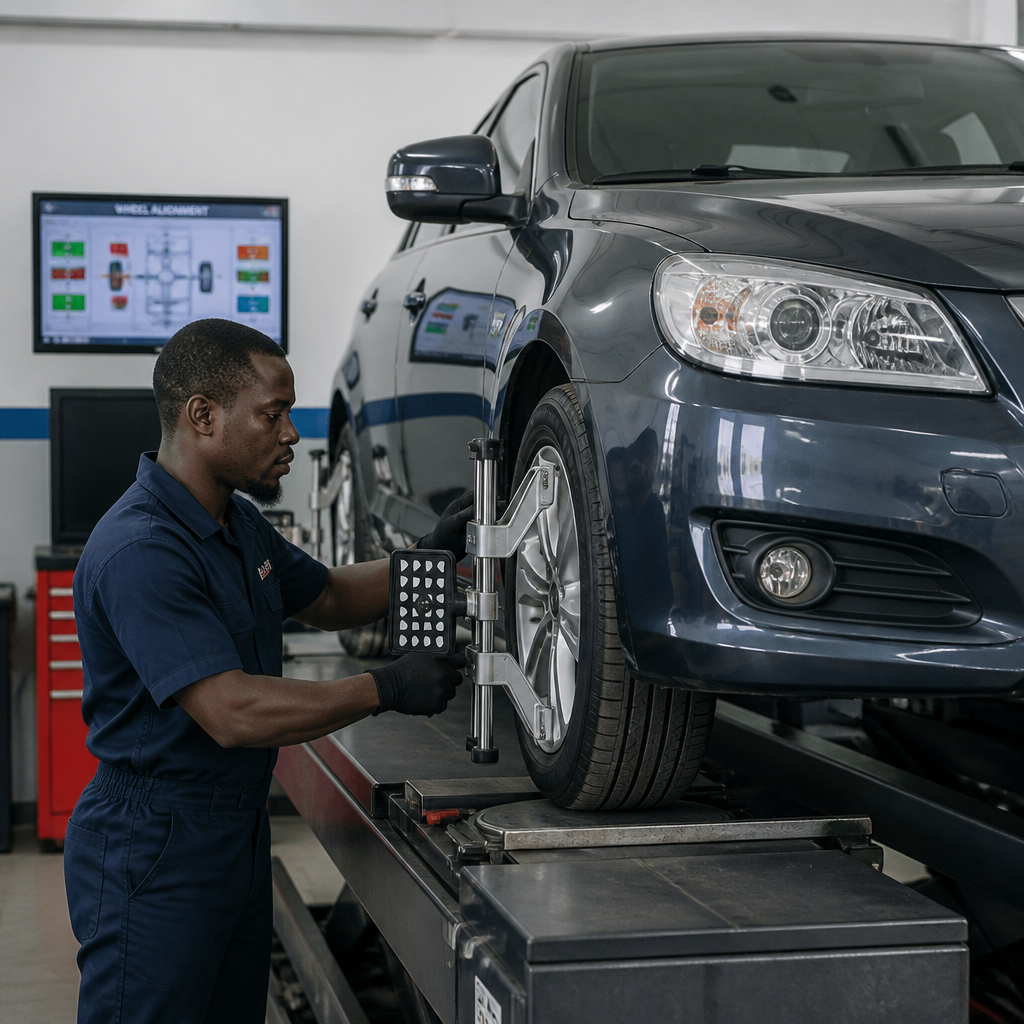
Wheel alignment problems can make your car pull to one side, wear tyres unevenly, or feel unstable on the road. This guide explains how to know when your car needs a wheel alignment, what causes alignment to change, and what you should do before the problem becomes expensive or unsafe.
Many drivers notice a steering or tyre problem but assume it will disappear after inflating the tyres. Sometimes low pressure is the cause. However, a vehicle can also have incorrect alignment angles, worn suspension parts, bent wheels, or damage from a pothole. Understanding the difference helps you avoid replacing good parts unnecessarily.
Wheel alignment is not usually a routine repair that every car needs at a fixed mileage. Instead, it is a service that becomes necessary when the wheel angles move outside the manufacturer’s specifications or when another steering and suspension problem affects how the car tracks. If you are preparing to buy a used car, a careful test drive can reveal several of these warning signs. Our guide on how to test drive a used car before you pay explains other behaviours worth checking during a purchase inspection. how to test drive a used car before you pay
What does wheel alignment mean?
Wheel alignment means adjusting the angles of the wheels so they sit correctly in relation to the road, the vehicle body, and one another. The goal is to help the tyres maintain proper contact with the road while the car moves straight and turns predictably.
A technician normally checks three important angles. The exact names and acceptable ranges vary by vehicle, but the basic principles are similar.
Camber
Camber describes how much the top of a wheel leans inward or outward when viewed from the front of the car. If the top leans too far inward, the vehicle has excessive negative camber. If it leans outward, it has excessive positive camber. a car that shakes when braking
A small amount of camber may be part of the vehicle’s design. The problem begins when the angle is outside the recommended range. Incorrect camber can place extra pressure on one edge of the tyre and cause a narrow strip of tread to wear quickly.
Toe
Toe describes whether the fronts of the tyres point slightly toward each other or away from each other when viewed from above. If the front edges point inward, the wheels have toe-in. If they point outward, they have toe-out.
Incorrect toe is a common reason for rapid, uneven tyre wear. It can also make the steering feel nervous or cause the car to wander. Because even a small change can affect the direction in which the tyres scrub across the road, toe should be checked after a strong impact.
Caster
Caster is the angle of the steering axis when viewed from the side of the vehicle. It influences steering stability, steering effort, and how well the steering wheel returns after a turn. how often you should service a car in Nigeria
Caster problems may result from damaged or bent components rather than a simple adjustment. On some vehicles, the technician can correct caster. On others, the angle may point to a worn part, a bent suspension component, or previous accident damage.
How to know when your car needs a wheel alignment
The most useful warning signs usually appear while you are driving or examining the tyres. One sign does not always prove that the alignment is wrong. Still, several signs together deserve prompt attention.
1. The car pulls to one side
A car that consistently moves left or right on a reasonably level road may need an alignment check. The pull may be mild at first. You might only notice it when you relax your grip on the steering wheel for a moment. detecting accident and repainted Tokunbo cars
Do not test this by removing your hands from the wheel in traffic. Instead, keep both hands ready and observe whether the vehicle repeatedly drifts in the same direction on a safe, straight road. Road camber can naturally make a vehicle move toward the edge, so a proper workshop inspection is necessary before reaching a conclusion.
A pull can also come from unequal tyre pressure, a sticking brake, a damaged tyre, or a problem with the suspension. Check the tyre pressures when the tyres are cold. If the pressures are correct and the vehicle still pulls, arrange a professional inspection.
2. The steering wheel is off-centre
If the car travels straight but the steering wheel sits noticeably turned to one side, the alignment may be incorrect. A crooked steering wheel often means the front wheels are not positioned evenly around the vehicle’s centre line.
This symptom can appear after a pothole strike, kerb impact, suspension repair, or steering component replacement. It can also indicate that a previous alignment was not completed accurately. A technician should inspect the steering and suspension before making adjustments.
3. The tyres wear unevenly
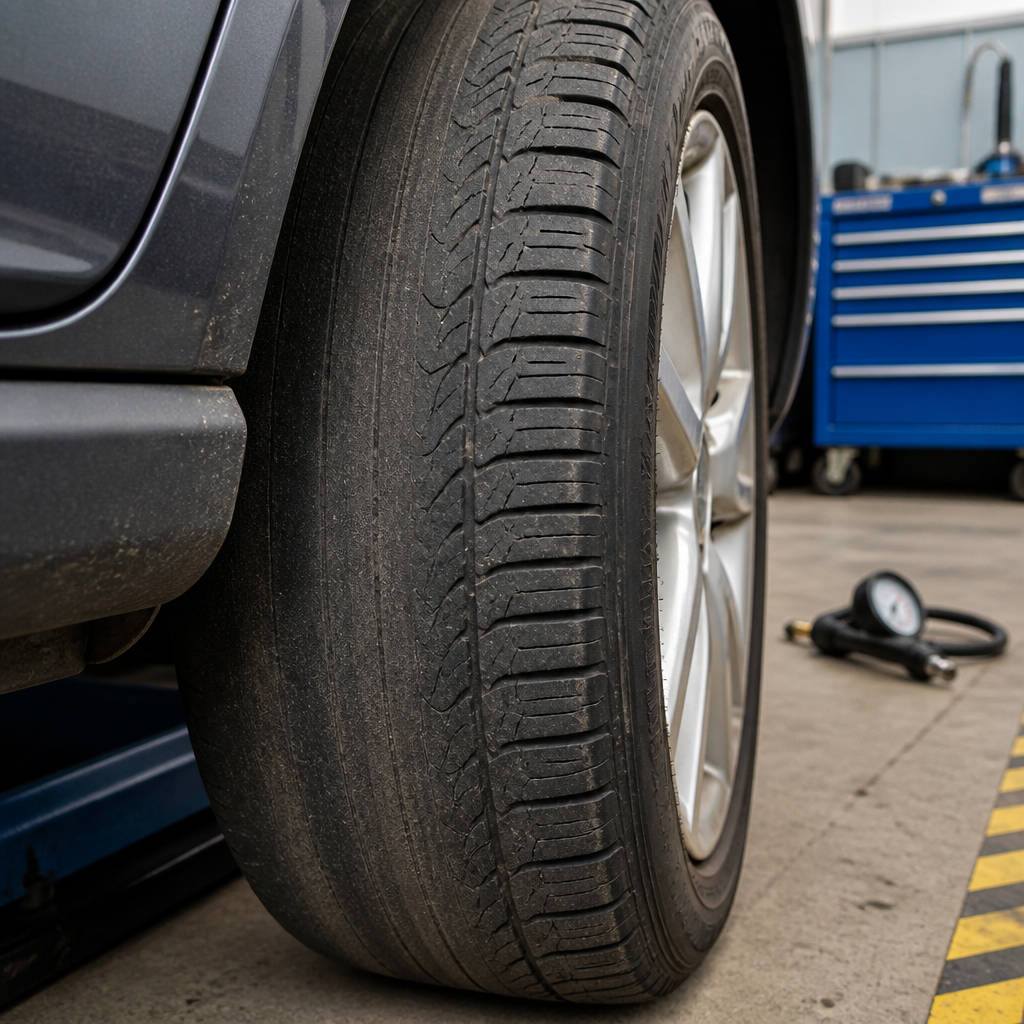
Inspect the tread across the full width of each tyre. Wear on one inside or outside edge may indicate incorrect camber or toe. Wear that looks saw-toothed, feathered, or slightly raised in one direction can also suggest that the tyre is not rolling evenly.
Run your hand lightly across the tread only when the vehicle is parked safely. If the tread feels smoother in one direction and rougher in the other, ask a tyre or alignment technician to examine it. Do not rely on appearance alone. Some alignment-related wear develops slowly and is easier to feel than see.
Tyre wear can also result from incorrect inflation, poor rotation habits, worn shock absorbers, overloaded vehicles, or a damaged wheel. That is why alignment should be checked alongside the tyres and suspension rather than treated as an isolated issue.
4. The car feels unstable or wanders
A vehicle with alignment or suspension problems may require constant steering corrections. It may feel as if it is wandering across the lane, especially on an uneven road or at higher speed. The steering may also feel less precise than it did previously.
This behaviour can be dangerous during an emergency manoeuvre. It may also become more noticeable when the vehicle carries passengers or luggage. Reduce your speed and arrange an inspection instead of trying to compensate by holding the steering wheel more tightly.
5. The steering wheel does not return normally
After turning, most cars should begin to bring the steering wheel back toward the straight-ahead position. If the wheel stays turned, returns very slowly, or behaves differently after left and right turns, the vehicle may have a caster, steering, tyre, or suspension problem.
Do not assume that this symptom always requires an alignment. Low tyre pressure, a worn steering joint, a damaged strut mount, or binding in the steering system can create similar behaviour. A complete inspection is safer than adjusting alignment without finding the cause.
6. The vehicle vibrates or feels rough
Wheel alignment is often blamed for vibration, but imbalance is a more common cause of a steering wheel that shakes at particular speeds. A bent rim, damaged tyre, loose wheel, worn suspension part, or brake issue can also produce vibration.
If the vibration began after hitting a pothole, inspect the wheel and tyre as soon as possible. If it occurs while braking, it may involve the braking system. You can learn more about that specific symptom in our guide to a car that shakes when braking, including causes that should not be confused with alignment trouble.
7. The tyres squeal during ordinary turns
Tyres may make a brief sound during a sharp turn, especially on dusty or polished surfaces. Repeated squealing during normal cornering, however, can suggest that the tyres are scrubbing across the road instead of rolling smoothly.
Incorrect alignment is one possible cause. Low pressure, worn tread, a suspension fault, or aggressive cornering can also create noise. Take note of when the sound occurs and whether it comes from one corner or both sides of the vehicle.
8. You recently hit a pothole or kerb
A strong impact can alter alignment immediately. The impact may also bend a wheel, damage a tyre, or deform a steering and suspension component. You should arrange an inspection if the steering changed suddenly, the car began pulling, or the tyre lost air after the impact.
Road conditions in many parts of Nigeria can make pothole damage difficult to avoid. Slow down where visibility is poor, leave enough space to identify hazards, and avoid striking a pothole while braking hard or turning sharply. If an impact happens, do not wait for uneven wear to become obvious before checking the vehicle.
9. You replaced a steering or suspension component
Alignment may be necessary after replacing parts such as tie-rod ends, control arms, ball joints, steering racks, struts, or other components that affect wheel position. The same applies after accident repairs or work that involved removing and refitting suspension parts.
Ask the workshop whether an alignment check was included in the repair. A vehicle can feel better after a new component is fitted but still have incorrect wheel angles. The technician should also confirm that all bolts are tightened correctly and that no damaged part remains.
10. The tyres were replaced and the car now behaves differently
New tyres can make an existing alignment problem more noticeable because their tread is even and responsive. In some cases, a change in tyre size, construction, or brand can also alter steering feel without indicating an alignment fault.
Tyre replacement is a good time to inspect the tread, check inflation, balance the wheels, and review the vehicle’s alignment. If the car pulls only after fitting one tyre, the tyre itself, wheel position, or pressure should also be examined.
Why wheel alignment changes
Manufacturers set alignment angles for a particular suspension design. Those angles can change when the vehicle suffers an impact or when parts wear. Normal driving does not always cause a sudden change, but repeated impacts and neglected maintenance can gradually affect the way the car tracks.
- Potholes and kerbs: A hard impact can move or bend components that control wheel position.
- Worn steering parts: Loose tie rods, ball joints, or control-arm bushes can allow the wheel to move under load.
- Accident damage: A repaired vehicle may need careful measurement to confirm that the suspension and body are correctly positioned.
- Overloading: Carrying more weight than the vehicle is designed for can place extra stress on tyres and suspension.
- Incorrect repairs: A replacement part that is loose, damaged, or incorrectly installed can affect alignment.
- Wheel or tyre damage: A bent rim or tyre defect can imitate an alignment problem.
- Normal wear: Bushes, joints, and mounts can deteriorate over time, allowing alignment to change.
A useful maintenance routine should look at the whole vehicle. Regular servicing can help identify worn parts before they affect tyre wear and handling. For a broader maintenance schedule, see our practical explanation of how often you should service a car in Nigeria.
What to check before booking an alignment
Before visiting a workshop, collect a few simple observations. This information helps the technician reproduce the problem and prevents guesswork.
- Check tyre pressure: Use the vehicle maker’s recommended pressure, not a random number written on the tyre sidewall. Check all four tyres and the spare when the tyres are cold.
- Inspect the tread: Look for one-sided wear, exposed cords, cracks, bulges, cuts, or objects in the tread.
- Check the wheel nuts: If a wheel was recently removed, confirm that the nuts are present and secure. If you suspect a loose wheel, do not drive until it is checked.
- Notice when the problem occurs: Record whether the pull happens during acceleration, braking, cornering, or steady cruising.
- Recall recent impacts: Tell the technician about potholes, kerbs, road debris, or collision repairs.
- Look for fluid leaks or sagging: A damaged shock absorber or suspension part may need attention before alignment.
Do not adjust suspension components at home unless you have the correct equipment, specifications, and training. Alignment requires accurate measurements. Guessing with a spanner can make tyre wear and handling worse.
What happens during a wheel alignment service?
A proper alignment service begins with an inspection rather than an immediate adjustment. The technician should confirm the tyre condition, tyre pressures, wheel condition, ride height, steering and suspension components, and any obvious damage.
The vehicle is then positioned on an alignment machine. Sensors or targets measure the wheel angles and compare them with the manufacturer’s specifications. Depending on the vehicle, the technician may adjust the front wheels, rear wheels, or both.
After adjustment, the technician should perform another measurement. Many workshops provide a before-and-after report. Keep this report because it can show which angles were outside specification and whether the final readings are within the recommended range.
Why an alignment cannot fix every problem
Alignment adjustments cannot repair a bent rim, broken spring, worn ball joint, damaged tyre, loose wheel bearing, or bent chassis component. If the machine cannot reach the correct reading, the technician should investigate the underlying fault.
Be cautious if a workshop promises to solve every handling problem with alignment alone. A good inspection identifies what can be adjusted and what needs replacement. Replacing a tyre or suspension component may be necessary before the final alignment can be completed.
How urgent is a wheel alignment problem?
The urgency depends on the symptom. A slightly off-centre steering wheel with stable handling may allow you to drive carefully to a reputable workshop. A vehicle that pulls sharply, loses air, shakes severely, or shows exposed tyre cords should not be driven normally.
Stop and seek assistance if the steering suddenly changes, a tyre develops a bulge, the vehicle feels difficult to control, or you hear repeated knocking from the suspension. These signs may involve a serious mechanical or tyre failure rather than alignment alone.
Even a mild alignment issue deserves attention because uneven wear can destroy a tyre before the driver notices. Once a tyre has worn heavily on one edge, alignment will not restore the missing tread. The tyre may need replacement as well.
Wheel alignment, balancing, and tyre rotation: what is the difference?
These services are related but solve different problems.
- Wheel alignment: Corrects the angles at which the wheels meet the road and each other.
- Wheel balancing: Corrects uneven weight distribution in the wheel and tyre assembly. It commonly addresses vibration at certain speeds.
- Tyre rotation: Moves tyres to different positions to help promote more even wear, where the vehicle and tyre design allow it.
- Tyre inflation: Sets air pressure to the vehicle maker’s recommendation. Incorrect pressure affects handling, wear, comfort, and fuel consumption.
A car can need one service or several at the same time. For example, a pothole may bend a rim, disturb alignment, and create imbalance. The workshop should diagnose each symptom rather than treating every problem as a single adjustment.
Can you check alignment at home?
You can identify warning signs at home, but you cannot accurately confirm modern alignment angles without suitable measuring equipment. A visual check may reveal obvious damage or uneven tyre wear. It cannot reliably tell you whether camber, caster, or toe is within specification.
Park on a flat surface and compare the steering wheel position, tyre pressures, and tread condition. Look at the car from a distance to see whether it appears to sit unusually low on one corner. Do not crawl underneath a vehicle supported only by a jack.
You may also observe the car on a quiet, level road at a safe speed. Keep both hands available and avoid deliberately releasing the steering wheel. The purpose is to notice whether the car consistently drifts, not to perform an unsafe experiment.
How to choose a workshop for alignment
Choose a workshop with suitable alignment equipment and technicians who understand your vehicle. Ask whether the service includes a pre-alignment inspection, a before-and-after reading, and checks for worn steering and suspension components.
A useful workshop should explain the findings in plain language. If a reading is outside specification, ask what adjustment is possible and whether a damaged part is responsible. You should also receive clear advice about any tyre that is unsafe or too worn to continue using.
Do not select a workshop only because it offers the lowest fee. A cheap adjustment that ignores a loose joint or bent wheel may leave the original danger in place. At the same time, a high charge does not automatically prove that the work is thorough. Look for clear inspection steps and transparent communication.
How to prevent alignment-related tyre wear
You cannot prevent every pothole impact, but regular checks can reduce the damage and help you notice problems earlier.
- Check tyre pressure regularly and before long trips.
- Inspect the tread and sidewalls for damage.
- Slow down on roads with potholes, broken surfaces, or poor visibility.
- Have the vehicle inspected after a strong impact.
- Keep loads within the vehicle’s recommended limits.
- Repair steering and suspension faults without unnecessary delay.
- Rotate tyres only according to the vehicle and tyre manufacturer’s guidance.
- Use the correct tyre size and specification for the vehicle.
- Request an alignment check after relevant suspension or steering repairs.
Record the date and reason for each tyre or suspension repair. This history can help you identify repeated problems. It is especially useful when maintaining an older car or inspecting a vehicle with an uncertain repair background.
Why alignment matters when buying a used car
Alignment symptoms can reveal more than a maintenance issue during a used-car inspection. Uneven tyre wear may indicate neglected servicing, repeated pothole damage, or worn suspension. A crooked steering wheel may also justify questions about previous repairs or an accident.
However, do not treat an alignment problem as proof that a car has been in a crash. Many vehicles develop alignment issues from ordinary road impacts. Ask for an independent inspection and compare the tyre wear, panel gaps, suspension condition, steering feel, and available service records.
Vehicle history checks should cover more than alignment. For example, our guide on detecting accident and repainted Tokunbo cars discusses visual clues that can support a broader inspection. Use several sources of evidence before deciding whether to buy.
If you purchase the vehicle, budget for an inspection, tyre-pressure correction, balancing, and alignment where necessary. A car that drives well during a short test drive may still have gradual tyre wear that only appears after closer examination.
Frequently asked questions about wheel alignment
Does every car need alignment at the same service interval?
No. Alignment needs depend on the vehicle, road conditions, suspension wear, impacts, tyre wear, and manufacturer guidance. Some drivers need an inspection after a pothole or repair, while others may go much longer without adjustment. Follow the vehicle manual and respond to warning signs.
Can bad alignment damage tyres?
Yes. Incorrect wheel angles can make one part of the tread work harder than the rest. This may cause uneven wear and shorten the useful life of the tyre. Alignment does not repair tread that has already worn away, so early action matters.
Can low tyre pressure feel like bad alignment?
Yes. Unequal pressure can make a vehicle pull, change steering effort, and produce uneven wear. Check pressure first, but do not stop there if the symptom remains. A tyre, wheel, brake, or suspension problem may still be present.
Will alignment remove steering-wheel vibration?
Not necessarily. Vibration often involves wheel balance, a damaged tyre, a bent rim, a worn suspension part, or a braking problem. The correct repair depends on when the vibration occurs and what the inspection finds.
Should I align all four wheels?
That depends on the vehicle’s design and the workshop’s measurements. Many modern vehicles have adjustable rear alignment as well as front alignment. If the rear wheels are not tracking correctly, adjusting only the front may not solve the vehicle’s handling behaviour.
Is a crooked steering wheel always an alignment issue?
No. It can result from a previous repair, a worn component, a bent wheel, a tyre problem, or an inaccurate earlier adjustment. The workshop should inspect the complete system before making a final diagnosis.
Can I continue driving with uneven tyre wear?
Only if the tyres remain safe and a technician advises that a short trip is acceptable. Severe edge wear, exposed cords, bulges, cuts, or air loss require immediate attention. Do not risk a long journey with a damaged tyre.
Final checklist: signs your car needs attention
Arrange a professional inspection if you notice one or more of the following:
- The car repeatedly pulls left or right.
- The steering wheel is off-centre while travelling straight.
- One edge of a tyre wears faster than the rest.
- The vehicle wanders or needs constant correction.
- The steering does not return normally after a turn.
- The tyres squeal during ordinary cornering.
- You recently hit a pothole or kerb.
- A steering or suspension component was replaced.
- The vehicle’s handling changed after a tyre replacement.
- The car shows vibration, instability, or unusual suspension noise.
Wheel alignment is a small part of vehicle maintenance, but it affects tyre life, steering response, and confidence behind the wheel. Do not diagnose it from one symptom alone. Check the tyre pressures, note the driving behaviour, and have the vehicle inspected when the signs persist.
Most importantly, treat alignment as part of a complete safety check. A careful technician should examine the tyres, wheels, steering, suspension, and brakes before recommending an adjustment. That approach gives you a better chance of fixing the real problem and keeping your car stable on Nigeria’s varied roads.
3 thoughts on “Wheel Alignment: How to Know Your Car Needs It”