
Understanding the true car ownership cost Nigeria drivers face helps you choose a vehicle you can afford beyond the purchase price. A car may look affordable at the dealership, yet fuel, servicing, insurance, repairs, documentation, parking and depreciation can create a much larger monthly commitment.
This guide shows you how to calculate those costs before you buy. You will learn how to separate fixed expenses from running expenses, estimate fuel use, create a repair reserve, compare different cars and build a realistic monthly budget. The figures will vary by vehicle, location, driving pattern, fuel price, road conditions and maintenance history, so use your own receipts and current quotations wherever possible.
The calculation starts with one important idea: the amount you pay to acquire a car is only the beginning. A responsible budget must include both predictable bills and irregular expenses. It should also allow for the value the car loses as it ages.
Before comparing ownership expenses, inspect the vehicle carefully. A car with hidden accident damage, a questionable history or neglected maintenance may become expensive very quickly. Use a proper inspection process, and review this guide on used car mileage and what is too high when buying if you are considering a pre-owned vehicle: used car mileage guide.
Once you know the car’s condition, gather the information needed for your estimate. Record the purchase price, engine size, fuel type, expected weekly distance, current fuel price, insurance quotation, service intervals, tyre size and documentation requirements. If you are buying from a dealer, ask for a written breakdown of every charge instead of relying on a single headline price.
What the true car ownership cost includes
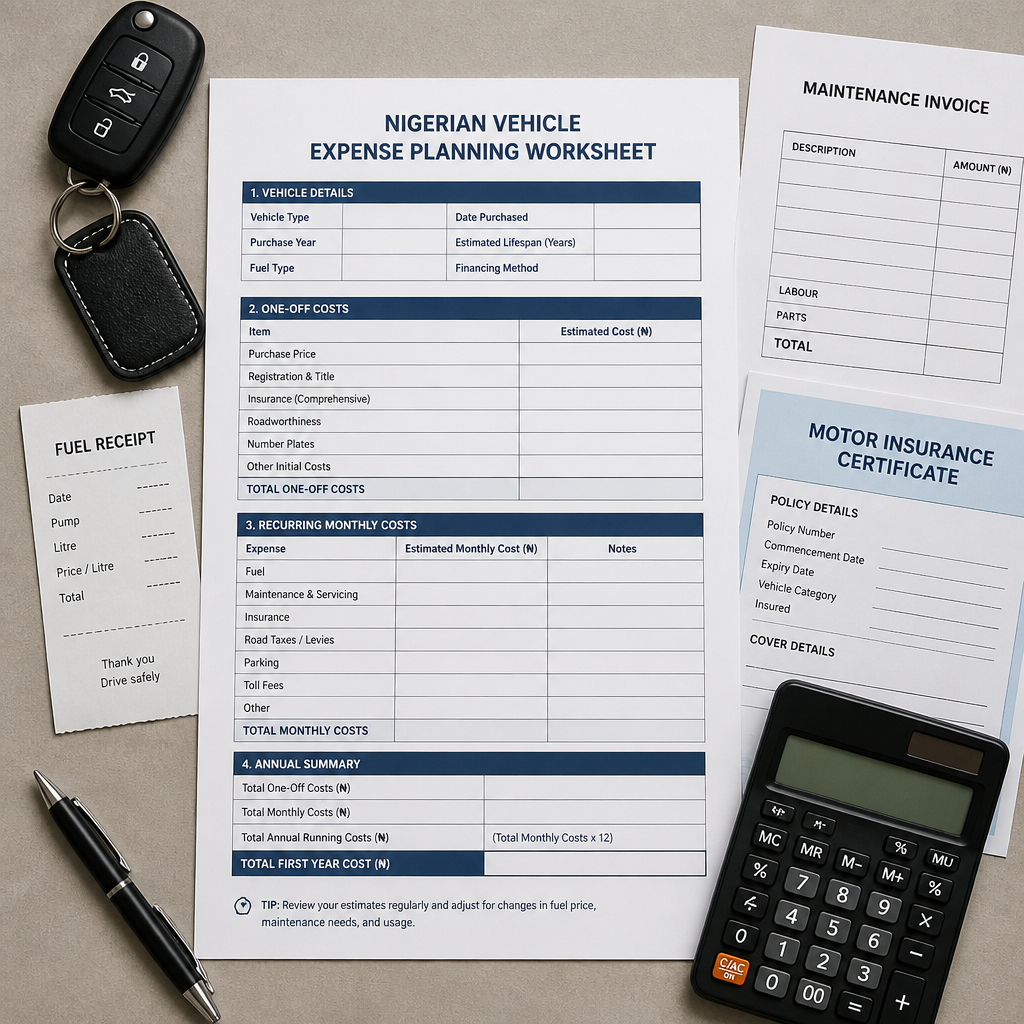
The true cost of owning a car is the total economic burden of acquiring, operating, maintaining and eventually replacing it. Some expenses leave your bank account every month. Others occur once a year or only when something fails. A useful calculation brings all of them into one monthly or annual figure.
Include these main categories:
- Acquisition cost: purchase price, inspection, registration-related charges, transfer expenses and any immediate repairs.
- Financing cost: interest, lender fees, processing charges and required insurance if you borrow money.
- Fuel or energy: petrol, diesel or charging expenses, depending on the vehicle.
- Routine maintenance: engine oil, filters, inspections, fluids, belts and scheduled service work.
- Wear items: tyres, brake components, wiper blades, batteries, suspension parts and bulbs.
- Unexpected repairs: cooling-system faults, electrical problems, air-conditioning repairs, transmission issues and accident-related work.
- Insurance: the premium for the cover you select and any excess or deductible that applies.
- Documentation: vehicle licence, number plate-related obligations, inspection requirements and other lawful renewal expenses.
- Parking and access: residential parking, workplace parking, tolls, car washes and security-related costs.
- Depreciation: the reduction in resale value while you own the car.
Not every owner will have every expense. However, leaving out irregular items makes the budget look cheaper than real life. A better approach is to convert annual and occasional bills into monthly reserves.
Step 1: Calculate the cost of acquiring the car
Start with the amount required to put the vehicle on the road in a usable and compliant condition. This is more than the seller’s advertised price.
Purchase and preparation costs
Write down the agreed purchase price separately from other expenses. Then add the cost of a pre-purchase inspection, diagnostic scan, document checks, ownership transfer, immediate servicing, replacement keys and any basic repairs required before regular use.
For an imported vehicle, your calculation may also need to account for shipping, port-related charges, customs and clearing expenses, inland transport and the cost of correcting incomplete paperwork. Do not assume that a vehicle is affordable because its overseas purchase price appears low. The landed and road-ready cost is the figure that matters.
For a Nigerian-used car, immediate preparation may include tyres, a battery, fluids, brake work, suspension repairs or air-conditioning service. Ask the mechanic to distinguish safety-critical repairs from cosmetic improvements. That distinction helps you decide whether the deal still fits your budget.
Use this formula:
Initial ownership cost = purchase price + acquisition charges + inspection + immediate repairs + initial documentation expenses
For example, imagine a vehicle advertised at ₦8,000,000. If inspection, transfer, first service, tyres and other necessary work add ₦700,000, your practical entry cost is ₦8,700,000. The exact amounts will differ, but the method remains the same.
Include money you cannot recover
Some costs increase the car’s value or usefulness. Others are simply required to complete the purchase. Treat non-recoverable charges as part of the acquisition cost because they reduce the money available for future ownership.
Also consider whether you need to spend on accessories immediately. Window tint, trackers, floor mats, a spare key, phone holders and security devices may be useful. They are still part of the cash needed to start ownership.
Step 2: Estimate your monthly fuel expense
Fuel is often the most visible running expense, but many owners estimate it poorly. Do not rely only on the manufacturer’s claimed fuel economy or a seller’s statement. Your real result depends on traffic, idling, road quality, tyre pressure, air-conditioning use, load, driving style and vehicle condition.
Use this simple formula:
Monthly fuel cost = monthly kilometres ÷ real-world kilometres per litre × current price per litre
First estimate your monthly distance. Add the distance to work, school, business locations, worship centres, shopping areas and regular family trips. Then include occasional journeys. If you drive 35 kilometres on a typical weekday, travel 20 kilometres on each weekend day and make two longer 150-kilometre trips each month, your estimate is:
- Weekday travel: 35 kilometres × 22 days = 770 kilometres.
- Weekend travel: 20 kilometres × 8 days = 160 kilometres.
- Longer trips: 150 kilometres × 2 = 300 kilometres.
- Estimated monthly distance: 1,230 kilometres.
Suppose your car achieves a measured average of 9 kilometres per litre. It would need about 137 litres for that distance. Multiply 137 litres by the current pump price in your area to estimate the monthly fuel bill. Replace the example mileage and price with your own figures.
Track fuel for at least two or three fill-ups. Record the odometer reading, litres purchased and amount paid. The calculation is:
Fuel economy = kilometres driven ÷ litres used
For a more accurate result, fill the tank to a consistent level and avoid comparing one unusually short trip with one long highway journey. A vehicle that performs well on an open road may consume considerably more in congested urban traffic.
Account for fuel waste and route choices
Idling in traffic, repeated short trips and aggressive acceleration can raise consumption. So can underinflated tyres, poor wheel alignment, clogged filters and a faulty oxygen sensor. Your budget should use a realistic average, not the best result you have ever recorded.
If you are comparing two vehicles, calculate fuel cost using the same monthly distance and local fuel price. This shows the difference clearly. A cheaper purchase price may not be cheaper to own if the car consumes much more fuel every week.
Step 3: Budget for servicing and routine maintenance
Every vehicle needs scheduled maintenance, even when nothing appears to be wrong. Routine service protects reliability and can prevent a small fault from becoming a major repair. The service schedule normally depends on time, mileage or both.
List the manufacturer’s recommended service items and divide the expected annual total by 12. Include engine oil, oil filters, air filters, cabin filters, transmission fluid where required, coolant checks, brake inspections, battery tests and general diagnostic work.
Service costs vary by engine, vehicle age, parts quality and workshop. Obtain a written estimate from a competent technician who knows the model. Ask whether the quotation covers labour, parts, consumables and diagnostic charges.
Many owners focus on the oil change and forget the larger scheduled items. Timing components, spark plugs, belts, transmission servicing and cooling-system work may have longer intervals. They should still appear in a sinking fund so the bill does not become a crisis when it arrives.
For practical planning, review how frequently a vehicle should be serviced and what checks matter in Car Service Nigeria: How Often Should You Service a Car?: car service schedule in Nigeria.
Use this formula:
Monthly routine maintenance reserve = estimated annual servicing cost ÷ 12
If you expect to spend ₦360,000 on scheduled maintenance over a year, reserve ₦30,000 each month. That does not mean you must spend exactly ₦30,000 every month. Some months may involve only an oil change, while another month may require a major service.
Step 4: Create a repair and wear-item reserve
Routine servicing is predictable. Repairs are less predictable, especially with older or poorly maintained cars. A realistic car ownership cost Nigeria budget must include a reserve for mechanical failures and replacement parts.
Common wear items include tyres, brake pads, brake discs, batteries, wiper blades, suspension bushes, shock absorbers, wheel bearings, belts and bulbs. Their replacement timing depends on road conditions, driving style, vehicle weight, part quality and previous maintenance.
Start by asking a mechanic to inspect the car and identify items that are already near the end of their useful life. Add those likely costs to your first-year estimate. Then create an ongoing reserve for repairs that cannot be predicted precisely.
Use a first-year and long-term reserve
A newly purchased used car often needs more attention during the first months. The previous owner may have postponed maintenance, used unsuitable parts or ignored warning signs. Therefore, separate your budget into two parts:
- Immediate correction reserve: work needed to bring the vehicle to a dependable baseline.
- Ongoing repair reserve: money saved for future faults and normal wear.
Do not use one generic repair estimate for every vehicle. A simple, common model may have more affordable parts and more mechanics familiar with it. A complex luxury vehicle may require specialist equipment, imported parts or longer waiting times.
Road conditions also matter. Frequent potholes and rough surfaces can increase the need for suspension, steering, tyre and alignment work. If the car shakes during braking, pulls to one side or makes a repeated knocking sound, investigate early rather than waiting for a larger failure.
Keep repair receipts and note the date, mileage, part replaced and workshop. After six to twelve months, your own records will provide a better estimate than a general online calculator.
Step 5: Add insurance to your annual budget
Insurance is an essential part of responsible vehicle ownership. The premium depends on the vehicle, policy type, insured value, driver profile, location, use of the car and the insurer’s terms. Obtain current quotations rather than copying an old figure from another vehicle.
Compare the protection provided, not just the lowest premium. Read the exclusions, claims process, excess, geographical limits, approved repair arrangements and requirements for reporting an incident. Ask the insurer or licensed intermediary to explain anything unclear before payment.
Third-party cover and comprehensive cover serve different purposes. Third-party insurance generally addresses liability to other people, while comprehensive policies may provide broader protection for the insured vehicle, subject to the policy wording. The right choice depends on your risk, vehicle value, lender requirements and ability to fund repairs yourself.
Learn the practical differences between third-party and comprehensive insurance in Nigeria before selecting a policy: third-party versus comprehensive insurance.
Use this formula:
Monthly insurance reserve = annual premium ÷ 12
If the annual premium is ₦240,000, reserve ₦20,000 each month. When renewal arrives, the money should already be available. Also keep a separate emergency amount for any excess or deductible payable after a claim.
Verify that the policy details match the correct vehicle, registration information and owner details. Keep proof of insurance safely, and confirm renewal status before driving. Insurance is not a substitute for careful driving or proper maintenance.
Step 6: Include licences, documents and compliance expenses
Vehicle documents create recurring costs and administrative responsibilities. The exact requirements and charges can change, so confirm current information through the appropriate official channels or a trusted professional.
Depending on your vehicle and circumstances, your budget may need to include vehicle licence renewal, insurance renewal, ownership transfer, number plate-related charges, inspection or emissions-related requirements where applicable, and document verification. Imported vehicles may also require careful review of customs and clearing records.
Do not budget only for the fee. Include transport, processing time, professional assistance and the cost of correcting errors if documents are incomplete or inconsistent. A missing or inaccurate document can delay a sale and create legal or financial problems.
Create a document calendar with the expiry date of each important item. Set reminders at least several weeks before renewal. For a practical document-management routine, see how to keep your vehicle documents safe and up to date: keep vehicle documents up to date.
Use official information when checking requirements. The Federal Road Safety Corps provides road safety and driver-related information, while the National Insurance Commission is the relevant regulator for insurance matters. For imported vehicles, consult the Nigeria Customs Service for customs-related guidance. The source links at the end of this article can help you begin your checks.
Step 7: Calculate depreciation and resale loss
Depreciation is the value your car loses while you own it. It is not always a monthly cash payment, but it is a real ownership cost. Ignoring it can make an expensive vehicle appear cheaper than it truly is.
Use this basic formula:
Annual depreciation = purchase value − expected resale value at the end of the ownership period
Monthly depreciation = annual depreciation ÷ number of ownership months
Suppose you buy a car for ₦10,000,000 and expect to sell it for ₦8,200,000 after 24 months. The estimated depreciation is ₦1,800,000, or ₦75,000 per month. This is only an estimate. Actual resale value depends on mileage, service history, accident history, demand, colour, transmission type, documentation, condition and the wider used-car market.
A vehicle may depreciate faster after a major accident, flood damage, odometer concern or poor-quality repair. Missing documents can also reduce buyer confidence. Keeping maintenance records, preserving the interior and repairing faults early can support resale value, although no maintenance plan guarantees a specific price.
When comparing cars, estimate resale value conservatively. It is safer to discover that the car is worth more than expected than to depend on an optimistic future sale price.
Step 8: Add financing, parking and convenience costs
If you borrow to buy the vehicle, include the full financing cost. Add the deposit, monthly instalments, interest, processing fees, valuation charges and any lender-required insurance. Do not compare only the monthly repayment with your salary. Add fuel, maintenance and other running costs to see the complete monthly commitment.
Use this formula:
Total financing cost = deposit + all repayments + lender fees − cash purchase price
The exact calculation depends on the loan agreement. Review the repayment schedule and ask whether the interest is calculated on a reducing balance or another basis. Confirm penalties for late payment and early settlement before signing.
Parking can also change the answer substantially. Include estate parking, workplace parking, commercial parking, security fees, tolls, car washes and occasional roadside assistance. If you use a driver, add the driver’s wages and employment-related costs to the household or business budget.
Convenience spending matters too. Some owners pay for regular detailing, tracking services, mobile mechanics or guarded parking. These services may be worthwhile, but they should be visible in the calculation.
Build a complete monthly car ownership budget
After gathering the figures, convert every annual or irregular expense into a monthly reserve. This creates one number you can compare with your income and other obligations.
Use this structure:
- Fuel: actual monthly estimate.
- Routine maintenance: annual estimate divided by 12.
- Repairs and wear items: planned reserve divided by 12.
- Insurance: annual premium divided by 12.
- Documentation: annual renewal estimate divided by 12.
- Depreciation: expected value loss divided by ownership months.
- Finance repayment: actual monthly instalment.
- Parking, tolls and cleaning: average monthly amount.
- Emergency buffer: a separate amount for unusually large bills.
The formula is:
Monthly ownership cost = fuel + maintenance reserve + repair reserve + insurance reserve + documentation reserve + depreciation + financing + parking and convenience costs
Keep acquisition cost separate when checking affordability. You can then calculate two useful figures: the amount needed to buy and prepare the car, and the monthly cost of keeping it.
Example of a practical comparison
Imagine you are comparing two used vehicles. Car A costs more to buy but uses less fuel and has a stronger service history. Car B costs less initially but needs immediate tyres, suspension work and more frequent repairs.
For each car, prepare the same worksheet. Enter the purchase and preparation cost, expected kilometres, measured or conservatively estimated fuel economy, annual insurance quotation, service estimate, repair reserve, document expenses, parking and expected resale value.
Car B may appear cheaper in the first row. However, if its immediate repairs and monthly fuel difference are high, the gap may disappear within a year. This is why purchase price alone is not a reliable affordability test.
Run the comparison under three scenarios:
- Normal month: expected driving and routine expenses.
- Expensive month: a service, tyre replacement or document renewal occurs.
- Stress scenario: fuel prices rise, mileage increases or a significant repair is required.
If the car is affordable only in the normal month, your budget may be too tight. A better choice leaves room for unexpected costs without forcing you into high-interest borrowing or delayed repairs.
How to make the estimate more accurate
Accuracy improves when you replace assumptions with evidence. Start a simple spreadsheet or notebook before purchasing. Record every fuel purchase, maintenance bill, parking payment, toll, renewal and repair.
At the end of each month, group expenses into categories. After three months, calculate your average. After twelve months, you will have a strong personal baseline for the same car and driving pattern.
Ask mechanics for itemised quotations. A useful quotation should identify the part, quantity, labour, diagnostic work and any additional consumables. Compare like with like. A very cheap quotation may use a different part quality or exclude labour.
Check the condition of common failure points before purchase. Look for warning lights, overheating signs, fluid leaks, unusual smoke, rough gear changes, uneven tyre wear, electrical faults and evidence of flood or accident damage. A pre-purchase inspection costs money, but it can reveal expenses that would otherwise arrive after payment.
Do not assume that a popular model is automatically inexpensive. Parts availability, engine condition and service history matter more than reputation alone. Likewise, an older car is not always more expensive if it has been maintained properly and has simple, available parts.
Common mistakes when calculating ownership cost
Looking only at the purchase price
This is the most common mistake. The purchase price says little about future fuel, repairs, insurance or depreciation. Always calculate the first-year cost separately because the first year often includes catch-up maintenance and document work.
Using the seller’s best fuel figure
Ask how the figure was obtained. A highway result may not represent daily Lagos, Abuja, Port Harcourt or other city traffic. Use your route and track actual fuel consumption after purchase.
Ignoring irregular expenses
Tyres, batteries, brake work and renewals may not occur every month. That does not make them free. Divide the expected annual cost by 12 and reserve the money gradually.
Underestimating old-car risk
A low purchase price can hide deferred repairs. Inspect the cooling system, transmission, suspension, electronics and air conditioner. If the seller refuses an independent inspection, treat that as a serious warning.
Forgetting time and inconvenience
Breakdowns can cause missed work, towing charges, emergency transport and lost business opportunities. A reliability reserve is useful because the financial effect of a fault can exceed the workshop invoice.
Failing to update the budget
Fuel prices, insurance quotations, repair costs and personal driving patterns change. Review your figures every few months. Update the budget when you move, change jobs, begin longer trips or switch vehicles.
Ways to reduce the total cost of ownership
Choose a vehicle that matches your actual use. A large SUV may be useful for family size, poor roads or heavy loads, but it can cost more to fuel, tyre and service than a smaller car. On the other hand, a very small vehicle may not suit your routes or passengers.
Buy condition rather than appearance. A clean interior and fresh paint do not prove mechanical health. A thorough inspection and clear maintenance records are more valuable than cosmetic presentation.
Follow the service schedule and fix small problems early. Replacing a worn belt, hose or brake component may prevent a more expensive breakdown. Use suitable parts and fluids, and keep receipts for future reference.
Maintain correct tyre pressure and check alignment after serious pothole impacts. Proper tyres can improve handling, braking and fuel efficiency. Replace damaged tyres instead of trying to extend their use beyond a safe condition.
Combine trips where practical, avoid unnecessary idling and drive smoothly. These habits may reduce fuel use and mechanical stress. They will not eliminate traffic or high fuel prices, but they can improve consistency.
Protect resale value by keeping the car clean, repairing warning signs and preserving its documents. When it is time to sell, an organised history helps a serious buyer understand the vehicle.
When should you decide not to buy?
Walk away or renegotiate when the complete ownership estimate does not fit your income. A car should not consume money needed for rent, food, healthcare, education, debt repayment or emergency savings.
Be especially cautious when the car requires several major repairs immediately. Add the purchase price, repairs and a contingency amount before deciding. If that total approaches the cost of a better-maintained alternative, the cheaper car may no longer be a bargain.
Also pause when documents cannot be verified, the vehicle identity is inconsistent, the seller refuses an inspection or the ownership trail is unclear. Mechanical savings cannot compensate for legal or documentation problems.
A useful affordability test is to maintain the proposed monthly car budget in a separate account for two or three months before purchase. If you cannot save that amount without difficulty, the vehicle may be too expensive for your current circumstances.
Frequently asked questions
What is the most important part of car ownership cost Nigeria buyers should calculate?
There is no single cost for every driver. Fuel often becomes a major recurring expense, but repairs, financing and depreciation can be larger over the full ownership period. Calculate all categories using your own mileage and vehicle condition.
Should depreciation be included in a monthly budget?
Yes, especially when comparing vehicles or planning a replacement. You may not pay depreciation as a bill, but the car’s resale value is declining. Including it shows the economic cost of using the vehicle.
How can I estimate repair costs for a used car?
Begin with an independent inspection. Ask the technician to list urgent repairs, recommended repairs and items approaching their service limit. Add the urgent work to the initial cost and create a monthly reserve for future repairs.
Is a cheaper car always cheaper to own?
No. A cheaper car may consume more fuel, need frequent repairs or lose value quickly. Compare the first-year cost and expected monthly cost instead of relying on the purchase price.
How much should I keep for emergencies?
The right amount depends on the car, your income and your access to reliable repairs. Build a separate reserve that can handle an unexpected mechanical bill without disrupting essential household expenses. Ask your mechanic for a model-specific risk assessment.
Should I buy comprehensive insurance for an older vehicle?
Consider the vehicle’s value, your ability to pay for repairs, your risk exposure and the policy terms. Compare the premium with the protection offered, and obtain current advice from a licensed insurer or intermediary.
How often should I recalculate my car budget?
Review it whenever fuel prices, insurance, mileage, residence, work location or repair patterns change. A quarterly review is practical, while an annual full review helps with renewals and replacement planning.
Final checklist
Before buying, complete this checklist:
- Confirm the total purchase and preparation cost.
- Estimate monthly distance using real routes.
- Use conservative fuel economy and a current local fuel price.
- Obtain an insurance quotation for the exact vehicle.
- Ask for a service estimate and inspect the maintenance history.
- Budget for tyres, brakes, battery and likely repairs.
- List document and renewal expenses.
- Estimate depreciation using a conservative resale value.
- Add finance, parking, tolls, cleaning and roadside assistance where applicable.
- Test the budget against a normal month and an expensive month.
- Keep an emergency reserve separate from routine spending.
The best buying decision is not always the car with the lowest advertised price. It is the vehicle whose total cost fits your life, driving pattern and financial safety margin. By calculating the full car ownership cost Nigeria drivers may face, you can compare cars more fairly, negotiate with better information and avoid surprises after payment.
1 thought on “How to Calculate Car Ownership Cost Nigeria”