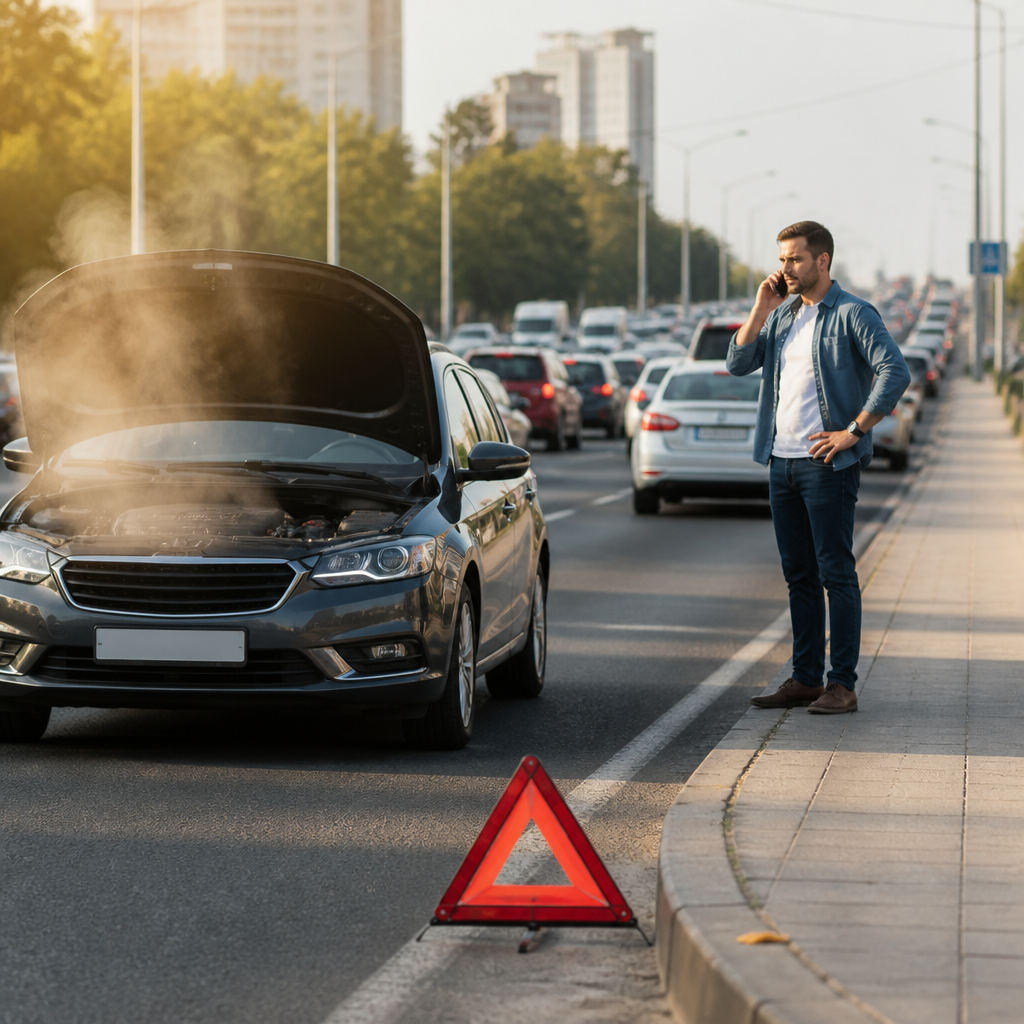
Car overheating in traffic can turn an ordinary journey into a serious roadside problem. If the temperature gauge rises, a warning light appears, or steam comes from under the bonnet, act calmly and quickly. Continuing to drive may cause expensive engine damage. This guide explains why vehicles overheat in slow-moving traffic, what to do immediately, and how to prevent the problem from returning.
Traffic creates a difficult environment for a vehicle’s cooling system. The engine keeps producing heat, but the car receives less air through the radiator. At the same time, the air-conditioning system adds heat to the engine bay. A weak cooling fan, low coolant, blocked radiator, worn belt, or faulty thermostat may only become obvious when the vehicle is stationary for several minutes.
The safest response is not to guess or force the car to continue. Move out of danger if possible, switch off the engine when necessary, and never remove a hot radiator cap. A few careful decisions can protect your engine, your passengers, and other road users. New Brake Pads: How to Know When Your Car Needs Them
What car overheating in traffic usually means
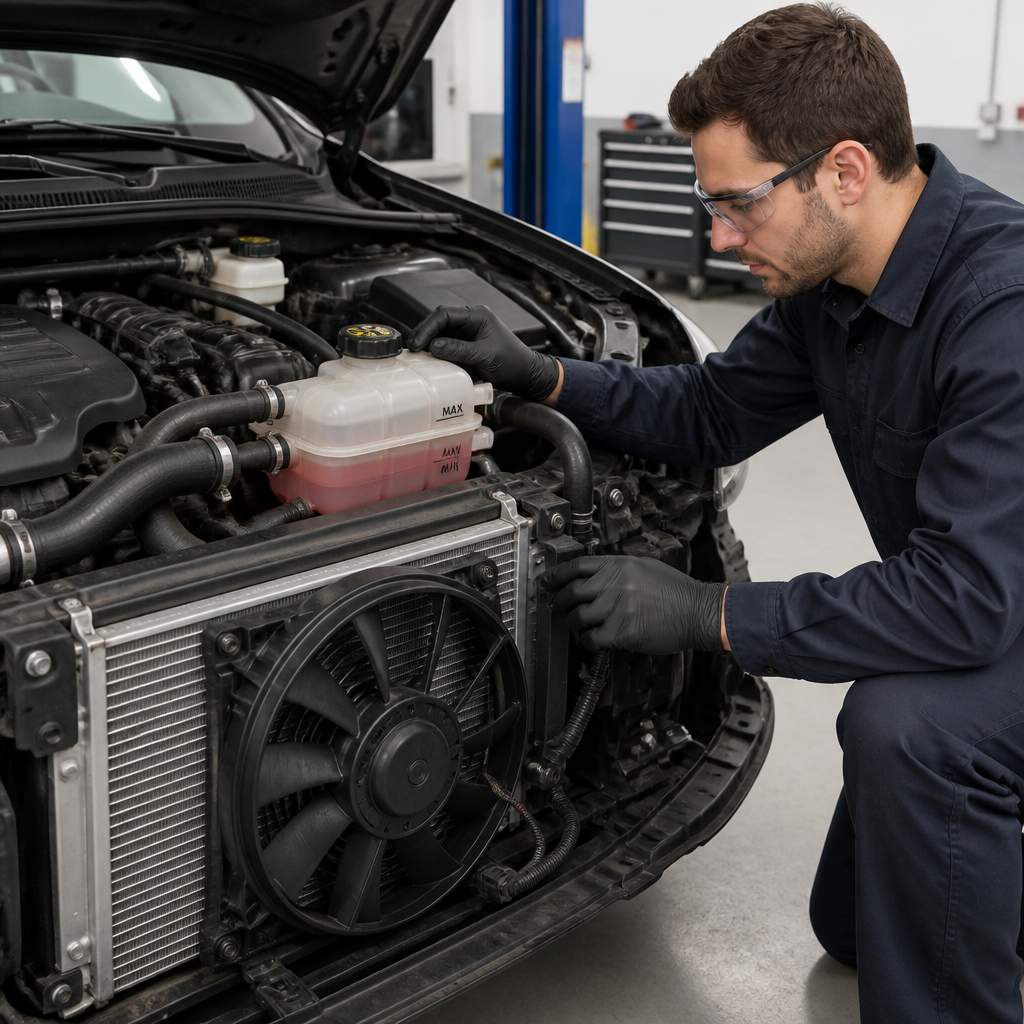
An engine operates within a controlled temperature range. Fuel burns inside the cylinders, producing power and a great deal of heat. The cooling system carries that heat away through coolant, hoses, the water pump, the thermostat, the radiator, and the cooling fan.
When the system cannot remove heat quickly enough, the engine temperature rises. The dashboard gauge may move towards the hot zone, or a red temperature warning light may illuminate. Some modern vehicles may show a message such as engine temperature high. Others may provide little warning before steam or a strong coolant smell appears.
Overheating does not always mean the engine is permanently damaged. However, the risk increases every minute the vehicle continues to run while too hot. Excessive temperature can distort cylinder-head components, damage gaskets, degrade engine oil, and cause parts to seize. In severe cases, the engine may stop completely.
Traffic is a common trigger because the radiator depends partly on airflow. When a car moves at road speed, air passes through the radiator and helps cool the liquid inside it. In a queue, the vehicle may rely mainly on its electric or mechanical cooling fan. If that fan fails, the engine can overheat even when it behaves normally on an open road.
Common causes of a vehicle overheating in traffic
Several faults can create the same warning signs. A professional diagnosis is important because replacing one part without finding the underlying cause may waste money and leave the vehicle unsafe.
Cooling fan failure
The cooling fan is one of the most important parts during slow driving. It pulls or pushes air through the radiator when natural airflow is limited. Depending on the vehicle, the fan may be electric or driven by a belt and clutch.
An electric fan can fail because of a blown fuse, damaged relay, faulty temperature sensor, wiring problem, seized motor, or control-module fault. A mechanical fan may have a worn clutch or damaged blades. If the temperature rises in traffic but falls again once the vehicle moves faster, fan operation should be checked early.
Do not place your hands near a fan to test it. Electric fans can start without warning, even after the ignition has been switched off. A technician can inspect the circuit and confirm whether the fan starts at the correct temperature.
Low coolant or a coolant leak
Coolant absorbs heat from the engine and carries it to the radiator. If the level is too low, the system may not circulate enough liquid. Air can also enter the system, reducing cooling performance and creating hot spots.
Leaks may come from a cracked hose, loose clamp, damaged radiator, water-pump seal, thermostat housing, expansion tank, or heater circuit. Look for coloured fluid or wet areas under the vehicle, although some leaks only appear when the system is hot and pressurised.
A sweet smell can indicate coolant. However, smell alone does not prove the source. Coolant may also leak inside the cabin through a heater core, causing damp carpets, misted windows, or a sweet odour from the air vents.
Never rely on topping up the reservoir as a permanent repair. A refill may get you to a safe location, but the leak still needs investigation. Driving with a low coolant level can quickly turn a small repair into major engine damage.
Blocked or damaged radiator
The radiator must transfer heat from the coolant to the surrounding air. Dirt, insects, mud, leaves, and road debris can restrict airflow through its fins. Internal corrosion or deposits can also reduce the passages available for coolant.
A radiator can look acceptable from the outside and still have an internal problem. Bent fins may restrict airflow, while a partial blockage may prevent coolant from moving evenly across the core. Physical damage from a minor collision can also reduce cooling capacity.
Cleaning the exterior may help when dirt is the cause, but use care. High-pressure water can bend delicate fins or force debris deeper into the radiator. An experienced technician can inspect the radiator and cooling system more safely.
Thermostat stuck closed
The thermostat controls when coolant flows through the radiator. When the engine is cold, it stays closed or partly closed so the engine warms efficiently. As temperature rises, it opens to allow coolant through the radiator.
If the thermostat remains closed, hot coolant cannot reach the radiator properly. The engine may overheat, while the radiator stays cooler than expected. A thermostat stuck open usually causes slow warm-up rather than traffic overheating, although other faults may exist at the same time.
Thermostats are relatively small parts, but diagnosis matters. Replacing one without checking for air in the system, a blocked radiator, or a failed water pump may not solve the problem.
Water-pump problems
The water pump circulates coolant through the engine and radiator. A worn bearing, damaged impeller, leaking seal, or slipping drive belt can reduce circulation. Some pumps fail gradually, while others develop a sudden leak.
Possible clues include coolant loss, a grinding or whining noise, visible leakage near the pump, poor cabin heat, or overheating that worsens with engine speed. These signs are not conclusive, so a mechanic should inspect the system.
On some engines, the water pump is driven by a timing belt. If that belt fails, the consequences may extend beyond overheating. Do not continue driving if a belt appears damaged or if the engine is making unusual mechanical noises. Best Used Cars Nigeria: A First-Time Owner’s Guide
Low engine oil or poor oil condition
Engine oil does more than reduce friction. It also carries heat away from moving components. A very low oil level or badly degraded oil can increase friction and operating temperature.
Oil cannot replace coolant, and adding oil will not repair a cooling-system fault. Still, checking the oil level during a safe inspection can reveal another maintenance problem. Follow the vehicle manufacturer’s instructions and use the correct oil specification.
Air trapped in the cooling system
Air may enter after a leak, hose replacement, radiator repair, or incorrect coolant refill. Air pockets can interrupt circulation and create inaccurate temperature readings. The heater may blow cold air even when the engine is very hot.
Many vehicles require a specific bleeding procedure. Some have bleed screws, while others need a particular filling process. Do not assume that repeatedly filling the reservoir removes all trapped air. A workshop should bleed the system according to the vehicle’s service instructions.
Head-gasket or internal engine damage
A failed head gasket can allow combustion gases into the cooling system or coolant into the engine oil. It may also cause coolant to enter a cylinder and leave through the exhaust.
Warning signs can include persistent white exhaust smoke after warm-up, bubbles in the expansion tank, unexplained coolant loss, milky oil, repeated overheating, misfiring, or a hard cooling-system hose soon after a cold start. These symptoms can have other causes, but they deserve prompt testing.
If the vehicle has overheated badly before, internal damage may be the reason it continues to overheat. Do not keep replacing external parts without checking the engine for combustion-gas leaks and compression problems.
What to do when the temperature rises
Your immediate priority is safety. A hot engine can damage itself, and a stopped vehicle can create a hazard in moving traffic. Use the following steps as a general guide, while giving priority to road conditions and the vehicle handbook.
- Notice the warning signs. Watch for a temperature gauge entering the hot zone, a temperature warning light, steam, a strong coolant smell, reduced power, or unusual engine noises.
- Turn off the air conditioner. Switching off the air conditioner can reduce the load on the engine and may reduce heat entering the engine bay. This is only a temporary measure, not a repair.
- Turn on the cabin heater if you must reach a safe stopping place. The heater can transfer some engine heat into the cabin. It may make passengers uncomfortable, but it can help for a short distance. Stop immediately if steam is heavy, the gauge is at maximum, or the engine runs badly.
- Find a safe place to stop. Move away from the traffic lane when possible. Use hazard lights if the vehicle is stopped in a dangerous position, and keep passengers away from moving traffic.
- Switch off the engine. Allow the engine to cool. Do not keep revving it or repeatedly restarting it to see whether the problem has disappeared.
- Wait before opening the bonnet. Steam and hot components can cause burns. If you open the bonnet, stand to the side and keep your face and hands away from the opening.
- Never remove the radiator cap while hot. The cooling system may be pressurised. Hot coolant can spray out and cause severe burns.
- Call roadside assistance or a qualified mechanic. If the temperature reached the red zone, coolant is leaking, steam is visible, or the engine has stopped, arrange recovery rather than driving on.
Do not pour cold water over a hot engine. A sudden temperature change may damage components, and the water may contact electrical parts. More importantly, this action does not fix the cause of overheating.
Can you drive after the engine overheats?
Sometimes a vehicle can move a very short distance after cooling, but that does not make it safe to continue a normal journey. The decision depends on the warning level, visible leaks, coolant level, engine noise, and the reason for the overheating.
If the gauge only rose slightly and returned to normal after switching off the air conditioner, the vehicle may still have a developing fault. Arrange an inspection as soon as possible. A fan may work intermittently, or the coolant level may be just high enough for normal driving but too low for traffic.
Do not drive if the warning light remains on, the gauge rises again, steam continues, coolant is pouring out, the engine is misfiring, or you hear knocking and grinding. Driving in that condition can cause far more damage than a tow.
If you must move the car out of immediate danger, travel only the minimum distance. Keep the engine load low, monitor the gauge constantly, and stop again if the temperature rises. Avoid treating this as permission to complete the journey.
How to check the vehicle after it cools
Only inspect the vehicle when it is safe and sufficiently cool. If you are on a busy road, poor shoulder, bridge, or other dangerous location, stay in a safe position and request assistance instead of working beside the vehicle.
Check the coolant reservoir
Many vehicles have a translucent expansion tank with minimum and maximum marks. Check the level only when the engine is cool. If the level is low, look for signs of a leak before adding the correct coolant mixture.
Use the coolant specified for the vehicle. Different products may use different technologies and may not be compatible. Mixing the wrong types can reduce corrosion protection or create deposits. The owner’s manual or a qualified parts professional can help identify the correct product.
In an emergency, clean water may be used temporarily in some cooling systems to reach a safe place, but this is not a proper long-term solution. Water alone does not provide the same boiling protection, freezing protection, or corrosion control as the correct coolant mixture. Never add any liquid to a hot pressurised system.
Look for obvious leaks
Check below the vehicle for fresh fluid and inspect hoses, the radiator area, the expansion tank, and the ground. Do not touch hot hoses or components. A leak may be difficult to see because it evaporates on hot parts.
Do not confuse coolant with air-conditioning condensation. Clear water dripping beneath a vehicle after using the air conditioner is often normal. Coloured fluid, a sweet smell, or a growing wet patch is more concerning. Used Car Mileage: What Is Too High When Buying?
Inspect the drive belt without touching it
A missing, loose, cracked, or damaged belt can affect the water pump, alternator, power steering, or other accessories. Do not reach into the belt area, even when the engine is off. Wait for professional inspection if the belt appears damaged.
Check for electrical warning signs
A cooling fan fault may come with a blown fuse, burning smell, melted wiring, or other electrical symptoms. Do not replace a fuse with a higher-rated fuse. The original fuse rating protects the wiring from excessive current.
Why overheating appears only in traffic
Many drivers are surprised when the temperature stays normal on an open road but rises during a queue. This pattern provides a useful clue.
At higher speed, airflow through the radiator helps remove heat. In traffic, that airflow falls sharply. The cooling fan must provide the missing airflow. If the fan does not engage, the vehicle may overheat while stationary and cool down again once it begins moving.
Traffic also increases the time the engine spends idling. Idling provides little forward airflow, yet the engine continues producing heat. With the air conditioner running, the condenser releases additional heat near the radiator. A partially blocked radiator or weak fan may cope on an open road but fail in a congested area.
Hot weather can make the problem appear sooner. However, a healthy vehicle should be able to operate in normal hot conditions when properly maintained. Heat is often the condition that exposes an existing weakness rather than the only cause.
Preventing car overheating in traffic
Regular maintenance is the best protection against an unexpected temperature warning. Prevention does not require guessing. It involves checking the cooling system at sensible intervals and responding to early symptoms.
- Check the coolant level when the engine is cold. A falling level needs investigation, even if there is no visible puddle.
- Inspect hoses and clamps. Look for swelling, cracks, soft spots, corrosion, or dampness.
- Keep the radiator and condenser clear. Remove leaves and surface debris carefully, without bending the fins.
- Service the cooling system correctly. Use the specified coolant and follow the recommended replacement procedure.
- Check the cooling fan. A mechanic can test fan operation, relays, sensors, wiring, and motor performance.
- Monitor the temperature gauge. Learn where the needle normally sits. A new change is worth investigating.
- Deal with small leaks early. A minor hose leak can become a major coolant loss in traffic.
- Maintain the engine oil level. Use the correct oil and address repeated oil loss.
- Replace belts according to the service schedule. A failed belt can disable cooling-system components.
- Use the correct air-conditioning refrigerant service. An air-conditioning fault can add unnecessary load and heat.
Before a long trip, inspect the coolant level, tyres, oil level, belts, hoses, and warning lights. This quick check cannot guarantee that a component will not fail, but it can reveal problems before the vehicle enters heavy traffic far from assistance.
What a mechanic should test
A proper diagnosis should identify why the engine overheated, not simply refill the reservoir. The exact tests vary by vehicle, but a technician may inspect several areas.
- Cooling-system pressure and leaks
- Cooling-fan operation and electrical controls
- Thermostat opening and coolant circulation
- Radiator condition and airflow
- Water-pump operation
- Drive-belt condition and tension
- Coolant concentration and contamination
- Temperature sensors and dashboard readings
- Combustion gases in the cooling system
- Engine oil condition and possible internal damage
Ask for an explanation of the failed part and the reason it failed. For example, replacing a blown fan fuse may restore operation temporarily, but the technician should determine why the fuse blew. Similarly, replacing a thermostat may not solve overheating caused by a blocked radiator or failed fan.
After repair, the system should be filled with the correct coolant, properly bled, and checked for leaks. The technician should confirm that the engine reaches and maintains normal temperature under conditions similar to the original problem.
Common mistakes to avoid
Drivers often make understandable decisions under pressure. Unfortunately, several common actions increase the risk of injury or engine damage.
Removing the radiator cap immediately
This is the most dangerous mistake. A hot system may contain pressurised coolant. Removing the cap can release boiling liquid and steam suddenly.
Continuing because the car still moves
An engine can keep running while damage develops. The fact that the vehicle has power does not mean the temperature is safe.
Adding coolant to a hot engine
Adding cold liquid to hot components can cause burns and, in some circumstances, thermal shock. Wait until the system is cool and follow the vehicle’s instructions.
Using stop-leak products as a full repair
Some sealant products may provide a temporary response to a small leak, but they can also restrict narrow passages or complicate later repairs. They should not replace a proper diagnosis.
Ignoring an intermittent warning
A temperature warning that disappears is still a warning. Intermittent fan faults, low coolant, and early gasket problems may appear only under heavy traffic or high ambient temperature.
Special considerations for older and imported vehicles
Older vehicles may have less efficient radiators, ageing hoses, worn fan clutches, corroded electrical connectors, or cooling systems that have not been serviced correctly. Imported vehicles can also have different coolant specifications, dashboard markings, and parts availability. Best SUVs for Nigerian Roads: A Practical Buying Guide
Do not judge a vehicle’s cooling system only by its appearance. A clean engine bay can hide an old radiator or a weak water pump. Conversely, surface dirt does not always mean the cooling system is failing.
If you recently bought a used car, include a cooling-system inspection in the initial maintenance plan. Confirm the coolant level, inspect for leaks, test the fan, and check whether the service history records cooling-system work. This is especially important before regular driving in congested urban areas.
Ask the technician to identify the exact engine and cooling-system configuration. Similar-looking vehicles can use different thermostats, fan controls, coolant types, and filling procedures. Correct parts and correct procedures matter.
When overheating becomes an emergency
Call for immediate roadside help when steam is heavy, coolant is leaking rapidly, the warning light remains on, or the engine has lost power. Also stop driving if there is smoke, a burning smell, loud mechanical noise, severe shaking, or oil pressure warning.
Keep people away from the front of the vehicle if steam is escaping. Do not stand directly in front of the radiator or reach beneath the bonnet. If the vehicle is in a dangerous traffic position, prioritise personal safety and follow local emergency guidance.
If a fire starts, move passengers away from the vehicle and contact emergency services. Do not open the bonnet fully if doing so could feed a fire with more air. Only use a suitable vehicle fire extinguisher if you have one, know how to use it, and can do so without approaching an unsafe vehicle.
Frequently asked questions
Why does my car overheat when the air conditioner is on?
The air conditioner adds load to the engine and releases heat through the condenser. A healthy cooling system should normally manage that extra heat. If the temperature rises only with the air conditioner operating, the fan, radiator airflow, refrigerant system, or engine cooling capacity may need testing.
Can low coolant cause overheating only in traffic?
Yes. Low coolant reduces the system’s ability to carry heat away. Traffic provides less natural airflow, so the weakness may become obvious sooner. Check for the reason the coolant is low rather than repeatedly topping up the reservoir.
Should I turn the engine off immediately?
First move to a safe stopping place if you can do so without continuing far. Then switch off the engine when the warning is serious or the gauge is near the hot zone. If steam or a major leak is present, stop as soon as safely possible.
Is it safe to use plain water in the radiator?
Plain water may be a temporary emergency measure in limited circumstances, but it is not a substitute for the correct coolant. It lacks the intended corrosion and boiling protection. Never add it to a hot pressurised system, and have the system corrected as soon as possible.
Why is my heater blowing cold air while the engine is hot?
This can indicate low coolant, air trapped in the system, poor coolant circulation, or a heater-control problem. When it occurs alongside overheating, stop driving and arrange diagnosis.
Can a bad thermostat cause overheating in traffic?
Yes. A thermostat stuck closed can restrict coolant flow to the radiator. However, a failed fan, low coolant, blocked radiator, and water-pump fault can produce similar symptoms. Testing is better than replacing parts based only on the symptom.
How long should I wait before checking the coolant?
There is no single safe waiting time for every vehicle or climate. Wait until the engine and cooling system have cooled substantially. The cap and hoses should not be treated as safe merely because a few minutes have passed. If unsure, wait longer and seek professional help.
Will turning on the heater fix the problem?
No. The heater may transfer some heat away from the engine for a short time, helping you reach a safe stopping place. It does not repair a failed fan, leak, thermostat, radiator, or water pump.
Final checklist for drivers
When the temperature rises in a traffic queue, remember this simple sequence:
- Turn off the air conditioner.
- Use the heater briefly only if you need to reach a safe stopping point.
- Move out of traffic when safe.
- Switch off the engine.
- Keep away from steam and hot coolant.
- Do not remove the radiator cap while hot.
- Arrange roadside assistance if the cause is not obvious or the warning was severe.
- Have the complete cooling system inspected before returning to normal driving.
Car overheating in traffic is usually a symptom of a cooling-system problem, not a normal feature of congestion. Prompt action can limit damage, but prevention is even better. Keep coolant at the correct level, respond to leaks and unusual temperature changes, and have the fan, radiator, thermostat, water pump, belts, and engine checked by a qualified professional when needed.
For general vehicle safety and maintenance information, consult the vehicle manufacturer’s handbook and reliable guidance from established motoring and road-safety organisations. The correct procedure can vary by make, model, engine, and cooling-system design.
2 thoughts on “Car Overheating in Traffic: Causes and What to Do”