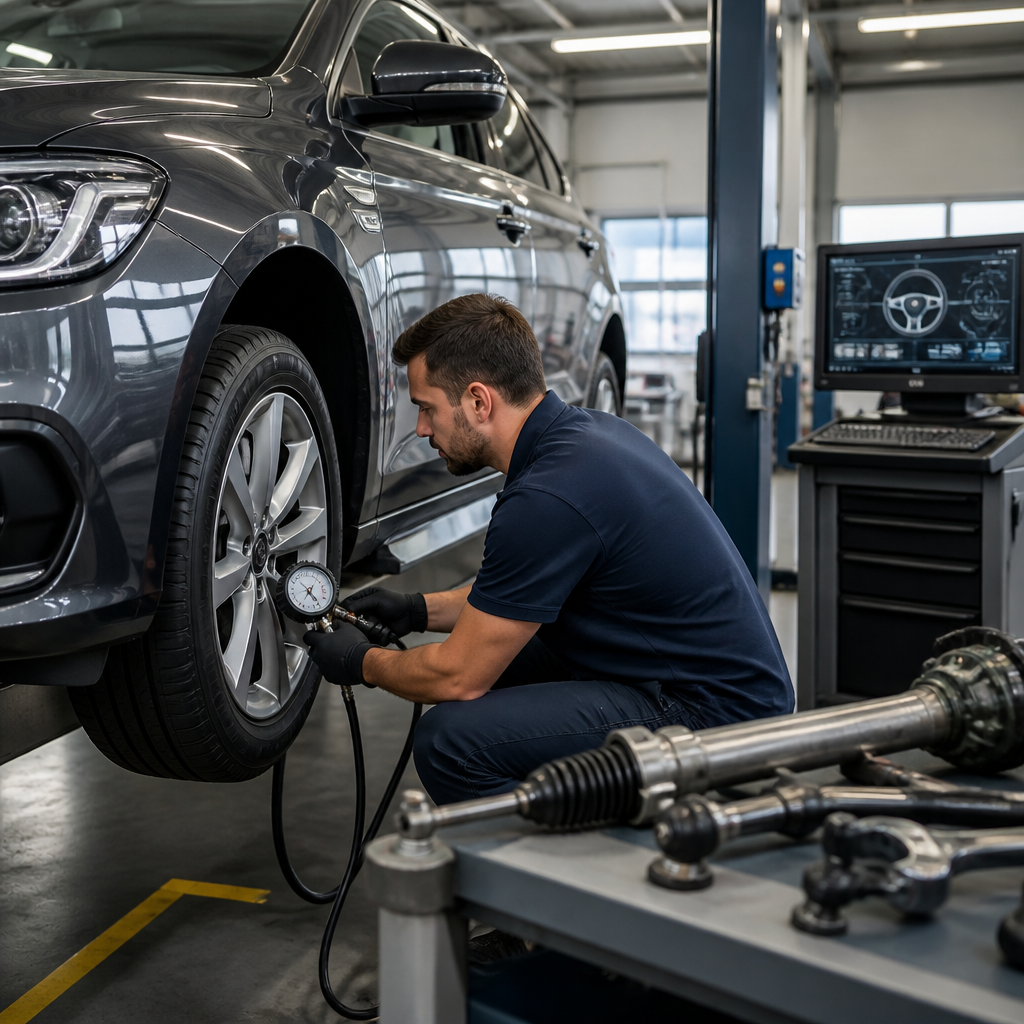
Heavy steering can make a car feel difficult to control, especially when turning at low speed, parking or moving through traffic. The problem may come from low tyre pressure, incorrect wheel alignment, worn suspension parts, a power-steering fault or an electrical issue. This guide explains the common causes of heavy steering, the checks you can make safely and the repairs a qualified technician may recommend.
Steering effort naturally varies between vehicles. A small car with manual steering may feel heavier than a newer model with electric assistance. However, a sudden change deserves attention. If the wheel becomes unusually difficult to turn, avoid treating it as a minor inconvenience. Steering affects your ability to avoid hazards and keep the vehicle on its intended path.
What does heavy steering feel like?
Drivers describe the symptom in different ways. You may notice that the steering wheel needs more effort than usual, particularly during parking. It may also feel slow to return after a turn, stiff at one point in its rotation or reluctant to move when the vehicle is stationary. How to Check Engine Oil Level Correctly
Some drivers notice the problem only after starting the engine. Others feel it after driving through standing water, hitting a pothole, carrying a heavy load or replacing a battery. The timing can provide an important clue.
- Heavy only at low speed: This often points towards reduced power assistance, low tyre pressure or a mechanical steering restriction.
- Heavy at every speed: A failed assistance system, seized joint, alignment problem or damaged steering component becomes more concerning.
- Heavy in one direction: Uneven assistance, a damaged component or an alignment issue may be involved.
- Heavy with noise: Whining, groaning, clunking or grinding can help identify a fluid, belt, bearing or suspension fault.
- Heavy with warning lights: A steering, battery or engine-management warning should be taken seriously.
Do not confuse normal steering feedback with a fault. Some vehicles are deliberately tuned to provide a firm, connected feel. The useful comparison is your vehicle’s recent behaviour. If it has become noticeably harder to turn, investigate the change.
Why does heavy steering happen?
Modern vehicles use one of three broad steering-assistance arrangements: hydraulic power steering, electric power steering or an electric-hydraulic system. Older vehicles may have no assistance at all. Each design has different failure points, but all systems rely on tyres, steering linkages, suspension components and correct wheel alignment.
A problem outside the steering system can still create the same sensation. For example, a tyre with insufficient air has a larger contact patch and greater rolling resistance. The steering then requires more effort, even though the steering rack itself may be working properly.
Low tyre pressure
Low tyre pressure is one of the simplest and most common causes of increased steering effort. It can happen because of a slow puncture, a leaking valve, temperature changes or ordinary air loss over time. The front tyres usually have the greatest effect because they guide the vehicle and carry a substantial share of the load.
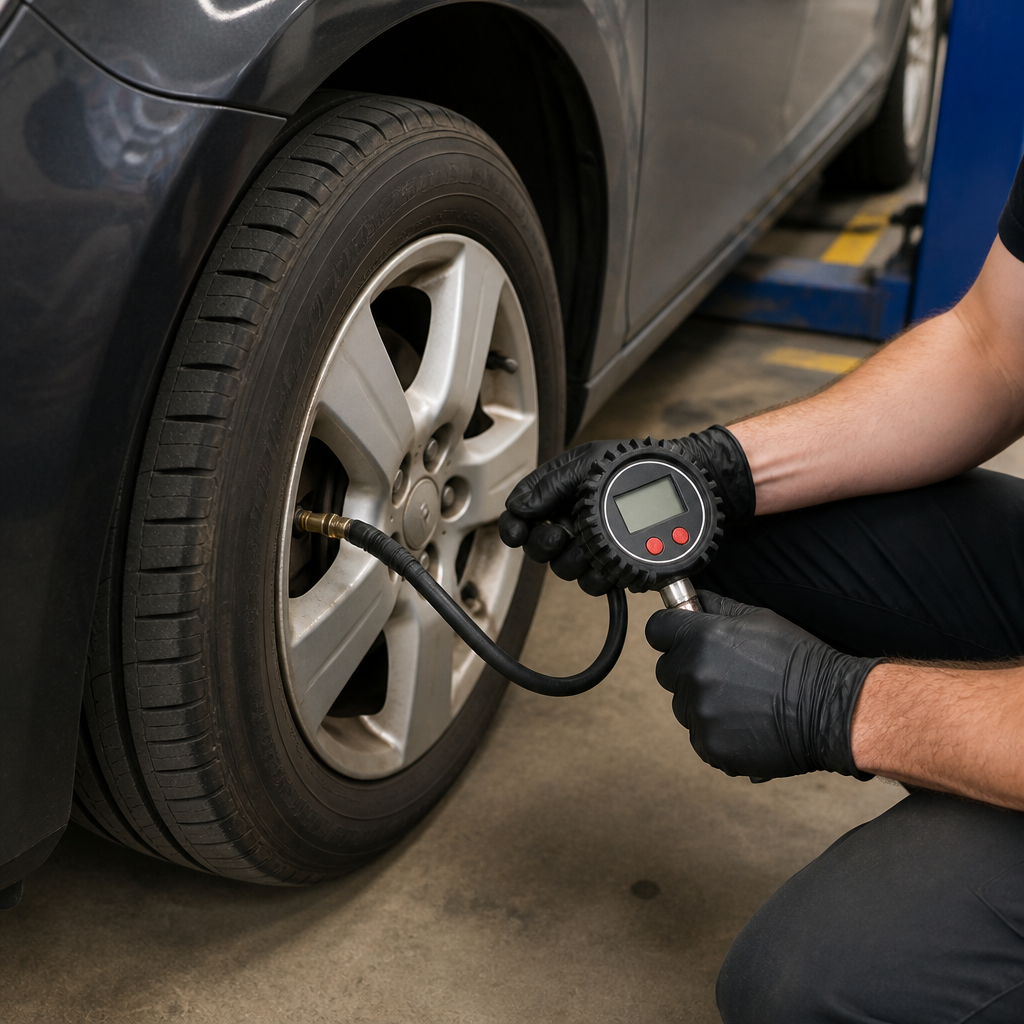
Check pressures when the tyres are cold. Use the pressure listed on the vehicle information label or in the owner’s manual, rather than the maximum pressure printed on the tyre sidewall. The recommended figures may differ between the front and rear axles, and they may change when the vehicle carries passengers or luggage.
Do not judge pressure by appearance alone. A tyre can look acceptable while being significantly underinflated. Use a reliable gauge, then inspect the tread and sidewall for nails, cuts, bulges or unusual wear. If one tyre loses pressure repeatedly, have the tyre and wheel checked instead of repeatedly adding air.
Incorrect wheel alignment
Wheel alignment describes the angles at which the wheels meet the road. Kerbs, potholes and rough surfaces can alter those angles. When alignment is incorrect, the vehicle may pull to one side, feel reluctant to turn or require constant steering correction.
Alignment problems often produce uneven tread wear. Look for wear on the inner or outer edge of a tyre, feathered tread blocks or a steering wheel that no longer sits straight when the car travels on a level road. These signs do not prove an alignment fault, but they justify a professional inspection.
A wheel alignment is not a substitute for repairing damaged suspension or steering parts. If a track-rod end, control-arm bush or ball joint is worn, the angles may change again after the alignment. A technician should inspect the underlying components first.
Problems with hydraulic power steering
Hydraulic systems use a pump, fluid, hoses, a drive belt and a steering rack or gearbox. The pump creates hydraulic pressure that reduces the effort needed to turn the wheel. If that pressure falls, the steering can become heavy, particularly during parking.
Common hydraulic causes include low fluid, a leak, a slipping or broken drive belt, a worn pump and internal rack problems. A whining or groaning sound that changes when you turn the wheel can indicate that the pump is struggling. Fluid beneath the vehicle or around hoses also deserves attention.
Use only the fluid specified for your vehicle. Power-steering fluids are not universally interchangeable, and some vehicles use automatic transmission fluid while others require a dedicated product. The reservoir cap or owner’s manual may identify the correct type. If the fluid is low, topping it up may provide temporary relief, but it does not repair the leak.
Never place your hands near a moving belt or pulley. If the belt has broken, the engine may also lose other belt-driven functions. Depending on the vehicle, this can affect charging, cooling or air conditioning. Switch off the engine before inspecting the area.
Electric power-steering faults
Electric power steering, often abbreviated as EPS, uses an electric motor and control electronics instead of a traditional hydraulic pump. It may be mounted on the steering column, rack or another part of the steering assembly.
An EPS fault can make the wheel suddenly feel heavy. A warning message or steering-wheel symbol may appear at the same time. The cause could be a weak battery, charging-system problem, blown fuse, damaged wiring, failed steering motor, faulty sensor or control-module issue.
Low system voltage can confuse electrical systems. If heavy steering appeared after a difficult engine start, battery replacement or charging warning, check the vehicle’s battery and alternator system. Do not assume that replacing the battery will solve every steering problem. The fault may require a diagnostic scan and voltage testing. Car Won’t Start but Lights Come On: Causes and Solutions
Some electric steering systems temporarily reduce assistance when they become too hot. Assistance may return after the system cools, but repeated loss is not normal. Arrange an inspection rather than relying on the system to recover.
Worn or damaged steering components
The steering wheel connects to the road wheels through several components. These can include the steering column, universal joints, rack, tie rods, track-rod ends, steering knuckles and ball joints. Wear, corrosion, impact damage or lack of movement can increase friction and make steering feel stiff.
A damaged steering joint may create a tight spot, clunk or unusual movement. A worn joint may instead cause looseness, wandering or a delay between moving the wheel and changing direction. Heavy steering and excessive play can occur together, so do not rely on one symptom alone.
Steering components are safety-critical. Avoid trying to straighten, heat, weld or lubricate a part unless the vehicle manufacturer specifically permits that procedure. A temporary reduction in noise does not make a damaged component safe.
Suspension faults and seized bearings
Suspension parts allow the wheel to move while maintaining controlled contact with the road. A seized upper strut bearing can make the steering resist turning, especially on vehicles with MacPherson struts. You may hear a spring-like pop or notice that the spring winds up and releases during steering.
Other possibilities include a damaged lower ball joint, worn control-arm bush, bent suspension arm or seized wheel bearing. A bearing problem may create humming or grinding that increases with road speed. It can also cause play, heat or uneven tyre wear.
Because several faults can produce similar symptoms, diagnosis should include a physical inspection. A technician may raise the vehicle, check for movement, rotate the wheels and observe the steering and suspension while an assistant turns the wheel.
Heavy steering after hitting a pothole or kerb
If the steering became heavy immediately after an impact, stop and examine the vehicle in a safe place. Look for a flat tyre, a damaged wheel, a displaced bumper liner or fluid leaking underneath. Check whether the steering wheel is off-centre and whether the car pulls sharply to one side.
A pothole can damage more than the tyre. It may bend a wheel, disturb alignment or damage a tie rod, control arm, strut or steering knuckle. Driving further may turn a manageable repair into a larger one, especially if a tyre has a sidewall bulge or the wheel has lost air.
Do not continue at normal speed if the vehicle wanders, vibrates heavily, pulls aggressively or shows visible damage. If you cannot confirm that the vehicle is safe, arrange roadside assistance or have it transported to a repair facility.
Simple checks you can perform safely
Basic checks can help you describe the fault accurately. They cannot replace a professional inspection, particularly when the steering has changed suddenly or a warning light is on.
- Compare the symptom: Think about when the problem started and whether it occurs while parking, cruising, turning left, turning right or braking.
- Check the dashboard: Look for a power-steering, battery, engine or stability-control warning. Note any message before switching the vehicle off.
- Inspect tyre pressure: Measure all four tyres when cold. Include the spare if the vehicle uses a full-size spare that may be fitted during an emergency.
- Look for visible damage: Check wheels and tyres for cuts, bulges, exposed cords, bent rims and embedded objects. Do not remove a nail from a tyre before a repairer sees it.
- Look for leaks: With the engine off, inspect the ground and visible steering components. Fluid colour varies, so do not identify a fluid by colour alone.
- Listen carefully: Note whining, clicking, clunking, rubbing or grinding. Tell the technician when the sound occurs.
- Check the belt only when safe: Never touch a running engine. A missing, loose or visibly damaged belt needs professional attention.
- Test warning symptoms: If the vehicle is safe to move, drive slowly in a quiet area. Notice whether it pulls, wanders, vibrates or fails to return after a turn.
Do not repeatedly turn the steering wheel from lock to lock while the engine is running. Hydraulic systems can build high pressure at full lock, and prolonged holding can strain the pump. Follow the owner’s manual for any manufacturer-specific procedure.
When should you stop driving?
Some steering problems allow a cautious trip to a nearby workshop. Others require immediate assistance. Stop driving and seek help if the wheel becomes extremely difficult to move, the steering assistance disappears suddenly or the vehicle cannot hold a safe line.
- A red or serious steering warning remains illuminated.
- The steering wheel has excessive free play or feels disconnected from the wheels.
- The car pulls sharply, wanders or changes direction without clear input.
- You hear grinding, repeated clunking or a loud mechanical knock.
- A tyre is flat, visibly damaged or losing air quickly.
- Fluid is leaking heavily beneath the vehicle.
- The steering wheel does not return normally after a turn.
- Impact damage has changed the wheel position or vehicle height.
Remember that steering effort alone does not indicate how safe the car is. A component can fail without making much noise. If you are uncertain, choose caution and obtain an inspection.
How a technician diagnoses the problem
A proper diagnosis begins with questions. The technician will usually ask when the symptom began, whether the vehicle recently struck a pothole, whether any parts were replaced and whether the problem changes with engine speed or vehicle speed.
The inspection may include a tyre-pressure check, visual examination, steering-fluid inspection, belt inspection and a battery and charging test. The vehicle may then be raised so the technician can examine steering and suspension joints, wheel bearings and rack movement. Car AC Not Cooling: 10 Possible Causes and What to Check
For electric systems, a diagnostic scan may identify stored fault codes. The scan is useful, but it is not a complete diagnosis by itself. A code may point to a circuit or sensor while the underlying cause is low voltage, damaged wiring or a mechanical restriction.
A road test can reveal whether the vehicle pulls, binds at a certain point or behaves differently under braking. The technician should use a controlled route and follow appropriate safety procedures. After repairs, the vehicle may need an alignment check, steering-angle calibration or another system reset.
Common repair solutions
Tyre and wheel repairs
If pressure is low because of a puncture or valve leak, the tyre may need repair or replacement. A damaged wheel may require replacement rather than straightening, depending on its condition and construction. After the repair, pressures should be set to the recommended figures and the tyres checked for uneven wear.
Alignment and suspension repairs
An alignment adjustment can correct wheel angles when the components are in good condition. If the inspection finds worn tie rods, ball joints, bushes or a bent arm, those parts need attention first. Replacing only the tyre may hide the symptom while the underlying fault continues.
Hydraulic steering repairs
Hydraulic repairs may involve replacing a leaking hose, renewing a seal, fitting a belt, flushing contaminated fluid or replacing a pump or rack. The exact repair depends on the leak location and the condition of the system. A clean reservoir does not guarantee that the fluid is correct or that the pump is healthy.
Electric steering repairs
Electric steering repairs can include correcting a charging fault, replacing a fuse, repairing wiring, calibrating a sensor or replacing a motor, rack or control unit. Some components can be serviced separately, while others are supplied as an assembly. Ask the repairer to explain what failed and why the recommended repair addresses that failure.
After any steering repair, confirm that the wheel is centred, warning lights are off and the vehicle tracks correctly. A short, careful road test is important. If the symptom remains, return to the repairer promptly rather than accepting it as normal.
How to prevent steering problems
Prevention starts with regular tyre care. Check pressure at suitable intervals and before long trips. Inspect the tread and sidewalls, and rotate tyres only when the vehicle maker’s guidance and tyre arrangement allow it.
Drive around potholes when you can do so safely. Slow down before rough surfaces rather than braking sharply while crossing them. Avoid striking kerbs, and do not overload the vehicle beyond its stated capacity. Extra weight can change steering response and place additional stress on tyres and suspension.
Follow the maintenance schedule for fluid checks, belts, suspension inspections and steering-system service. If the vehicle uses hydraulic assistance, use the specified fluid and address leaks early. If it uses electric assistance, pay attention to battery and charging warnings.
Keep wheel alignment under review after significant impacts, suspension work or unexplained uneven tyre wear. Alignment is also useful after replacing steering components. However, a routine alignment cannot compensate for worn parts.
Finally, pay attention to gradual changes. A steering wheel that becomes slightly less willing to return, a new vibration or a small pull can be an early warning. Early diagnosis often gives you more repair options and reduces the risk of a roadside failure.
Heavy steering in different driving situations
The situation in which the symptom appears can narrow the possible causes. Steering that feels heavy only while parking often points towards a loss of assistance, low front-tyre pressure or a mechanical restriction. If it is heavy at higher speeds as well, a broader inspection is more appropriate.
If the steering becomes heavy after rain or washing, water may have affected a belt, electrical connection or sensor. Water itself does not prove a fault, and the symptom may be coincidental. Still, repeated occurrence after wet conditions should be reported to a technician. Imported Used Cars vs Nigerian-Used Cars: What to Check
If the problem appears when the air conditioner or other electrical loads operate, an electrical charging problem may be involved. In a hydraulic vehicle, a slipping belt could also explain why assistance changes under load. Avoid guessing based only on the timing; test the system.
If the car feels heavy only when carrying passengers or luggage, check tyre pressures and load recommendations. The vehicle may require different pressures under heavy load. If the sensation is excessive, inspect the tyres, suspension and steering rather than assuming that the load is the only cause.
Questions to ask a repairer
Clear questions can make a repair conversation more useful. Ask whether the diagnosis is based on a visual inspection, a road test, a pressure test, an electrical test or a diagnostic scan. You can also ask which component failed and what evidence supports the recommendation.
- Is the steering system hydraulic, electric or electric-hydraulic?
- Were the tyre pressures checked against the vehicle manufacturer’s figures?
- Are any steering or suspension joints worn, bent or seized?
- Is there a fluid leak, and where does it begin?
- Does the battery and charging system meet the required voltage?
- Will the repair require a wheel alignment or calibration?
- Are any tyres or wheels unsafe to continue using?
- What should I monitor after the repair?
A trustworthy repairer should be willing to explain the findings in plain language. If a major steering repair is recommended, a second opinion can be reasonable, provided the vehicle is safe to move or can be transported.
Frequently asked questions
Can low tyre pressure make steering heavy?
Yes. Low pressure increases the tyre’s contact with the road and can make the steering harder to turn. Check pressure when the tyres are cold and use the vehicle manufacturer’s recommended figures. If pressure keeps falling, investigate for a puncture, valve leak or wheel problem.
Is heavy steering always a power-steering problem?
No. Tyres, alignment, suspension, wheel bearings and steering joints can all affect steering effort. A power-steering fault is one possibility, but replacing a pump without checking the basic causes may waste time and money.
Can I drive with heavy steering?
It depends on the severity and cause. A small change with no warning lights may allow a slow trip to a nearby workshop, but sudden or severe difficulty requires stopping safely. Do not drive if the vehicle pulls sharply, wanders, loses assistance or has visible tyre or steering damage.
Why is steering heavy when the car is stationary?
Turning a vehicle while stationary always requires more effort than turning while moving slowly. However, a sudden increase can indicate low tyre pressure, reduced power assistance, a slipping belt, a weak electrical system or a mechanical restriction. Avoid holding the wheel at full lock for long periods.
What does a whining noise during steering mean?
In a hydraulic system, whining may indicate low fluid, air in the system, a leak or a worn pump. In other cases, noise can come from a belt or another component. Electric systems may make different sounds, so the vehicle type matters. Have the sound assessed rather than adding an unspecified fluid.
Does wheel alignment fix heavy steering?
Alignment can improve steering response when incorrect angles are causing resistance or pulling. It will not fix a failed power-steering system, seized bearing, worn joint or bent suspension part. The repairer should inspect the vehicle before carrying out an alignment.
Can a weak battery cause heavy steering?
It can affect electric power steering on some vehicles, especially when system voltage falls below the required level. A charging warning, slow engine cranking or multiple electrical faults strengthens that possibility. The battery and alternator should be tested rather than replaced based on symptoms alone.
Why does the steering feel heavy on one side?
Uneven assistance, a damaged steering component, alignment trouble or a suspension restriction may cause one-sided heaviness. This symptom deserves prompt inspection because it can affect how the vehicle responds during turns and emergency manoeuvres.
Final advice
Heavy steering is a symptom, not a diagnosis. Start with safe basics such as tyre pressure, visible damage and dashboard warnings. Then arrange a proper inspection if the change remains, appears suddenly or comes with noise, leaks, pulling or looseness.
Steering and suspension systems deserve careful treatment because they control the vehicle’s direction. Use the correct fluids and parts, follow the owner’s manual and let a qualified technician handle safety-critical repairs. Acting early can protect your tyres, improve handling and help prevent a small fault from becoming a serious roadside problem.
2 thoughts on “Heavy Steering: Causes, Checks and Practical Solutions”