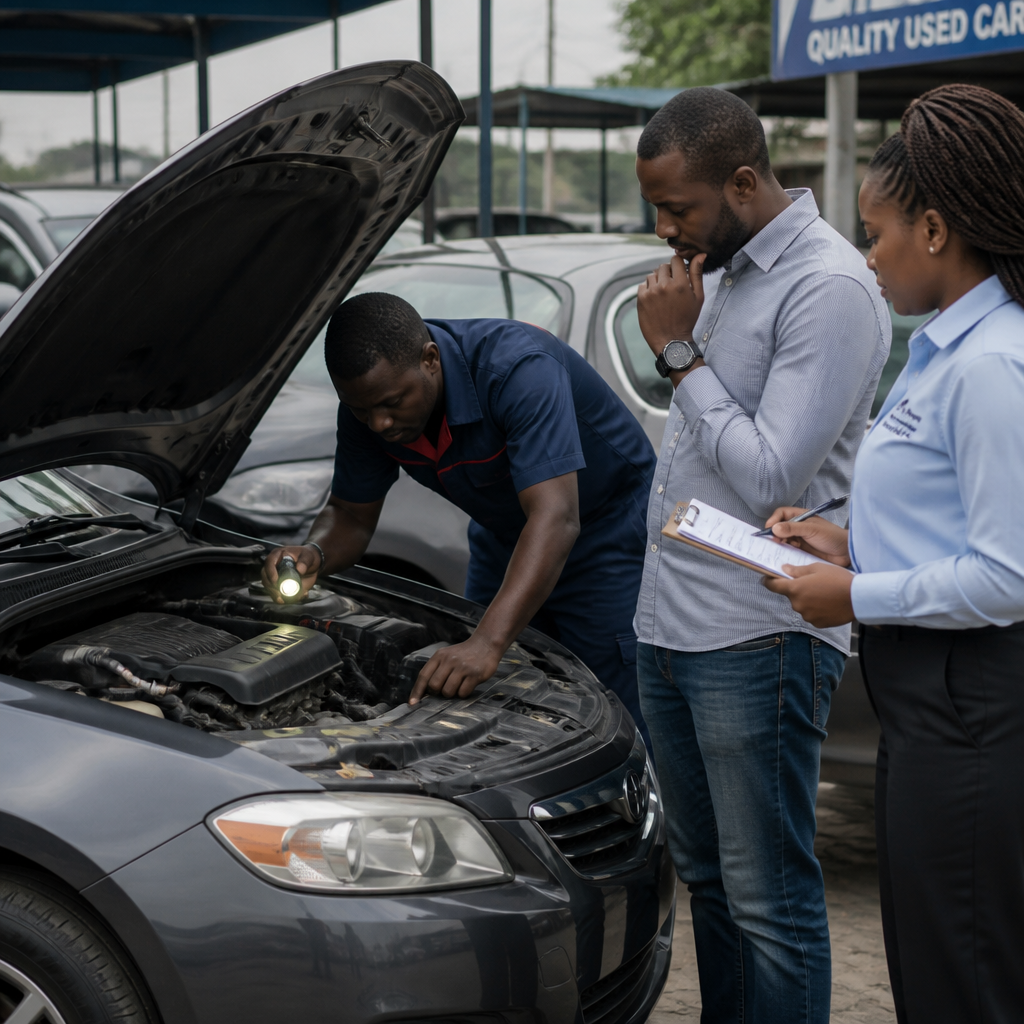
Buying a tokunbo car can save you money, but only when the vehicle is genuine, properly documented and honestly represented. Before you pay, learn how to inspect a tokunbo car, verify its identity, confirm its import history and test its mechanical condition. A clean-looking vehicle is not automatically a sound one.
In Nigeria, the word tokunbo usually refers to a used vehicle imported from another country. Some imported cars are in excellent condition. Others may have hidden accident damage, altered mileage, flood damage, outstanding finance, stolen identities or serious mechanical faults. The difference often depends on how carefully you investigate the car before making a commitment.
This guide gives you a practical process for checking a used imported vehicle. You will learn what to inspect on the body, where to find the vehicle identification number, how to compare documents, which questions to ask the seller and when to walk away. If you are still comparing dealers and private sellers, understanding how to buy a used car safely can also help you plan the wider purchase process.
Why a genuine tokunbo car still needs careful checking
A genuine imported car is not necessarily a trouble-free car. The vehicle may have entered the country through a legitimate process and still have worn suspension, neglected servicing, accident repairs or a failing transmission. Import status tells you where the car came from. It does not prove its current condition.
Likewise, a seller may provide some genuine documents while giving you an incomplete picture. A customs document may support the importation history, but it does not confirm that the engine, gearbox, airbags and chassis are healthy. You need to assess the car as a complete package.
Fraud can also involve the vehicle identity. A dishonest person may alter a VIN plate, replace number plates, use copied documents or present a different car during negotiations. Therefore, inspect the physical vehicle and its paperwork together. Never rely on a single document, stamp or verbal promise.
The safest approach is simple: verify first, inspect independently, test-drive carefully and pay only when the evidence agrees. If one important detail does not match, pause the transaction until you understand why.
Start with the vehicle identification number
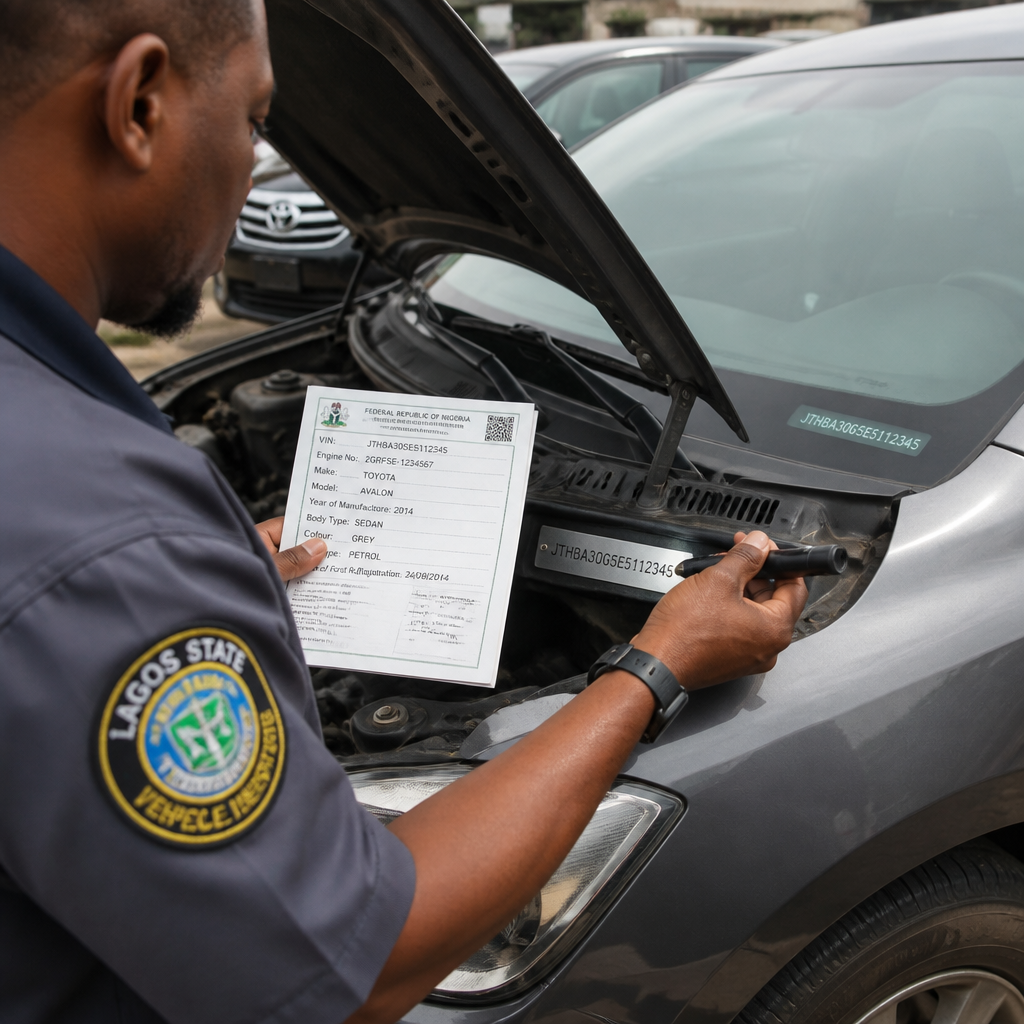
The vehicle identification number, commonly called the VIN, is one of the most important clues in a vehicle investigation. It is usually a unique identifying code assigned to the vehicle by its manufacturer. Depending on the model, you may find it on the dashboard near the windscreen, on the driver-side door frame, inside the engine bay, on the chassis or in the vehicle documents.
Find every VIN location
Do not check only the easiest VIN location. Look for the number in every place provided by the manufacturer. The dashboard VIN should match the label on the door frame and the number recorded on the relevant documents. Some vehicles have additional identification markings in less obvious locations.
Use a torch when necessary, but do not scrape, sand or remove any material around the identification marks. Signs of fresh paint, uneven metal, damaged rivets, unusual stickers, mismatched fonts or disturbed panels deserve attention. These signs do not prove criminal activity on their own, but they justify a professional inspection.
Write the VIN down carefully or take clear photographs with the seller’s permission. Compare every character. A letter and number can look similar, especially on poorly printed paperwork. One wrong character can produce an incorrect history search.
Check the VIN against independent records
Use the VIN to search reputable vehicle-history and identification services that cover the country where the car was previously registered. Some services may provide information about title branding, reported theft, insurance loss, odometer records or recorded accidents. Coverage differs by country and vehicle, so a clear result is not a guarantee that nothing ever happened.
For vehicles from the United States, the National Highway Traffic Safety Administration provides a public VIN decoder that can help confirm basic manufacturer and vehicle information. The National Insurance Crime Bureau also provides a VINCheck service for certain theft and salvage records. These tools are useful starting points, not substitutes for physical inspection.
If the VIN search identifies a different model, engine, year, body style or country of manufacture from what the seller described, stop and investigate. A minor listing error may be possible, but you should not dismiss a major mismatch. The vehicle identity must be clear before you consider paying.
Compare the car with its documents
Ask to see the available documents before you take the car for a serious negotiation. The exact documents may vary depending on the vehicle’s origin, age, import route and current registration status. Ask the seller to explain what each document represents and why any expected document is missing.
At minimum, compare the VIN, engine number where applicable, make, model, colour and other identifying details across the papers. Also check whether the seller’s name matches the person or business authorised to sell the vehicle. If a dealer is selling on behalf of an owner, ask for a clear explanation and appropriate evidence of authority.
Import-related paperwork may include a customs declaration, duty evidence, release documentation or other records connected with clearance. Do not assume that a paper shown on a phone is sufficient. Ask to inspect the original where practical, and verify important information through the appropriate official channel before payment.
Documents can be forged, altered or reused. Look for inconsistent fonts, spelling mistakes, different dates, unusual logos, missing pages, mismatched VIN characters and unexplained changes in ownership. A professional-looking document is still only evidence. It is not proof until the issuing authority or a reliable verification process supports it.
For guidance on the paperwork that may accompany an imported vehicle, review reliable information about vehicle documentation and ownership records before you visit the seller. [
Confirm the import and clearance position
Ask the seller how the vehicle entered Nigeria and which documents support that claim. A trustworthy seller should be able to explain the vehicle’s route without becoming evasive. If the answer changes several times, or the seller says documentation is not important, treat that as a serious warning.
Where customs or clearance records are relevant, use official channels rather than relying on an agent’s private claim. The Nigeria Customs Service is the appropriate starting point for general customs information and any available verification guidance. Be cautious if someone asks you to send money to a personal account to release a document or solve an unexplained customs problem.
Do not confuse a customs issue with a mechanical issue. A vehicle may have valid import records and still need extensive repairs. Conversely, a mechanically excellent car may have unresolved documentation problems. You need both sides checked before purchase.
If the seller says the car has already been cleared but cannot produce any supporting evidence, do not pay the full amount based on a promise. You may agree to continue discussions while verification takes place, but put every important condition in writing. Never allow pressure to replace due diligence.
Inspect the body for accident and repair evidence
Examine the vehicle in daylight and, if possible, when the body is dry and clean. Poor lighting can hide dents, colour differences and uneven repairs. Walk around the car slowly instead of looking only at the side that appears in the seller’s photographs.
Stand several metres away and view the panels from different angles. Reflections can reveal ripples, shallow dents and repainting. Compare the colour of adjoining panels. A door that looks slightly different from the front wing may have been replaced or refinished.
Look closely at panel gaps and fasteners
Panel gaps should generally look even and consistent for the vehicle’s design. A large gap on one side, a bonnet that sits higher than the wing or a boot that does not close evenly may indicate previous impact or poor repair work.
Open the bonnet, doors and boot. Look for scratched bolts, fresh tool marks, disturbed sealant and paint overspray on rubber seals or wiring. These signs can indicate that a panel or structural component has been removed. They do not automatically mean the car is unsafe, because some repairs are properly completed. However, they tell you to obtain a qualified inspection.
Check the spare-wheel well and the areas beneath the carpets. Water marks, rust, damp odour, silt or discoloured fabric may point to flood exposure. Flood damage can create electrical problems months after purchase, so do not ignore a wet interior simply because the seats look clean.
Inspect the windscreen and other glass for markings and damage. Replaced glass is not always a problem, but a mismatch in glass dates or markings can support a wider repair history. Check the headlights and taillights too. New lights on one side and older, cloudy lights on the other may suggest a previous collision.
Check the interior, airbags and electronics
Enter the vehicle and assess its condition honestly. Excessively worn pedals, steering-wheel surfaces, driver-seat bolsters and gear selectors may conflict with a claimed low mileage. Interior wear alone cannot establish the true mileage, but it can reveal inconsistencies.
Turn the ignition on without starting the engine. Watch the warning lights on the instrument cluster. Important systems should perform their normal self-check, and warning lights should not remain illuminated after the engine starts. If the seller has already started the engine before you arrive, ask to repeat the check from a cold start.
Check the airbag warning light, ABS light, engine warning light, transmission warning light and other relevant indicators. A missing warning light can also be suspicious if the bulb has been removed or the system has been altered. A diagnostic scan by a competent technician can reveal stored fault codes, but a scan is not a complete mechanical inspection.
Inspect the steering wheel, dashboard, seat sides and curtain-airbag areas for unusual stitching, gaps or replacement materials. Airbags may deploy in a crash and be replaced poorly. Do not attempt to remove an airbag yourself. Ask a qualified technician to inspect the restraint system safely.
Test the air conditioner, windows, central locking, lights, horn, wipers, indicators, audio system, reverse camera and dashboard controls. Electrical faults can be expensive to trace. Also check that all keys, remotes and security features work as represented.
Inspect the engine and mechanical systems
Ask to see the car with a cold engine. A seller may warm up an engine to hide hard starting, smoke, a noisy timing system or a rough idle. Touching the engine is not always reliable, so arrive early or ask the seller not to start it before inspection.
Look for oil leaks around the engine, transmission, power-steering components and cooling system. Check the coolant reservoir for the correct appearance for that vehicle. Milky oil, heavy sludge, excessive pressure in the cooling system or a strong exhaust smell in the coolant can signal expensive problems.
Do not judge an engine only by how clean it looks. A freshly washed engine bay may be harmless, but it can also make leaks harder to identify. Ask why it was washed and inspect the area again after the test drive.
Listen during startup. Excessive tapping, knocking, rattling or belt noise deserves professional attention. Observe the exhaust after the engine warms. Persistent blue, thick white or unusually dark smoke may indicate an issue, although weather, engine design and operating conditions can affect exhaust appearance.
Check the transmission during the test drive. Automatic gear changes should feel appropriate for the model, without severe slipping, banging or unexplained delays. For a manual vehicle, listen for clutch noise and feel for excessive clutch slip. A technician should assess any concern before you negotiate.
Inspect the tyres for even wear and compare the brand, size and condition across all four wheels. Uneven wear may indicate alignment, suspension or accident-related problems. Check the spare tyre and jack as well. They may not affect the purchase decision by themselves, but missing safety equipment should be recorded.
Take a proper test drive
A short drive around the seller’s compound is not enough. With the owner’s permission and where it is safe and lawful, drive on different road surfaces. Test the vehicle at low speed, moderate speed and during braking. Keep the radio off so you can hear the car.
Notice whether the vehicle pulls to one side, vibrates through the steering wheel or shakes during braking. Listen for knocks over bumps and humming noises that rise with road speed. Test the steering at low speed and observe whether it feels loose, heavy or inconsistent.
Check acceleration and gear changes without abusing the car. The engine should respond in a way that matches its specification and condition. Monitor the temperature gauge throughout the drive. An overheating problem may appear only after the vehicle has been driven for some time.
After the test drive, park on a clean surface and look underneath for fresh leaks. Open the bonnet carefully and listen again. A car that starts well but develops a strong smell, rising temperature or new noise after driving needs further investigation.
Do not let the seller rush the test drive or insist that you remain a passenger. If you are not comfortable driving the vehicle, bring someone experienced or arrange an independent road test. Safety comes first.
Get an independent pre-purchase inspection
The most valuable step in buying a used imported car is an inspection by a mechanic who is independent of the seller. “Independent” means the inspector does not earn a commission from approving the sale and has no reason to hide defects.
Choose a technician who understands the vehicle’s make, engine and transmission. Ask for a written report that separates urgent safety issues, major mechanical faults, routine maintenance and cosmetic defects. A vague statement such as “the car is okay” is less useful than specific findings.
The inspection should cover the engine, transmission, cooling system, suspension, steering, brakes, tyres, exhaust, electrical systems, underbody and body structure. It should also include a diagnostic scan where appropriate. The inspector may need to raise the vehicle safely to examine leaks, corrosion and previous repairs.
Consider paying for the inspection yourself. This removes the seller’s control over the process and gives you a report you can keep. If the seller refuses an independent inspection, ask why. A refusal does not prove fraud, but it is a strong reason to reconsider the purchase.
If the inspection finds a problem, do not automatically walk away. First determine its seriousness and likely repair cost. A worn tyre or overdue service may be negotiable. Chassis damage, persistent overheating, missing airbags or uncertain vehicle identity should receive much more caution.
Check mileage without trusting the odometer alone
Odometer tampering can make a car appear younger than it is. Treat the displayed mileage as one piece of evidence rather than a guarantee. Compare it with service records, inspection documents, auction records where available, import records and the vehicle’s physical wear.
Look at the driver’s seat, pedals, steering wheel, buttons, door handles and seat belts. A very low mileage claim combined with heavy wear requires an explanation. However, a clean interior does not prove the mileage is genuine because interiors can be replaced or refurbished.
Ask the seller directly whether the mileage has ever been changed, corrected or converted between measurement systems. Record the answer in writing. If the seller cannot explain a large gap between two records, do not rely on a verbal assurance.
Some history databases contain incomplete mileage records. Therefore, a consistent result is helpful but not conclusive. Physical inspection, documents and electronic records should support the same general story.
Investigate theft, finance and ownership risks
Before buying, confirm that the person selling the car has the right to sell it. Ask for proof of identity and compare it with the ownership records available for the vehicle. If a company is involved, confirm who has authority to sign the sale documents.
Ask whether the car has ever been stolen, written off, used as security for a loan or involved in an unresolved dispute. The seller may not provide complete information, so use independent checks where they are available in the vehicle’s country of origin and current location.
For imported cars, a theft search in the export country may be useful, but databases do not cover every incident. A vehicle can also have a clean search result because the relevant record was never reported, never uploaded or is not accessible to the public.
Be especially cautious if the seller wants payment from a different person, refuses to provide a receipt or says the registered owner is unavailable. Make sure the sale agreement identifies the vehicle by VIN and states the agreed price, payment status, mileage displayed, known defects and documents handed over.
Understanding how vehicle ownership records should be reviewed can help you avoid accepting incomplete paperwork during a private sale.
Recognise common warning signs
- The seller refuses to provide the VIN before you inspect the car.
- The VIN on the car does not match the documents.
- The price is unusually low and the seller demands immediate payment.
- The seller will not allow an independent mechanic to inspect the vehicle.
- The car is advertised as accident-free, but several panels show repainting or disturbed bolts.
- The warning lights do not perform a normal ignition self-check.
- The engine is already hot when you arrive without a clear reason.
- The seller claims documents are unnecessary because the vehicle is already in Nigeria.
- The payment account belongs to someone unrelated to the seller.
- The seller gives different answers about the car’s origin, mileage or ownership.
- The vehicle has signs of flood exposure, severe corrosion or a persistent damp smell.
- The seller pressures you to pay a deposit before verification.
One warning sign may have an innocent explanation. Several warning signs together should change your decision. You are not obliged to complete a purchase simply because you have travelled to see the car or negotiated for several days.
Ask the seller the right questions
Prepare questions before you meet the seller. Written questions help you notice contradictions and reduce the chance that excitement will control the conversation.
- Where was the vehicle imported from?
- How long has the seller owned it?
- Why is it being sold?
- Has it been involved in an accident or flood?
- Has any body panel, engine, gearbox or airbag been replaced?
- Is the mileage original and supported by records?
- Are there outstanding loans, ownership disputes or unpaid obligations?
- Which documents are available, and can they be independently verified?
- Can the vehicle be inspected by a mechanic of my choice?
- What defects does the seller already know about?
Pay attention to how the seller answers, not just to the answers themselves. A transparent seller may admit ordinary wear or previous repairs and allow time for checks. A dishonest seller often avoids specific questions, changes the subject or creates urgency.
Verify the seller and payment process
Search for the seller’s physical location, business identity and previous customer experience, but remember that online reviews can be incomplete or manipulated. Visit the actual premises when possible. Be cautious when the seller insists on meeting in a random location and refuses to show business records or a verifiable address.
Do not send the full purchase price before you have inspected the car, verified the documents and signed a clear agreement. If a deposit is necessary, document the amount, purpose, refund conditions and circumstances under which the transaction may be cancelled.
Use a payment method that creates a clear record. Confirm the recipient’s name before transferring funds. Avoid cash handovers in unsafe locations, payments to unexplained third parties and pressure to use an irreversible method before the final checks.
Collect a signed receipt. It should identify the seller, buyer, vehicle, VIN, registration details where applicable, amount paid, date, documents delivered and any agreed repairs. Keep copies of messages, adverts and payment evidence. These records may become important if a disagreement arises.
What to do when the seller says the car is “foreign used”
The phrase “foreign used” describes an imported used vehicle, but it does not guarantee a particular history. Ask what the vehicle was used for before importation and whether the seller has records from that period.
Some imported vehicles come from climates with snow, road salt, heavy rain or flooding. Others may have spent years on rough roads or in stop-and-go traffic. The vehicle’s previous environment affects corrosion, suspension wear, cooling systems and underbody condition.
Inspect the underside where possible. Surface dirt is normal, but extensive rust, flaking metal, fresh underseal or thick coating that hides repairs needs investigation. A clean underbody may be a good sign, but it can also mean recent preparation for sale.
Do not assume that a car is better because it has low local mileage. It may have had substantial use abroad before importation. The complete history matters more than a sales label.
How to decide whether to buy
Create a simple decision sheet with four columns: identity, documents, mechanical condition and seller reliability. Mark each item as verified, uncertain or failed. This method prevents one attractive feature, such as a low price or clean interior, from hiding a serious problem elsewhere.
Buy only when the VIN is consistent, the seller’s authority is clear, the paperwork is reasonably supported, the mechanical inspection is acceptable and the payment terms are documented. If one major area remains uncertain, delay the purchase.
Calculate the total cost, not just the advertised price. Include inspection fees, registration-related expenses, insurance, immediate servicing, tyres, battery, fluids, repairs and possible transport costs. A cheap vehicle with hidden faults may cost more than a fairly priced car with a documented history.
When negotiating, use verified defects rather than rumours. For example, a mechanic may identify worn brake pads, leaking shock absorbers or a weak battery. Ask for the repair cost and decide whether the seller should repair the item or reduce the price.
Do not buy a vehicle that makes you uncomfortable simply because someone else says it is a bargain. A genuine purchase should survive reasonable questions and independent checks.
Common mistakes buyers make
Relying on appearance
Polished paint, new seat covers and detailed engine bays can make an old car look attractive. Appearance matters, but it cannot confirm structural safety, mileage or ownership. Inspect beneath the presentation.
Using only the seller’s mechanic
A mechanic recommended by the seller may be honest, but you cannot assume independence. Bring your own technician or use a reputable inspection service that has no financial connection to the transaction.
Skipping the cold start
Starting an engine after it has warmed up can hide problems. Insist on a cold start and observe the vehicle before, during and after the test drive.
Ignoring small inconsistencies
A spelling error may be harmless. However, a spelling error combined with a VIN mismatch, missing document and urgent payment demand creates a much larger concern. Consider the complete pattern.
Paying before the final inspection
A deposit can make buyers feel committed. Do not allow a deposit to prevent you from cancelling when new information appears. Agree on written deposit terms before transferring money.
A practical inspection checklist
- Record the VIN from every visible location.
- Compare the VIN with all available documents.
- Check the make, model, engine, colour and body style against the records.
- Ask where the vehicle came from and request supporting evidence.
- Inspect the body in daylight for colour differences, repairs and uneven gaps.
- Check the boot, spare-wheel well, carpets and underbody for water or rust.
- Inspect warning lights before starting the engine.
- Request a cold start and listen for unusual noises.
- Test the air conditioner, lights, windows, locks and dashboard systems.
- Take a careful test drive on more than one road surface.
- Arrange an independent inspection and diagnostic scan.
- Compare the mileage with service records and interior wear.
- Confirm the seller’s identity and authority to sell.
- Verify important import, customs and ownership information through appropriate official channels.
- Sign a detailed receipt or sale agreement before final payment.
Keep this checklist on your phone and tick each item only after you have checked it. If the seller refuses any essential step, record that refusal and reconsider the transaction.
Frequently asked questions
Can a tokunbo car be genuine if it has been repainted?
Yes. Repainting does not automatically make a vehicle fraudulent or unsafe. Owners repaint cars for cosmetic reasons, and accident repairs can also involve refinishing. The important questions are why the car was repainted, whether the structure was affected and whether the repairs were completed properly.
Is a clean VIN report enough to buy the car?
No. A VIN report may not contain every accident, theft record, service event or ownership change. It can support your investigation, but you still need a physical inspection, document comparison and test drive.
What if the seller does not have service records?
Missing service records do not prove that the vehicle was neglected. However, you should treat the history as uncertain and budget for a full baseline service. Ask an independent mechanic to assess the car before you make an offer.
Should I buy a car with an accident history?
Some repaired vehicles can be safe and reliable. The decision depends on the extent of the damage, the quality of the repair, the condition of safety systems and the price. Avoid vehicles with unexplained structural damage, missing airbags or evidence that the identity has been altered.
What should I do if the VIN does not match?
Do not pay or drive away with the vehicle until the mismatch is fully explained and independently verified. A simple clerical error may be corrected, but a physical mismatch can indicate a serious identity problem. Get professional and official guidance before proceeding.
Can a dealer guarantee that the car has never been in an accident?
A dealer’s statement is useful only if it is accurate and supported by evidence. Ask for the claim in writing, inspect the vehicle independently and make sure the sale agreement records the information provided. No verbal guarantee should replace due diligence.
Final advice before you pay
Knowing how to assess a tokunbo car protects more than your wallet. It can help you avoid unsafe repairs, ownership disputes, unexpected breakdowns and documentation problems. The best buying decision comes from several matching sources: the physical car, the VIN, the records, the inspection report and the seller’s conduct.
Take your time. Inspect the vehicle during daylight, ask for a cold start, arrange an independent mechanical check and verify important documents through the relevant authorities. If the seller creates pressure, refuses reasonable checks or gives conflicting information, walk away.
When you eventually find a suitable vehicle, keep copies of every document, receipt and communication. Also plan for immediate maintenance, even if the car appears healthy. A proper service after purchase can establish a reliable maintenance baseline.
For buyers dealing with imported vehicles, it is also wise to understand customs and vehicle clearance checks before completing a transaction. A genuine tokunbo car should be identifiable, documentable and inspectable. If all three conditions are satisfied and the mechanical condition matches the price, you can buy with much greater confidence.
Related Reading
- Vehicle Papers Renewal Cost in Nigeria (2026): Complete Price Guide
- How to Check if a Car is Stolen or Has Police Case in Nigeria Before Buying
- The Ultimate Guide to Buying Tokunbo Cars in Lagos in 2026
- How to Check Vehicle Document Validity Before You Drive
1 thought on “How to Know If a Tokunbo Car Is Genuine Before Buying”