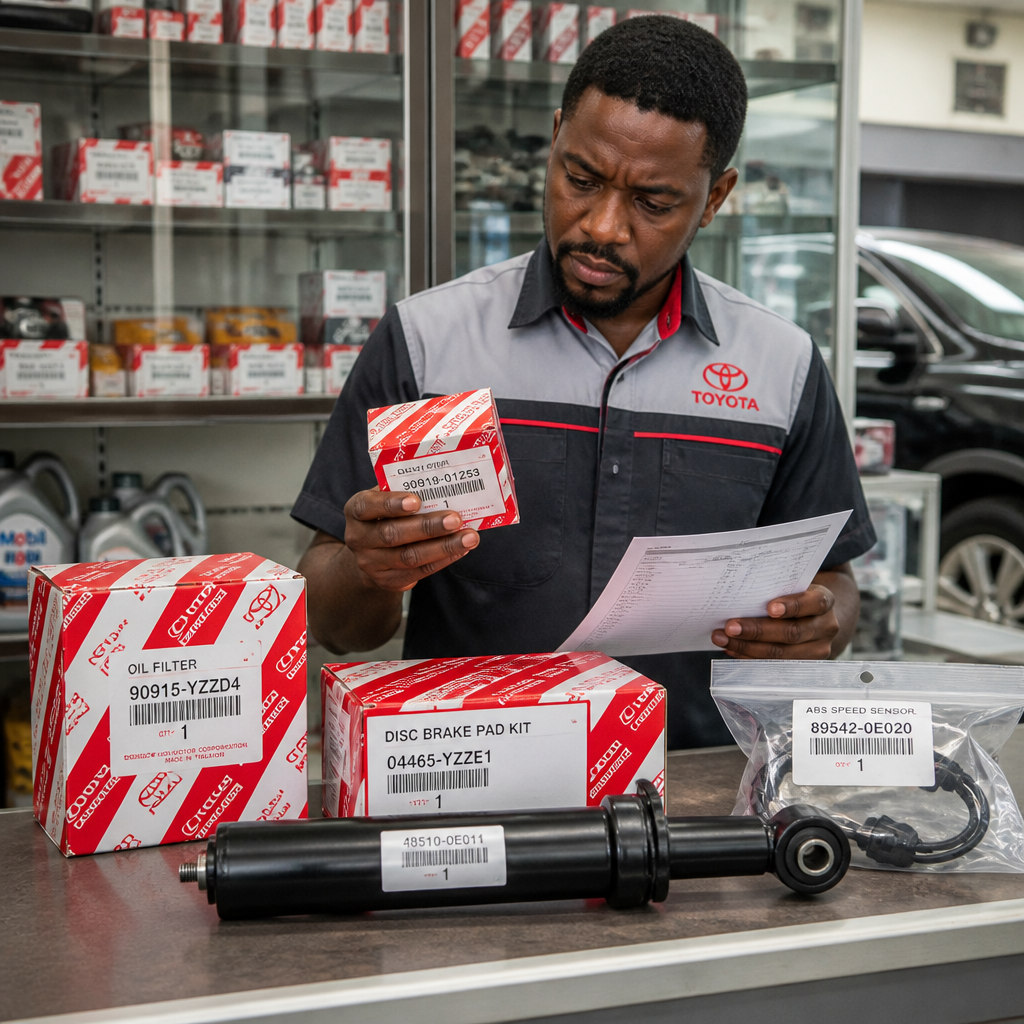
Buying genuine Toyota parts in Nigeria requires more than checking a box, logo, or attractive price. Counterfeit and incorrectly matched components can look convincing, especially in busy spare-parts markets. This guide explains how to inspect packaging, compare part numbers, assess the seller, verify compatibility, and make safer decisions for Toyota and Lexus vehicles.
A spare part may fit physically and still be the wrong component. It may have a poor-quality material, an inaccurate electrical specification, or a design that does not match the vehicle’s system. The result can include repeated repairs, poor performance, warning lights, safety risks, and unnecessary expense.
For that reason, treat every purchase as a verification exercise. Ask questions before paying, record the information on the vehicle, and avoid rushing because a seller claims that only one unit remains. A careful buying process helps you distinguish a genuine part from a counterfeit, a used original component, a quality aftermarket alternative, and a part intended for another Toyota or Lexus model. What to Do When Your Car Breaks Down on a Nigerian Highway
Why authenticity matters for Toyota and Lexus components
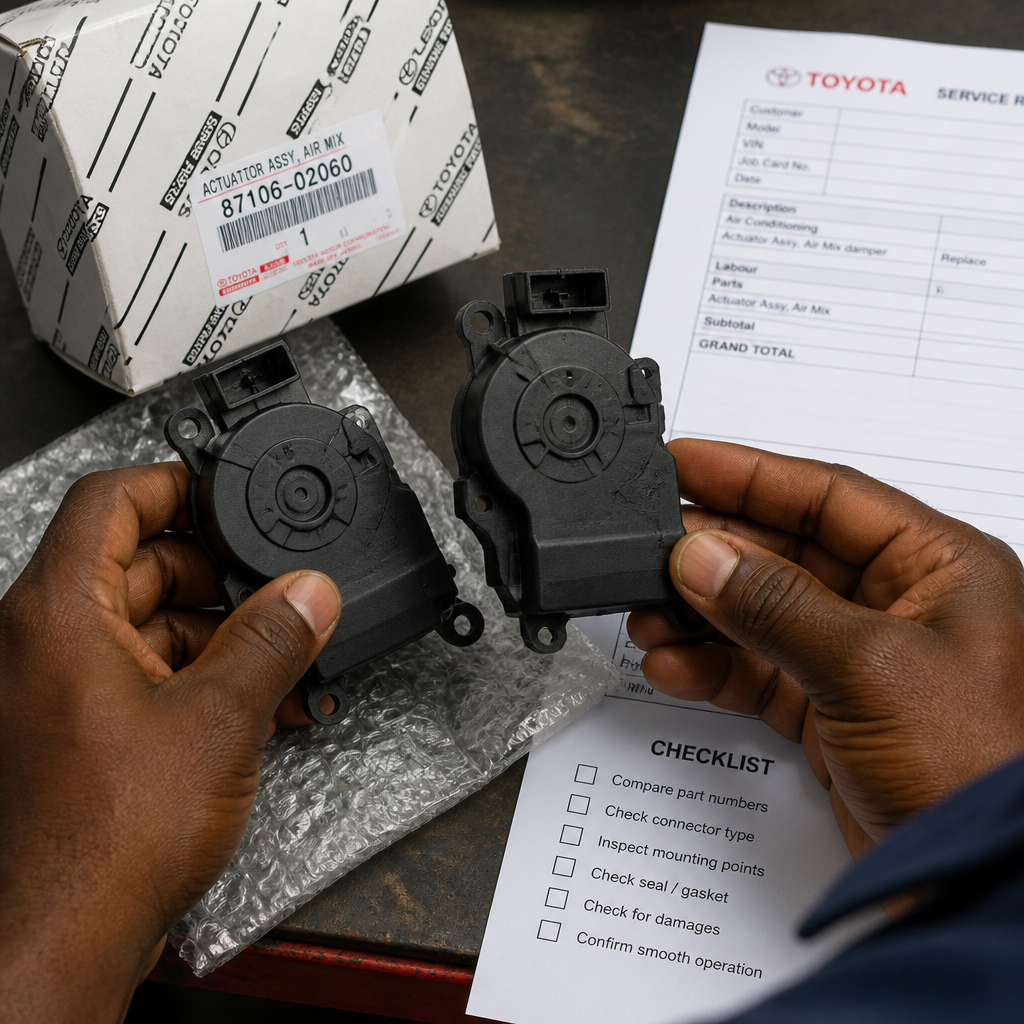
Toyota and Lexus vehicles are known for sharing platforms, engines, transmissions, and electrical systems across different markets. That shared engineering can make parts easier to find. However, it can also create confusion. Two parts may look similar while having different dimensions, connectors, software requirements, or operating specifications.
A brake component is a useful example. A pad that appears to fit may have the wrong friction characteristics or shape. It might create noise, uneven braking, premature wear, or reduced stopping performance. The same concern applies to suspension components, steering parts, filters, belts, engine sensors, and transmission parts.
Counterfeit parts can also damage other components. A poor-quality oil filter may not filter correctly or maintain pressure as designed. A fake air-flow sensor may send inaccurate information to the engine control system. An inferior coolant hose may soften, crack, or swell after exposure to heat.
Genuine Toyota parts are designed for the relevant Toyota application. Genuine Lexus components are designed for the relevant Lexus application. They are not automatically interchangeable simply because both brands belong to the same wider automotive group.
That does not mean every non-genuine product is dangerous or useless. Reputable aftermarket manufacturers make many serviceable parts. The important point is to know what you are buying. A seller should not describe an aftermarket product as an original Toyota or Lexus part.
Understand the main categories before you buy
Many disputes begin because buyers and sellers use the words “original,” “Tokunbo,” “used,” “OEM,” and “replacement” differently. Before inspecting a component, establish its category and condition.
New genuine parts
A new genuine part is supplied for the vehicle brand and application through an authorised or established distribution route. It should have identifiable packaging, a part number, and product information that corresponds with the vehicle or parts catalogue.
Packaging alone does not prove authenticity. Counterfeiters can copy labels, printing, colours, and barcodes. Still, packaging is an important first inspection point when combined with the part number, seller history, and vehicle compatibility.
Aftermarket replacement parts
An aftermarket component is made by a company other than the vehicle manufacturer or its official parts supplier. Some aftermarket brands have strong quality controls and a good reputation. Others may be poorly made.
A responsible seller should identify the brand clearly. Ask whether the part is genuine Toyota, genuine Lexus, an original-equipment supplier product, or an aftermarket replacement. Do not accept vague descriptions such as “same thing” when the distinction matters.
Used original parts
A used component may be an original part removed from another vehicle. It can be useful for older models, hard-to-find trim pieces, electronic modules, body panels, and some mechanical assemblies. However, used does not mean tested, reliable, or suitable for immediate installation.
Ask for the donor vehicle information where available. Inspect the condition, connectors, mounting points, seals, and signs of overheating or impact. For safety-critical parts, consider whether a new component is the better choice.
Reconditioned or rebuilt parts
Some components are rebuilt or reconditioned. Examples may include alternators, starter motors, steering racks, compressors, and transmissions. Quality depends on the rebuilder, the replacement components used, and the testing process.
Clarify whether the unit is new, used, rebuilt, or repaired. Also ask what is included in the price and whether the seller provides any practical return arrangement. Never assume a rebuilt component has the same status as a new genuine part.
Start with the vehicle, not the shop shelf
The safest search begins with accurate vehicle information. Take the vehicle identification number, commonly called the VIN or chassis number, to a competent parts professional. Also record the model, model year, engine type, transmission, drive configuration, and market version where possible.
Many Toyota and Lexus models have different specifications by country. A vehicle imported from the United States may use a different sensor, light assembly, emissions component, or computer module from a similar vehicle sold in another market. Even a small difference in production period can affect compatibility.
Bring the old part when practical. It allows a direct comparison of shape, connectors, mounting points, and markings. However, do not rely only on visual similarity. The old part may already be incorrect, or its number may have been superseded by a newer number.
A professional parts seller should be willing to ask questions. Be cautious if the seller refuses to check the VIN and immediately selects a part based only on the vehicle name. “Toyota Camry” or “Lexus RX” is not enough information for many parts.
Information to gather before visiting a seller
- Vehicle identification number or chassis number.
- Exact model and body style.
- Engine code, if available.
- Transmission type.
- Model year and production period.
- Current mileage and symptoms, where relevant.
- Part number printed on the old component.
- Photographs of the old part, connectors, and mounting points.
- Any diagnostic trouble codes provided by a qualified technician.
This preparation reduces guesswork. It also gives you evidence if the supplied part later proves to be different from what you ordered.
How to identify genuine Toyota parts in Nigeria
There is no single visual test that proves authenticity. Use several checks together. A genuine Toyota part should make sense as a complete purchase: the packaging should be credible, the number should correspond with the vehicle, the part should show appropriate manufacturing quality, and the seller should explain its source without making unrealistic claims.
Inspect the box and label carefully
Look for clean printing, consistent colours, correct spelling, clear product information, and a label that has not been crudely replaced. Poor alignment, blurred text, low-quality cardboard, mismatched stickers, or unusual packaging can justify further questions.
Check whether the label contains a part number, description, quantity, and other identifying information. Compare the label with information from a trusted parts reference or an established Toyota parts department. Do not assume that a Toyota logo makes the box genuine. What to Do After a Rejected Car Insurance Claim in Nigeria
Watch for packaging that appears opened, resealed, or damaged. A damaged box does not automatically mean the part is fake. It may have been stored or transported poorly. However, the seller should explain the condition and allow you to inspect the contents before payment.
Find and record the part number
The part number is one of the most useful clues. It may appear on the packaging, the component, a label, a plate, or a moulded surface. Write it down exactly, including letters, numbers, hyphens, and suffixes.
A small suffix can be important. It may indicate a revision, side of the vehicle, market specification, colour, or application. Do not remove characters because they seem unnecessary. Take a clear photograph before installation.
Use the number to check compatibility through a trusted Toyota or Lexus parts source. A number that exists is not automatically proof that the item in your hand is genuine. It only helps confirm whether the claimed product and application are plausible.
Compare the component with the old part
Place the old and new parts side by side. Compare the connector shape, number of pins, mounting holes, brackets, casting marks, gasket profile, bolt spacing, and overall finish.
Look for rough edges, weak moulding, uneven seams, poor plating, loose terminals, damaged threads, or materials that feel unusually light. These signs are not conclusive by themselves, but they deserve attention.
For rubber components, inspect the surface for cracking, excessive softness, sharp mould lines, or an unusual smell. For electrical parts, check pins and seals. For filters, compare the filter media, end caps, gasket quality, and construction with a known correct sample where possible.
Check printing and markings on the part
Some parts have manufacturer marks, batch markings, casting numbers, date codes, or other identifiers. They should look professionally applied and correspond logically with the packaging. A label that peels easily, contains spelling errors, or differs sharply from the box should prompt more questions.
Not every genuine component will display the same markings. Some parts are supplied by different production facilities or through different markets. Therefore, do not reject an item solely because its marking looks different from an online photograph. Instead, ask a qualified source to confirm the application and identification.
How to assess Lexus spare parts
Lexus vehicles require the same careful verification as Toyota vehicles. Some Lexus and Toyota components may share a platform or be manufactured within related supply chains. That does not mean a Toyota-branded part is automatically the correct Lexus component.
Start with the Lexus model, VIN, engine, production period, and exact part number. Pay special attention to suspension, hybrid system, electronic control modules, lighting, interior electronics, and advanced driver-assistance components. These systems may require precise specifications or calibration after installation.
A seller may tell you that a Toyota part is “the same as Lexus.” Sometimes the component may be technically compatible. In other cases, it may have a different calibration, finish, software version, or mounting arrangement. Ask the seller to demonstrate the basis for the claim.
For electronic modules, do not buy based only on a matching housing or connector. The module may need programming, configuration, immobiliser registration, or other procedures. Confirm this with a qualified technician before purchase.
Hybrid vehicles require additional care. High-voltage components should be handled by technicians with the appropriate training and equipment. Do not open, test, or install high-voltage parts casually because a seller says the job is simple.
Use the seller as part of the verification process
A trustworthy seller does more than quote a price. The seller should ask for vehicle details, explain whether the part is new or used, identify the brand, and provide a clear description of what is included.
Look for businesses with a consistent physical presence, clear contact details, organised stock, and a reputation that can be checked through real customers or established trade relationships. A large shop is not automatically honest, and a small specialist is not automatically unreliable. Judge the buying process and the evidence offered.
Questions to ask before paying
- Is the part genuine Toyota, genuine Lexus, aftermarket, used, or rebuilt?
- What is the exact part number?
- Has the number been checked against my VIN or chassis number?
- Is this part intended for my engine, transmission, and market specification?
- Is the package sealed, opened, or repacked?
- What is included in the price?
- Does installation require programming, calibration, or special tools?
- What happens if the part does not match the vehicle?
- Can I inspect the part before payment?
- Will I receive a written receipt showing the description and part number?
A seller who becomes defensive about reasonable questions is a warning sign. So is a seller who insists that a part must be paid for immediately before you can inspect it. Good sellers understand that correct fitment protects both sides.
Be careful with unusually low prices
Price alone cannot prove that a component is counterfeit. Genuine parts may be discounted, while some counterfeit parts are sold at high prices. Still, a price far below the normal range deserves investigation.
Ask why the price is low. The reason may be legitimate, such as old stock, damaged packaging, a clearance sale, a used part, or a different brand. If the explanation is unclear, compare the offer with another established seller before making a decision.
Remember the total cost. A cheaper part may require repeated replacement, create damage, or cause additional labour charges. The lowest purchase price is not always the lowest ownership cost.
Red flags that should make you pause
Counterfeiters often rely on urgency, confusion, and attractive pricing. Pause the transaction when several warning signs appear together. How to Verify Car Insurance in Nigeria Before You Drive
- The seller refuses to provide a part number.
- The packaging has spelling errors, poor printing, or suspicious re-sealing.
- The seller claims the part fits every Toyota or Lexus model.
- The item has no credible brand, label, or identifying information.
- The seller discourages comparison with another shop.
- The part has rough finishing, loose connectors, or damaged threads.
- The price is unusually low without a clear explanation.
- The seller will not issue a receipt.
- The seller changes the description from genuine to aftermarket during the discussion.
- The part number on the box does not match the number on the component.
- The seller says installation is urgent even when the vehicle is safe to inspect later.
- The item is offered as new but shows clear signs of prior installation.
One warning sign may have an innocent explanation. Several together should make you walk away or seek a second opinion.
Verify the part before installation
Do not wait until the vehicle is dismantled to discover that the part is wrong. Inspect it as soon as you receive it. Photograph the packaging, label, part number, and component from several angles.
Compare the new item with the old component before removing anything that is difficult to reinstall. Ask the technician to confirm the match. If the part is electronic, confirm whether programming or calibration is required before fitting it.
For filters, belts, hoses, brake parts, and suspension components, compare the dimensions and mounting details. For body parts, check colour, trim level, sensors, brackets, and lighting provisions. For engine parts, confirm the engine code and revision.
Never force a component into place. If a connector does not seat correctly, a bolt does not align, or a gasket does not fit naturally, stop. Forcing the part can damage the vehicle and may hide a compatibility problem.
What to do if the part is wrong
Keep the packaging and do not install the component. Contact the seller promptly and describe the problem clearly. Provide photographs of the part number, the vehicle information, and the mismatch.
If the item has already been installed, ask the technician to document the issue. Keep the invoice, payment evidence, messages, and any diagnostic report. These records may help you resolve a dispute with the seller.
Do not alter, disassemble, or discard the part while seeking a resolution. A seller may need to inspect it. If the seller will not respond, consider reporting suspected counterfeit goods to the relevant Nigerian authorities and seeking appropriate consumer or legal guidance.
Buying Toyota and Lexus parts online in Nigeria
Online shopping can provide access to more sellers, but it also makes inspection harder. Product photographs may be generic, and a listing may not show the exact unit you will receive.
Read the description closely. Look for the brand, condition, part number, vehicle application, location, delivery terms, and return conditions. A listing that only says “fits Toyota” provides too little information.
Ask the seller to send photographs of the actual item. Request a clear image of the label and part number. Compare those details with the listing. Be cautious if the seller sends only catalogue images or refuses to show the actual product.
Before transferring money, confirm the seller’s identity and contact details. Keep copies of the listing and all messages. When the package arrives, inspect it before installation. If the product is materially different from the description, document the issue immediately.
Do not assume that a marketplace badge, many reviews, or professional photographs proves authenticity. These can be useful signals, but they do not replace part-number verification and physical inspection.
How mechanics can help you avoid mistakes
A capable technician is an important part of the buying process. The mechanic can identify the failed component, distinguish symptoms from causes, and confirm whether the proposed replacement is appropriate.
However, the mechanic may not be a parts-authentication specialist. Ask the technician to record the part number and inspect the component before installation. If the part is safety-critical or expensive, get a second professional opinion.
Be especially careful when a workshop insists on buying the part on your behalf without showing the packaging or invoice. Some workshops operate honestly, but you should still know what brand and condition you are paying for.
Ask for the old part after replacement, unless a supplier or warranty process requires its return. The old component can help you compare the new one and provides a record of what was removed. Also request an invoice that lists the part description, brand, number, labour, and any warranty terms offered.
Parts that deserve extra caution
Some components have a direct connection to safety or expensive systems. Do not choose them on price alone. How to Avoid Scams When Buying a Car Online in Nigeria
- Brake components: pads, discs, calipers, hoses, master cylinders, and sensors need correct specifications.
- Steering and suspension: ball joints, tie rods, control arms, bearings, and shock absorbers affect handling and stability.
- Timing components: belts, chains, tensioners, and water pumps can cause severe engine damage if they fail.
- Electrical sensors: incorrect readings can cause poor running, warning lights, or increased fuel consumption.
- Airbags and restraint components: use qualified professionals and avoid unknown used or counterfeit safety parts.
- Hybrid and high-voltage components: require specialist handling and appropriate safety procedures.
- Engine and transmission parts: verify codes, revisions, clearances, and calibration requirements.
- Tyres and wheels: confirm size, load rating, speed rating, condition, and suitability for the vehicle.
If you are uncertain about a safety-critical component, delay the purchase until a qualified professional verifies it. A short delay is better than installing a questionable part.
A practical buying checklist
Use this checklist whenever you need Toyota or Lexus spare parts in Nigeria:
- Identify the exact vehicle, engine, transmission, and production details.
- Record the VIN or chassis number.
- Identify the failed component and confirm the diagnosis.
- Find the part number on the old component or obtain it from a trusted parts source.
- Ask whether the replacement is genuine, aftermarket, used, or rebuilt.
- Compare the label, packaging, part number, and physical construction.
- Check whether the part is intended for the vehicle’s market specification.
- Ask about programming, calibration, or special installation requirements.
- Compare the price with more than one credible seller.
- Obtain a receipt that records the product details.
- Photograph the part and packaging before installation.
- Have a qualified technician confirm the fit before dismantling or forcing anything.
This process takes more time than accepting the first offer. It can also save time because the correct part is more likely to fit and work as intended.
How to build a reliable parts-buying routine
Keep a maintenance file for the vehicle. Record the VIN, engine code, previous part numbers, service dates, mileage, invoices, and workshop details. This information becomes increasingly valuable as the vehicle ages.
Save photographs of labels and receipts. If a part fails early, the records help the mechanic understand what was installed. They also make it easier to order the same component again or identify a newer replacement number.
Build relationships with sellers who provide clear information and consistent service. You do not need to buy every part from one shop. However, having trusted sources reduces pressure when the vehicle needs urgent attention.
Also learn the difference between a part that is unavailable and a part that is merely unavailable from one seller. Ask another established supplier, a brand service channel, or a reputable specialist. Do not let one seller’s lack of stock push you into accepting an unverified substitute.
Frequently asked questions
Are all Toyota parts sold in Nigeria genuine?
No. The market includes genuine parts, aftermarket products, used original parts, rebuilt units, and counterfeit goods. Sellers should identify the category honestly. Buyers should verify the part number, condition, source, and compatibility before paying.
Can a Toyota part fit a Lexus vehicle?
Sometimes, but not automatically. Some Toyota and Lexus vehicles share components, while others require different specifications, finishes, calibrations, or mounting arrangements. Confirm compatibility with the exact part number and vehicle identification details.
Is a hologram proof that a part is genuine?
No single label feature proves authenticity. Holograms, barcodes, stickers, and printed logos can be copied. Treat them as one part of a wider check that includes the seller, packaging, part number, physical quality, and vehicle fitment.
Is a cheap spare part always counterfeit?
No. It could be an aftermarket product, used part, clearance item, or older stock. The issue is whether the seller describes it accurately and whether it is suitable for the vehicle. Ask why the price differs and compare the product category before deciding.
Should I buy used original parts?
Used original components can be practical for some vehicles and parts. Inspect their condition, source, and compatibility. Avoid unknown or damaged safety components, and ask a qualified technician whether the used part is appropriate for the repair.
What should I do if the part number matches but the part looks different?
Stop before installation. The part may be a revised design, a different market version, incorrectly packaged, or counterfeit. Ask a trusted Toyota or Lexus parts source or qualified technician to confirm the number and application.
Do genuine parts always last longer?
Genuine parts are designed for the stated application, but service life also depends on installation, driving conditions, maintenance, related faults, storage, and vehicle condition. A genuine part can fail if another problem remains unresolved.
Can a mechanic confirm that a part is genuine?
A skilled mechanic can identify many inconsistencies and confirm fitment. However, physical inspection alone may not prove the supply chain or authenticity. For expensive or safety-critical parts, combine the mechanic’s assessment with documentation and seller verification.
Final advice for Nigerian Toyota and Lexus owners
The best way to buy genuine Toyota parts is to slow down the decision. Identify the vehicle accurately, obtain the correct part number, inspect the packaging and component, question the seller, and document the purchase.
Apply the same discipline to Lexus parts. A familiar logo, a convincing box, or a confident sales pitch is not enough. The correct part should match the vehicle, the description should match the product, and the seller should be comfortable with reasonable verification.
When in doubt, do not install the part. Seek a second opinion from a qualified technician or an established parts source. Careful checking protects your vehicle, your passengers, and your budget.
1 thought on “How to Identify Genuine Toyota Parts in Nigeria”